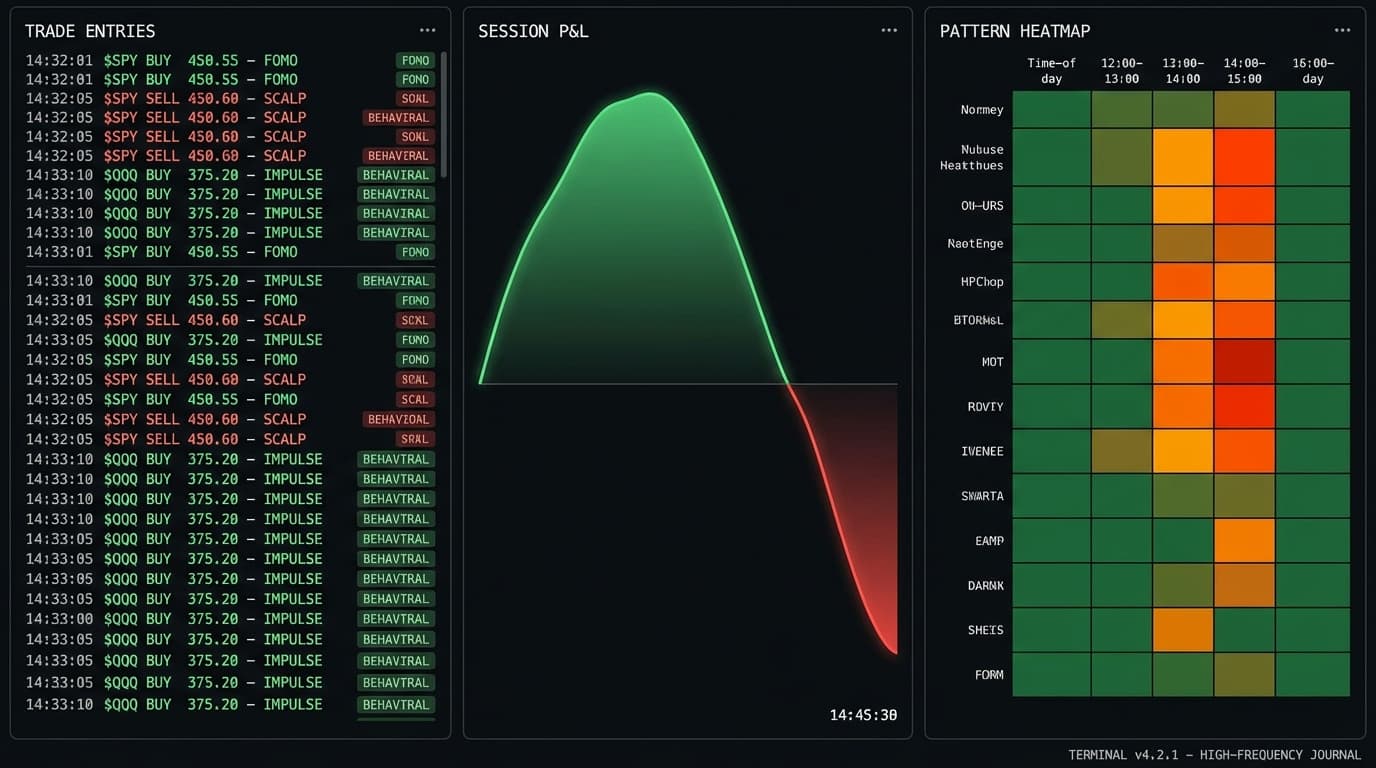
Swing traders take 5–20 trades per week. Day traders can take that many before lunch. The difference isn't just volume — it's the entire behavioral landscape of the session.
Day trading introduces intraday emotional arcs that swing trading doesn't have. You might start flat, blow up trade 3, revenge-trade through trades 4–7, then recover by 2pm. A swing trading journal tracks position-level data. A day trading journal needs to track session-level behavioral context: when did you deviate from your rules, what was your mental state at the open vs. close, did tilt compound across consecutive losses?
According to research by Barber and Odean (2000), the more frequently traders trade, the worse they perform on average — not because frequency is inherently bad, but because high-frequency trading amplifies every behavioral weakness. Overconfidence, FOMO, and revenge trading happen faster and compound harder when you're making 30 decisions a day instead of 3.
The U.S. Commodity Futures Trading Commission (CFTC) has consistently found that approximately 70–80% of retail day traders lose money over any 12-month period. The FCA's disclosure requirements for CFD providers in the UK show similar figures: between 70% and 80% of retail CFD accounts lose money. The traders who beat those odds consistently share one trait: they review their behavioral patterns systematically, not just their P&L.
A day trading journal built for swing traders won't surface what's killing your performance. You need a tool designed for the speed, volume, and behavioral complexity of intraday trading.