Updated: 2026-03-05

How to Find Your Trading Edge (A Practical 5-Step System)

Most traders think their strategy is their edge. It is not. A strategy is a repeatable process. An edge is the subset of that process where you have a measurable, statistically reliable advantage over the market. The two overlap — but they are not the same thing. A strategy can be applied consistently and still lose money. An edge is condition-specific and data-proven. Research by Barber and Odean (2000) found that the most active retail traders underperform the market by more than 6% per year on average — not because they lack strategy, but because they trade without a defined edge. Here is the system for finding yours.

How to Find Your Trading Edge (A Practical 5-Step System)

What a Trading Edge Actually Is

A trading edge is a positive expectancy across a meaningful sample of trades in a specific, defined set of conditions. Expectancy = (win rate × average win) − (loss rate × average loss). When that number is positive over 100 or more trades in specific conditions, you have an edge in those conditions.

The critical phrase is 'specific conditions.' This is what separates traders with edges from traders with strategies. A breakout setup does not have an edge. A breakout setup in the first 30 minutes of a trending session, in a liquid instrument, with clean range expansion and above-average volume — that might. The same setup in choppy afternoon conditions with compressed range might have a clearly negative expectancy. The edge is condition-specific, not setup-specific.

This matters because it changes what you optimize. Traders without edge clarity optimize their strategy — tightening entries, adjusting stops, tweaking indicators. Traders with edge clarity optimize their condition filter — removing trades that happen outside their defined edge conditions, even when the setup looks valid.

  • Edge = positive expectancy over 100+ trades in specific, defined conditions
  • Expectancy = (win rate × avg win) − (loss rate × avg loss)
  • The same setup can have opposite expectancy in different market conditions
  • Condition-specificity separates an edge from a strategy that sometimes works

The Difference Between a Strategy and an Edge

A strategy tells you what to do. An edge tells you when your strategy works.

Most trading education stops at strategy level: entry rules, exit rules, risk parameters. This is necessary but insufficient. A trend-following strategy applied in all market regimes will produce strong results in trending conditions and poor results in ranging conditions. If you do not know which regime you are in, you are applying your strategy 50% of the time in conditions where it has no edge.

The professional trader's operating model is: identify the strategy, then systematically find the conditions where the strategy has a positive expectancy, then only trade in those conditions. This sounds simple and is rarely done. According to a study published in the Journal of Finance (2009), fewer than 1% of day traders consistently profit over a multi-year period — and the ones who do show a common behavioral pattern: they trade less frequently, with higher selectivity, and in a narrow range of setups.

Edge discovery is the process of finding your equivalent of that narrow, profitable range.

  • Strategy = what to do; edge = when your strategy works
  • Applying a strategy in all conditions averages together winning and losing contexts
  • Research shows consistently profitable traders trade less, not more — higher selectivity
  • Edge discovery narrows your trading to the conditions where your strategy is statistically valid

Step 1: Track the Data That Reveals an Edge

You cannot find what you do not measure. The fields required for edge discovery are different from what most journals track. Most journals focus on outcome data — PnL, win rate, drawdown. Edge discovery requires process and condition data: what state triggered the trade, what market conditions existed at entry, and whether execution matched the plan.

**Minimum fields for edge discovery:** - Setup name (specific, not 'breakout' — something like 'opening range break above VWAP with volume confirmation') - Session segment (first hour, mid-session, close) - Market regime at entry (trending, ranging, news-driven) - Planned vs. reactive (was this in the pre-session plan?) - Behavioral state (calm, elevated, tilt, FOMO) - Execution quality (honored stop and size: yes/no) - Outcome (R-multiple or dollar PnL)

With these fields tagged consistently across 100+ trades, you can generate the segment comparisons that reveal where your edge actually lives. Without them, you are computing win rate on an undifferentiated dataset that tells you almost nothing actionable.

  • Setup name must be specific enough to segment — not a category, the exact trigger
  • Session segment is often the highest-signal variable for edge discovery
  • Market regime at entry dramatically changes expectancy for most trend setups
  • Planned vs. reactive split consistently shows one cohort is negative-expectancy for most traders

Step 2: Build a Sample Large Enough to Trust

Statistical significance in trading requires more data than most traders expect. At 100 trades with a 55% win rate, the 95% confidence interval spans from approximately 45% to 65% — a range wide enough to include a losing strategy. At 250 trades, the interval tightens significantly. At 500+, the estimate is robust.

This does not mean you should suspend all evaluation until you have 500 trades. It means you should interpret small samples as directional hypotheses, not confirmed edges. The practical protocol:

- 30-50 trades: form a hypothesis ('this setup seems to work better in the first hour') - 100 trades: preliminary expectancy calculation, directional signal only - 250+ trades: reliable edge validation, strong enough to act on as a defined rule

For traders who are just starting: simulated trading data helps build mechanical familiarity with setup execution but does not generate valid behavioral data. The edge — or its absence — shows up differently under real P&L pressure, because your decision-making changes when real money is at risk. Paper trading samples cannot substitute for live data in edge discovery.

  • 100 trades minimum for directional signal; 250+ for reliable statistical confidence
  • Treat small samples as hypotheses to test, not edges to trade on
  • Paper trading builds mechanical skill but does not generate valid behavioral edge data
  • Consistency of tagging across the sample matters as much as sample size

Step 3: Segment Your Data to Find Where the Edge Lives

Blended win rate across all trades is the least useful metric in edge discovery. The edge lives in the segment, not the average. A trader with a 52% overall win rate might have a 68% win rate in their first-hour planned trades and a 38% win rate in their afternoon reactive trades. The average hides a profitable edge inside a losing overall pattern.

**High-signal segmentation splits to run:**

**Planned vs. reactive:** Tag every trade as planned (in your pre-session plan) or reactive (entered in response to price action that was not pre-planned). In analysis across Tiltless users, planned trades show 30-60% higher expectancy than reactive trades on average. If your planned trades are profitable and reactive trades are not, the solution is immediate: stop trading reactively, not improve your setup.

**First session hour vs. mid-session vs. close:** Time-of-day edge is one of the most commonly discovered and most underutilized findings in trading data. Many traders show strongly positive first-hour expectancy and negative or break-even mid-session expectancy. Simply stopping trading after the first hour often produces a dramatic improvement — no strategy change required.

**Trade sequence within session:** Compute expectancy on trade 1, 2, 3, 4 of each session. Most traders show declining expectancy with each successive trade. This is a signal about optimal session length — often much shorter than traders expect.

  • Blended win rate hides edges — segment by condition before drawing conclusions
  • Planned vs. reactive is the highest-ROI segmentation split for most traders
  • Time-of-day analysis often reveals the single most actionable constraint
  • Trade sequence data tells you the optimal number of trades — often 2-3, not 10+

Step 4: Define Your Edge Conditions Precisely

Once you have identified segments with positive expectancy, you need to define the conditions precisely enough that you can evaluate any candidate trade against them in real time, at the moment of decision. Vague conditions produce inconsistent application.

**Weak edge condition:** 'I trade breakouts in trending markets.'

**Strong edge condition:** 'I trade opening range breaks in instruments with ADR above 2%, in sessions where the first 30 minutes closed above the prior day's high, and only in the first 60 minutes of the primary session. I do not take this setup in choppy conditions or after 10:30 AM Eastern.'

The difference is that the strong definition lets you answer a binary question at each potential entry: does this moment match these conditions? If yes, execute. If no, pass — regardless of how good the setup looks.

Precisely defined conditions also serve as the foundation for written trading rules. Rules derived from data are more defensible and easier to follow than rules based on intuition, because you can point directly to the expectancy differential that justifies them. When you feel the urge to bend a rule, the data provides a check: the rule exists because the condition outside it has historically negative expectancy.

  • Edge conditions should be specific enough to evaluate in under 10 seconds at entry
  • Vague conditions ('trending market') produce inconsistent filter application
  • Data-derived rules are more defensible and easier to follow than intuition-based rules
  • Write your conditions as a binary pre-entry checklist — not a feel, a check

Step 5: Validate Your Edge Under Live Conditions

Historical data analysis tells you what your edge looked like in the past. Live validation tells you whether you can execute it consistently going forward — which is a different question.

Several things shift between analysis and live trading:

**Cognitive load under pressure:** In live conditions you are simultaneously evaluating the setup, managing risk, tracking related positions, and regulating your emotional state. Conditions that seem clear in hindsight become harder to evaluate in real time.

**Market regime shifts:** Markets evolve. A setup that had strong expectancy in the prior trending regime may degrade as market structure changes. Your edge conditions need regime filters that can be updated on a periodic review cadence.

**Execution drift:** As you accumulate session losses, filter application tends to loosen. Your historical sample reflects your average execution — not your optimal execution. Live validation catches the gap between the two.

The protocol: trade your defined edge conditions for 30-50 live sessions before making modifications. Track rule adherence separately from trade outcomes. Non-adherent trades should be excluded from edge assessment and logged as behavioral data. The adherence rate matters as much as the win rate — if you are only applying your conditions 60% of the time, you are not testing your edge, you are testing a blend of your edge and everything else.

  • Live validation is different from historical analysis — execution behavior changes under real P&L
  • 30-50 sessions of consistent live data needed before modifying edge conditions
  • Track rule adherence separately from outcomes — adherence is as important as win rate
  • Exclude non-adherent trades from edge assessment; log them as behavioral data instead

How Edge Lab Automates the Discovery Process

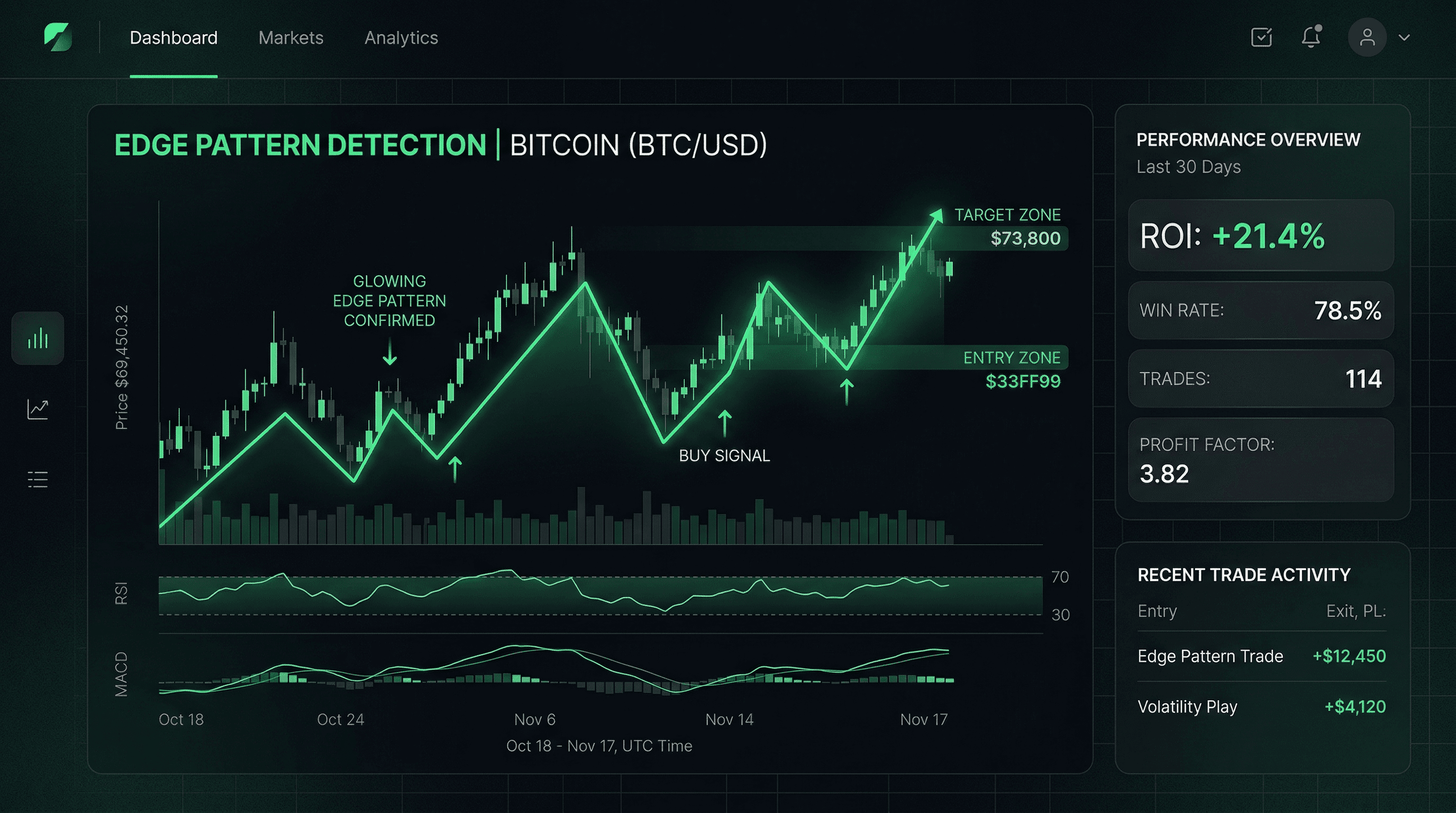
The manual version of this system — tagging trades, segmenting datasets, computing expectancy by condition — is genuinely time-consuming and requires consistent discipline over weeks. Tiltless Edge Lab is built to do this work automatically once your trades are tagged.

Edge Lab runs statistical significance tests (Fisher exact, Welch t-test with Bonferroni correction for multiple comparisons) across 12 trading dimensions simultaneously: setup type, session time, day of week, trade sequence, behavioral state, size tier, market regime, time since last stop, prior session result, instrument, entry type, and holding period. It identifies the conditions where your expectancy differs most significantly and surfaces them ranked by statistical confidence.

For traders with 100+ tagged trades, Edge Lab typically surfaces 3-5 statistically significant edge conditions in the first analysis. The most common high-confidence finding: a specific session block (frequently the first 60 minutes of the primary session) dramatically outperforms the rest of the day, combined with a planned-vs-reactive expectancy differential large enough to act on immediately.

Edge Lab outputs a ranked list of your conditions with sample size and confidence interval for each. You convert the top results into a pre-session checklist and measure whether adherence to those conditions improves your rolling expectancy in the next 50 sessions.

  • Edge Lab runs 12-dimension statistical analysis automatically on your tagged trade history
  • Fisher exact and Welch t-test with Bonferroni correction — proper statistical methodology
  • First analysis on 100+ tagged trades typically surfaces 3-5 significant edge conditions
  • Output is a ranked list with sample size and confidence interval — not gut feel, evidence

Common Mistakes When Defining a Trading Edge

**Overfitting:** Discovering a condition that had perfect historical expectancy but requires 7 simultaneous factors to align. An edge with too many required conditions triggers rarely, is nearly impossible to apply consistently, and frequently reflects data overfitting rather than a genuine structural advantage. Start with 2-3 key conditions, not 7.

**Survivorship bias in setup selection:** Evaluating only the setups you remember taking. Traders naturally remember the interesting setups and analyze those — forgetting the boring losses. Valid edge discovery requires a complete sample of all trades for a setup, not the ones you selected for analysis.

**Modifying conditions too early:** Seeing 10 consecutive losses in a defined edge condition and immediately changing the conditions. At typical trading frequencies, 10 losses in a row is statistically expected even with a 55% win rate (approximately once every 400 trades). Modifying conditions in response to short-run outcomes destroys the validity of your test. Make modifications on a scheduled review cadence — every 100 trades or every 90 days — not in response to runs.

**Conflating monthly PnL with edge:** A profitable month does not confirm an edge, and a losing month does not disconfirm it. At typical sample sizes within a month, results are dominated by variance. Edge validation requires a larger sample than any single month provides.

  • Overfitting: too many required conditions make an edge untradable and often illusory
  • Survivorship bias: analyze all trades for a setup, not the ones you remember taking
  • Modifying conditions after short-run losses destroys the statistical validity of your test
  • Monthly PnL is variance, not edge validation — use rolling 100+ trade samples instead

Related Resources

FAQ

?What is a trading edge?

A trading edge is a positive expectancy — (win rate × average win) − (loss rate × average loss) — across a meaningful sample of trades in specific, defined conditions. It is the subset of market conditions where your strategy produces statistically reliable positive returns, not just a strategy you use repeatedly.

?How many trades do I need to identify my edge?

At minimum 100 trades per setup or condition set to generate a directional signal, and 250 or more for statistically reliable expectancy calculation. Fewer than 100 trades is dominated by variance and cannot meaningfully distinguish edge from luck.

?What is the difference between a strategy and a trading edge?

A strategy is a process — entry rules, exit rules, and risk parameters. An edge is the specific conditions within that strategy where the process produces a positive expectancy. A strategy can be consistently applied and still lose money if it lacks a defined edge or is applied outside edge conditions.

?Can I find my trading edge without a trading journal?

Not reliably. Edge discovery requires consistent condition tagging across a meaningful trade sample. Without logged data for setup type, session time, behavioral state, and planned vs. reactive classification, you cannot segment your trades to find the conditions where your expectancy is positive.

?How do I know if my edge has stopped working?

Set a predetermined review threshold: if expectancy in your defined conditions falls below zero across the next 50 live trades, treat the edge as invalidated and return to analysis. Do not evaluate on shorter samples — variance will produce false alarms. A scheduled review every 100 trades or 90 days is a sound ongoing cadence.

?Does having a trading edge apply to crypto trading?

Yes. The same framework applies across all markets — crypto, stocks, options, futures, and forex. The specific conditions differ by market (crypto edges often cluster around specific session times, volatility regimes, and liquidity conditions), but the process of measuring expectancy by condition is identical.

Find Your Edge With Edge Lab

Connect your trades and Edge Lab runs statistical significance tests across 12 dimensions to surface your actual edge conditions — with sample sizes and confidence scores, not gut feel.

How to Find Your Trading Edge | Tiltless