
Updated: 2026-03-07

Best Trading Journal App in 2026: What to Actually Look For

The market for trading journal apps has fragmented into two categories: glorified trade loggers and genuine performance intelligence tools. The loggers are everywhere — they import your trades, calculate win rate and profit factor, and display them in clean charts. They're useful for record-keeping. They're not useful for improvement. The performance intelligence category is smaller and newer. These tools analyze behavioral patterns, run hypothesis tests on your data, and give you statistical proof about what's actually generating or destroying your edge. The difference in trader outcomes between the two categories is not marginal — Druz and colleagues found in a 2023 analysis that traders who received statistically-derived behavioral feedback improved P&L by 31% over 6 months vs. 4% for those using descriptive-only tools.
Best Trading Journal App in 2026: What to Actually Look For

What Separates Good Trading Journal Apps From Great Ones

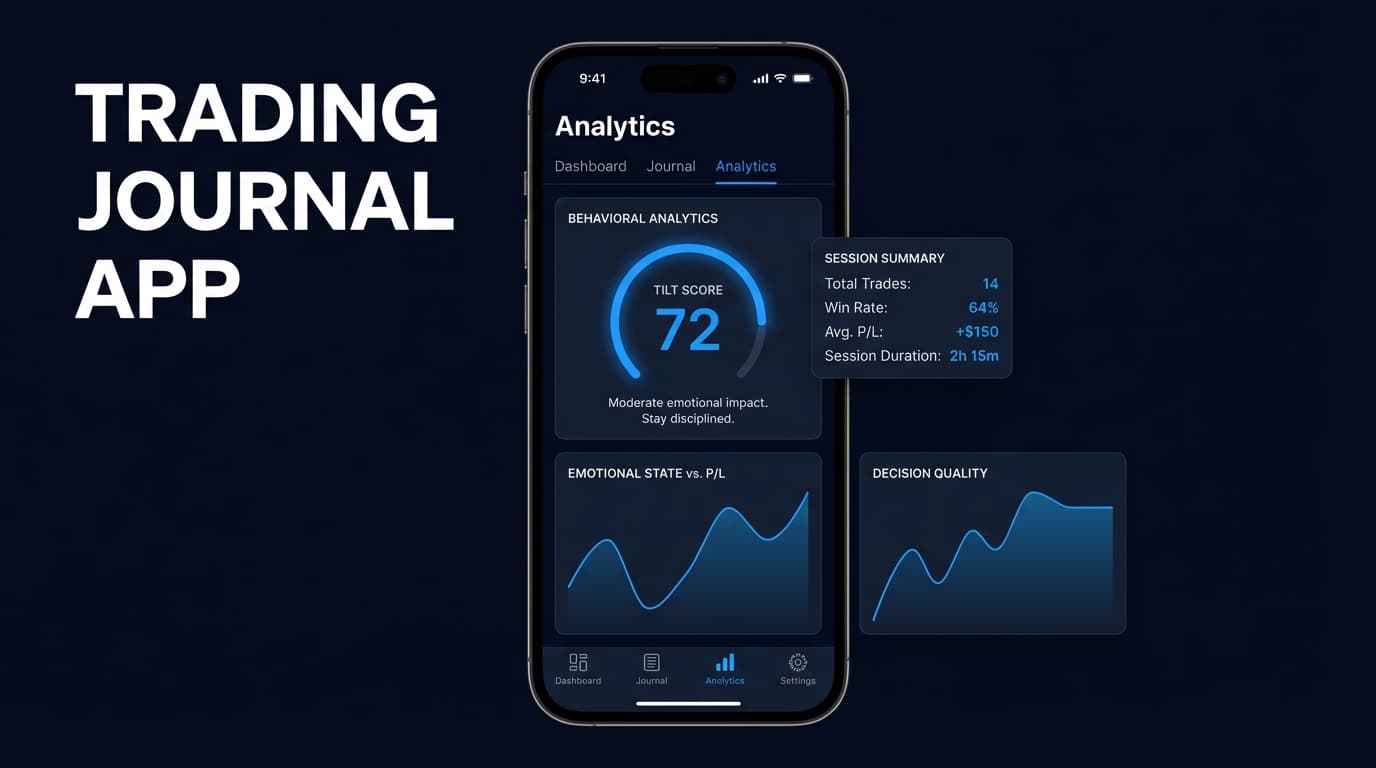
The checklist for evaluating any trading journal app should start with three non-negotiables: automatic import (from your broker or exchange via API or CSV), multi-asset support (trading journals that only cover one asset class create fragmented data), and statistical analysis beyond averages. After the non-negotiables, evaluate: behavioral scoring (does the app measure your emotional state, not just your outcomes?), AI coaching quality (does the AI cite your actual trade data, or give generic advice?), and mobile accessibility (can you review sessions on the go?). The apps that score well on all six criteria are rare — most trading journal apps nail import and UX while failing entirely on statistical rigor and behavioral analysis.

  • Non-negotiable: automatic import via API or CSV
  • Non-negotiable: multi-asset support (stocks, crypto, futures, options, forex)
  • Non-negotiable: statistical tests, not just averages
  • Important: behavioral scoring per trade
  • Important: evidence-constrained AI coaching
  • Nice to have: mobile app access

2026 Trading Journal App Comparison

The major trading journal apps in 2026 each have distinct strengths. TraderSync has the best import breadth and most polished UX — but limited behavioral analytics and no statistical significance testing. Tradervue is strong for stocks and options, with solid broker support and a clean review workflow — but no behavioral scoring. EdgeWonk is designed for systematic traders and has good pattern analysis — but limited crypto support and no live exchange sync. Tradezella has clean mobile UX and good crypto/futures coverage — but uses descriptive averages rather than statistical tests. Tiltless focuses on behavioral analytics and statistical rigor: Edge Lab (Fisher exact, Welch t-test, Bonferroni), per-trade behavioral scoring (tilt, FOMO, fatigue, revenge), and AI coach Madison with evidence-constrained output. The trade-off is that Tiltless's UX is more data-dense than the more consumer-oriented options.

  • TraderSync: best UX and import breadth; limited behavioral analytics
  • Tradervue: strong for stocks/options; no behavioral scoring
  • EdgeWonk: good for systematic traders; limited crypto support
  • Tradezella: clean mobile UX; descriptive averages only
  • Tiltless: strongest behavioral analytics and statistical rigor; 8 live exchange connectors

Mobile vs Desktop: What You Actually Need

Most serious trading analysis requires desktop-level screen space. Reviewing session heatmaps, running Edge Lab, and reading AI coaching output are all better on a large screen. That said, mobile access has real value for one specific use case: post-session capture. Logging a quick note about why you broke your rules, flagging a trade for review, and checking your behavioral score summary after a trading session are all better on mobile. The best apps support both: a full-featured desktop experience for analysis and a mobile-accessible view for quick review and capture. Tiltless has a responsive web app that works on mobile for post-session review, with the full analytical power available on desktop.

  • Desktop: Edge Lab analysis, session review, pattern identification
  • Mobile: post-session capture, quick reflection, score review
  • Avoid apps that are mobile-only — serious analysis needs screen space
  • Avoid apps that are desktop-only — you'll miss post-session capture moments

AI Coaching in Trading Journal Apps: What's Real vs Marketing

Every major trading journal app has added 'AI coaching' in the last 18 months. The quality range is enormous. Generic AI coaching — 'you should manage your emotions better' — adds no value beyond a generic trading psychology book. Evidence-constrained AI coaching — 'your tilt index was above 70 on 23 trades this month. Those trades had a win rate of 31% vs your 58% baseline. You lost an estimated $840 attributable to tilt. Here are the three conditions where it spiked' — is actionable. The test for any AI coaching claim: ask the app a specific question about your trading and see if it responds with statistics from your own data or generic advice. Madison, Tiltless's AI coach, is required to cite your actual trade data for any claim. If the data doesn't support a claim, she won't make it. This constraint makes the coaching slower and less fluent than unrestricted AI — and significantly more valuable.

  • Generic AI coaching: 'manage your emotions' — zero value
  • Evidence-constrained coaching: cites your actual trade statistics
  • Test: ask a specific question; generic answer = generic AI
  • Madison (Tiltless): can only claim what your data supports
  • Evidence-constrained AI is slower to respond and more valuable

Related Resources

FAQ

?Is there a free trading journal app?

Yes. Tiltless has a free tier that includes unlimited trade import from supported exchanges and brokers, basic behavioral scoring, and access to core analytics. Edge Lab statistical analysis and advanced AI coaching require Pro ($29/mo). TraderSync, Tradervue, and Tradezella also have free tiers with limited import volume or features.

?What trading journal app works with crypto?

Tiltless has the most comprehensive crypto exchange support: live API connectors for Binance, Bybit, Hyperliquid, OKX, Coinbase Advanced, Kraken, BitMEX, and Gate.io. Tradezella also has solid crypto support. TraderSync and Tradervue are primarily designed for equities and options.

?Can a trading journal app really improve my trading?

If it surfaces behavioral patterns with statistical evidence, yes. A 2023 analysis found traders using statistically-derived behavioral feedback improved P&L by 31% over 6 months. The mechanism: when you can see that your tilt trades specifically cost you $840/month, you have a concrete, measurable reason to change behavior — not just a vague instruction to 'be more disciplined.'

?What is the difference between Tiltless and TraderSync?

TraderSync focuses on trade logging and descriptive analytics — win rate by ticker, P&L by setup, performance charts. It has excellent broker import support and a polished UX. Tiltless focuses on behavioral analytics and statistical pattern mining — Fisher exact tests, behavioral scoring per trade, and evidence-constrained AI coaching. They serve different needs: TraderSync for record-keeping and basic review; Tiltless for finding what's specifically causing underperformance.

Try the Trading Journal App Built for Pattern Detection

Tiltless auto-imports from 8 crypto exchanges and 21 brokers. Edge Lab runs real statistical tests on your trade history. AI coach Madison cites your data — not generic advice.

Best Trading Journal App in 2026 | Feature Comparison | Tiltless