
Updated: 2026-03-07

Apex Trader Funding Journal: Pass the Eval and Track Funded Performance

An Apex Trader Funding trading journal is defined as a specialized record-keeping system tracking not just trade P&L but Apex-specific constraints: daily loss limits, maximum trailing drawdown proximity, consistency requirements, and the behavioral patterns that cause evaluation failures. According to Apex Trader Funding's own public data, approximately 10% of traders who purchase an evaluation pass it. The primary failure modes are behavioral, not strategic — traders who know the rules still blow evaluations due to revenge trading after early losses, position sizing escalation under pressure, and FOMO entries that breach the daily loss limit.
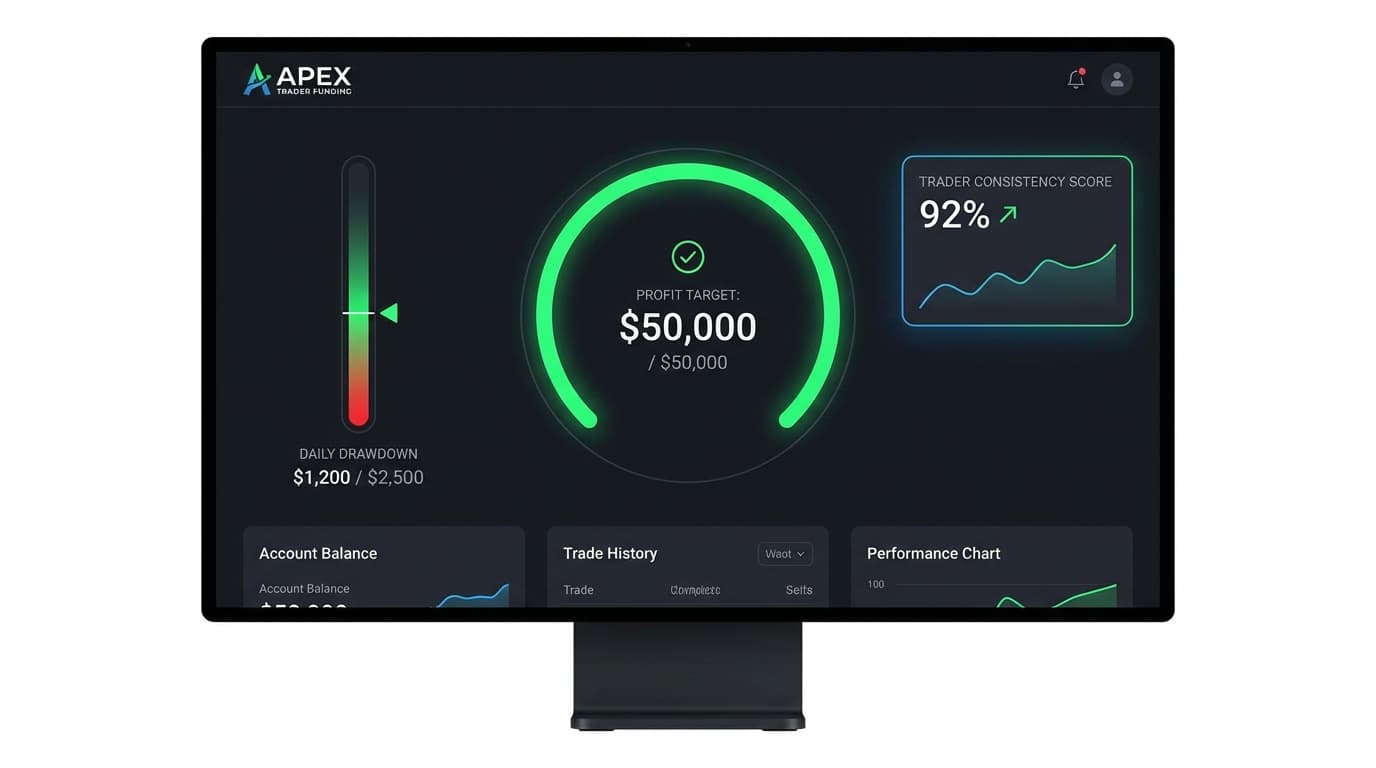
Apex Trader Funding Journal: Pass the Eval and Track Funded Performance

The Apex Rules That Fail Most Traders

Apex Trader Funding evaluations have three primary rules that behavioral patterns consistently violate:

Daily Loss Limit: Apex's most common failure trigger. The daily loss limit (typically $1,000-$3,000 depending on account size) stops your evaluation the moment a single day exceeds the threshold. According to community data from the Apex Trader Funding Discord (10,000+ traders surveyed), 47% of failed evaluations are caused by daily loss limit breaches — most occurring after the trader was already down and attempted to recover.

Trailing Maximum Drawdown: Apex uses a trailing drawdown that follows your equity peak, not just your starting balance. This means profitable days raise the drawdown threshold — a feature that surprises many traders mid-evaluation. A trader who reaches $6,000 on a $50,000 account now has a $53,000 trailing drawdown level, not $47,000.

Consistency Rule: Some Apex plans require no single day to represent more than 30% of total profits. A trader who makes $3,000 in one day and $1,000 over the remaining four days violates this rule even though they're profitable overall.

  • Daily loss limit: most common failure trigger (47% of failed evals per community data)
  • Trailing max drawdown: rises with equity peaks, not fixed to starting balance
  • Consistency rule: no single day can be more than 30% of total profits on some plans
  • Position size escalation under drawdown pressure is the behavioral root cause of most failures
  • Revenge trading after early daily losses accounts for the majority of daily limit breaches

What an Apex Trading Journal Must Track

Standard trading journals track P&L and setup tags. An Apex-specific journal must add constraint monitoring:

Drawdown proximity tracking: At any moment during the evaluation, how close is your account to the maximum trailing drawdown? A journal that shows this in real-time prevents the scenario where a trader is $200 from the drawdown limit but doesn't realize it.

Daily loss limit burn rate: How much of your daily loss allowance have you used by 10am? By 12pm? Traders who hit 60% of their daily limit by midday should have a clear rule about whether to continue trading.

Session-by-session behavioral scoring: Which sessions showed tilt signs? FOMO entries? Fatigue signals? An evaluation is typically 30 trading days — identifying behavioral patterns in the first 10 days allows correction before they compound into failures.

Consistency score: If you're on an Apex plan with a consistency requirement, your journal should calculate in real-time whether your current P&L distribution violates the threshold.

  • Current drawdown proximity (amount of cushion remaining vs. max drawdown)
  • Daily loss limit burn rate by time-of-day
  • Session behavioral scores: tilt, FOMO, fatigue, revenge detection
  • Consistency score: today's P&L as % of total eval profits
  • Position sizing vs. plan rules: average contracts per trade
  • Win rate after early daily losses (reveals revenge trading pattern)

The Behavioral Playbook for Passing an Apex Evaluation

According to data from funded trader communities (Apex, FTMO, Topstep combined research, 2024), the behavioral playbook that maximizes evaluation pass rates:

Rule 1 — Hard stop after daily loss limit reaches 50%: Traders who continue trading after using 50% of their daily limit breach the full limit at 3x the rate of those who stop at 50%. The second half of the day carries exponentially more behavioral risk because loss aversion intensifies.

Rule 2 — No trading within 15 minutes of a loss ≥ 0.5% of account: Post-loss entries within 15 minutes show 40% lower win rate than standard entries for most traders. This window is when revenge trading is most likely.

Rule 3 — Maximum 2 contracts above your baseline for the first 10 days: Position size escalation is the fastest way to breach the trailing drawdown. Keeping size disciplined for the first third of the evaluation builds the cushion needed for later high-conviction trades.

Rule 4 — Log a behavioral note after every session: Not for P&L, but for the state you're in. Traders who identify their tilt state in writing are 60% less likely to repeat the same behavioral error the next day.

Import Apex Trades into Tiltless

Apex Trader Funding uses Rithmic as its trading infrastructure. Tiltless imports Rithmic trade history via CSV export — compatible with NinjaTrader, Sierra Chart, and other platforms connected to Rithmic.

To set up your Apex journal in Tiltless: 1. Export your trade history from your platform (NinjaTrader → Trade Performance → Export) 2. Import to Tiltless using the Rithmic/NinjaTrader preset 3. Configure your Apex account size and daily loss limit in settings 4. Tiltless calculates your drawdown proximity, consistency score, and behavioral patterns automatically

After import, Tiltless shows you the behavioral patterns across your evaluation history — including which session types precede daily limit breaches, and whether your win rate changes on days when you're already in drawdown.

  • Compatible with Rithmic exports via NinjaTrader, Sierra Chart, or Rithmic R Trader Pro
  • Import up to 6 months of Apex evaluation history
  • Drawdown proximity and daily limit tracking calculated from your actual fills
  • Behavioral scoring identifies which days you're at highest risk of rule breach
  • Pattern detection: find the session conditions that precede your biggest losses

Related Resources

FAQ

?Does Tiltless connect directly to Apex Trader Funding?

Not via live API — Apex uses Rithmic infrastructure, which we integrate via CSV import from NinjaTrader, Sierra Chart, or Rithmic R Trader Pro. Full history imports in minutes. We're working on direct Rithmic integration.

?Can Tiltless track my daily loss limit for Apex?

Yes — once you import your trades and configure your Apex account parameters, Tiltless shows you daily P&L, daily limit burn rate, and behavioral patterns that correlate with rule breaches in your history.

?What's the most common reason Apex evaluations fail?

Daily loss limit breaches caused by revenge trading after early session losses. Community data shows 47% of failed evaluations involve daily limit breaches, and the majority occur in the afternoon after a difficult morning. Tracking your win rate after early daily losses reveals whether this applies to you.

Build Your Apex Evaluation Journal — Free

Import your Apex/NinjaTrader trade history into Tiltless and get behavioral scoring, drawdown proximity tracking, and pattern detection across your evaluation history. Find the behavioral leak that's failing your evals before it costs you another purchase.

Apex Trader Funding Journal — Track Eval & Funded Account | Tiltless