
Updated: 2026-03-06

Prop Firm Statistics: Why 95% of Funded Traders Fail

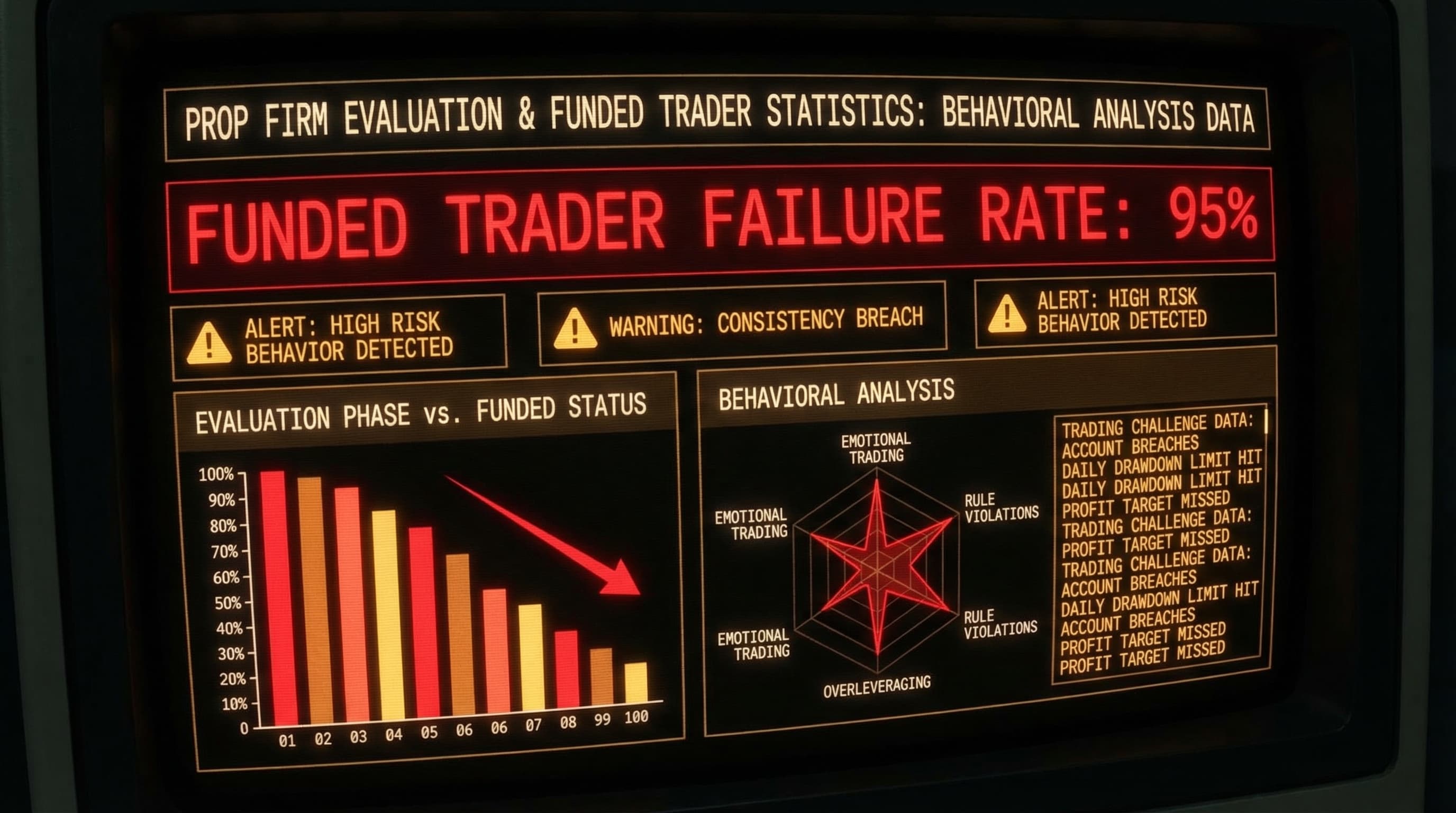
The funded trading industry has grown into a multi-hundred-million-dollar market in less than a decade, attracting traders who want access to institutional-scale capital without years of track record. The economic model is straightforward: traders pay for evaluations, the firm keeps the fees from those who fail, and the rare traders who pass and retain funding generate shared profits. Industry estimates and disclosures from major prop firms suggest failure rates among challenge participants exceed 90%, with most losing funding within the first three months. The firms are not shy about this — their business model depends on it. What the failure data reveals, when examined carefully, is that the traders who wash out are not systematically wrong about market direction. FCA and ESMA risk disclosures show that 74–78% of retail derivative traders lose money even trading their own capital, where there are no consistency rules, no daily drawdown limits, and no maximum loss thresholds. The prop firm environment does not create behavioral problems. It exposes ones that were already there.
Prop Firm Statistics: Why 95% of Funded Traders Fail

Prop Firm Failure Rate: Key Statistics

The prop firm failure rate exceeds 90% at most major programs. Here is what the available data shows:

  • Challenge pass rate: 5–15% of traders pass the initial evaluation (varies by firm and market conditions)
  • Funding retention: fewer than 10% of accounts that pass a funded futures evaluation (Topstep, Apex, MyFundedFutures) retain funding beyond 90 days
  • Combined probability: passing an evaluation AND remaining funded for 6 months is below 5% at most programs
  • ESMA/FCA disclosure: 74–78% of retail derivative traders lose money even without prop firm rules — the rules amplify existing behavioral problems, not create new ones
  • Barber & Odean (Journal of Finance, 2000): the most active traders — the profile of most prop firm candidates — underperform passive investors by 6.5% per year on average
  • Primary failure cause: behavioral pattern violations (consistency rule, daily loss limit breaches), not strategy failure

What the Available Statistics Actually Show

Precise, audited statistics from prop firms are difficult to obtain — most firms do not publish detailed outcome data. However, several data points have entered the public record. Multiple funded futures programs have disclosed that fewer than 10% of accounts that pass their initial evaluation retain funding beyond 90 days. Community-aggregated data from thousands of shared prop firm accounts suggests pass rates on standard challenges sit between 5% and 15% depending on time period and market conditions. The combined probability of passing an evaluation and remaining funded for six months is likely below 5% for most major programs.

The evaluation phase and the funded phase have different failure profiles. The evaluation phase filters for traders who can follow rules under moderate pressure. The funded phase filters for traders who can maintain that discipline when real capital is at stake — even if it belongs to the firm. Behavioral psychology research suggests that real-stakes decision-making activates loss aversion to a degree that simulated or small-stakes trading does not, which is why traders who perform well on evaluations frequently behave differently once funded.

Why the Failure Is Behavioral, Not Strategic

The most common narrative among prop firm washouts is strategy failure: 'my edge stopped working,' 'the market regime changed,' 'I needed better entries.' These narratives are self-protective. The actual patterns that appear in trade data before a prop account blows up are almost universally behavioral.

Kahneman and Tversky's prospect theory (1979) provides the foundational explanation. Under real-stakes loss conditions, traders systematically take on more risk to return to a reference point — in the prop context, that reference point is the maximum drawdown threshold. When a trader is approaching their maximum allowed drawdown, the rational response is to reduce size and protect the account. The behavioral response, driven by loss aversion in the domain of losses, is to increase size to recover faster. This is exactly the pattern that terminates most funded accounts.

Barber and Odean's analysis of 66,465 retail brokerage accounts (Journal of Finance, 2000) found that the most active traders underperformed passive portfolios by 6.5% per year. The behavioral patterns they identified — overtrading, holding losers too long, selling winners too early — are the same patterns magnified in the prop firm context, where the rule structure creates additional pressure and evaluation timelines create artificial urgency.

The Consistency Rule and What It Actually Tests

Most funded trading firms impose some form of consistency requirement: your best trading day cannot represent more than 30–40% of your total profit, your daily losses must stay below a fixed threshold, and your lot sizes must remain within a defined range. These rules are described as protecting the account, but they serve a more important secondary function: they test whether a trader's behavioral consistency holds across different P&L states.

A trader who can post consistent results when up is easy to find. The consistency rule tests what happens to trading behavior when down. Does lot size stay constant? Does trading frequency change? Does the session extend? These are the exact behavioral tells that separate the 5–10% who remain funded from the 90–95% who do not.

Traders who fail consistency rules almost never fail them on their best days. They fail them on recovery days — when they are trying to close a drawdown gap before an evaluation deadline, when they have had a bad week and feel urgency to compensate, or when a large early win creates the feeling that 'the market is on their side.' All three of these failure modes are behavioral, and all three are detectable in historical trade data before they become account-ending events.

The Three Behavioral Patterns That Cause Most Prop Firm Failures

Across the population of prop firm failures, three behavioral patterns appear with overwhelming frequency.

Revenge sequence trading: A loss triggers an immediate follow-up trade, usually larger than standard, aimed at recovering the loss in a single position. The revenge trade has lower average win rate and higher average loss than the trader's normal entries. It is often taken in conditions the trader would otherwise pass on — wrong time of day, insufficient confirmation, too close to a key level. A revenge sequence can consume the entire weekly loss allowance in a single session.

Late-session recovery attempts: As end-of-day or end-of-evaluation drawdown limits approach, traders who are below their target extend their sessions and take trades outside their normal setup criteria. Session analysis of prop firm failures consistently shows that trades in the final 20% of a session — particularly on already-losing sessions — have materially worse expectancy than trades in the first 80%.

Drawdown panic: When the maximum drawdown limit approaches, position sizing becomes erratic. Some traders double down (trying to recover). Others stop taking trades they would normally take (trying to protect the threshold). Both responses are triggered by the threshold becoming salient — consistent with Kahneman and Tversky's reference point model — and both produce worse outcomes than maintaining standard parameters regardless of account state.

What the 5% Who Remain Funded Do Differently

The traders who pass evaluations and retain funded status over multiple months share a consistent behavioral profile, not a consistent trading strategy. They trade futures, forex, crypto, and equities. They use different entry methodologies and different timeframes. What they share:

Pre-commitment rules that operate independent of P&L state. They have defined, non-negotiable session cutoffs. They have loss limits that trigger breaks, not revenge trades. They do not adjust position sizing in response to recent performance — size is determined by setup quality and volatility, not by how far they are from their daily peak.

Review loops that close quickly. The funded traders who last are reviewing their trade data regularly — not to feel good about wins, but to identify behavioral drift before it becomes a threshold breach. They catch the pattern of increasing size after losses before it costs the account. They notice when their session end-time has crept 45 minutes forward three days in a row.

Awareness of their specific tilt triggers. Generic advice to 'avoid emotional trading' is not actionable. What is actionable is knowing, from your own trade history, that your win rate after a stop-out drops by 22 percentage points in the following 15 minutes — so you take a mandatory 20-minute break after every stop-out, regardless of what the chart is doing.

How to Use Trade Data to Prepare for a Prop Firm Evaluation

The best preparation for a prop firm evaluation is not backtesting your strategy or refining your entries. It is identifying and eliminating the behavioral patterns in your current trading that would cause you to fail the consistency rules or breach the drawdown limit.

This requires a systematic behavioral audit of your existing trade history — ideally three or more months of real trades from your personal account. Look specifically at: your win rate and average loss on trades taken within 15 minutes of a stop-out; your position size variance on days when you are running a session loss; your trading frequency in the final hour versus the first hour of your session; and your session length on days where you started negative.

These four metrics will show you exactly which behavioral patterns would terminate a prop firm account. Fix them before you pay for an evaluation, not after. Tiltless Edge Lab runs these behavioral scans automatically against your connected exchange history, surfaces the patterns using statistical significance testing, and lets you verify whether they are improving before you risk evaluation capital. Start for free — no credit card required.

Related Resources

FAQ

?What is the real failure rate at prop firms?

Published data is limited, but industry estimates from community disclosures, firm interviews, and aggregated user data suggest fewer than 10% of traders who pass an initial evaluation retain their funding beyond 90 days. Evaluation pass rates vary by firm and market conditions but commonly sit between 5% and 20%. The combined probability of passing and remaining funded for six months is likely below 5% for most major programs.

?Is the main problem strategy or behavior?

Available data consistently points to behavior. Traders who fail funded accounts typically do not fail because their entry methodology stopped working. They fail because their position sizing, session length, and trade frequency change in response to drawdown pressure — all behavioral responses to loss, not strategic failures. The same patterns identified in retail trading research (Barber & Odean, 2000) appear in prop firm failure data, amplified by the rule structure and timeline pressure.

?What rules do most funded traders violate?

Consistency rules (daily profit concentration), maximum daily drawdown limits, and trailing drawdown thresholds are most commonly violated. Almost all violations occur when the trader is in a loss state — trying to recover too quickly. Very few funded accounts are terminated by a single catastrophic trade taken in a calm, planned state. Most terminations reflect behavioral deterioration across a session or week of mounting losses.

?How can Tiltless help me prepare for or survive a prop firm evaluation?

Tiltless scans your connected exchange trade history and surfaces the behavioral patterns that would cause you to fail a prop firm evaluation: revenge sequences, position size drift after losses, late-session recovery trading, and session extension patterns. Once you can see which behavioral leaks exist in your current trading, you can implement hard rules to prevent them before you risk evaluation capital. Free to start — connect your exchange and see your first behavioral audit within minutes.

Run Your Behavioral Audit Before Your Next Evaluation

Connect your exchange and see the behavioral patterns that would fail a prop firm consistency rule — before you pay for the evaluation to find out.

Prop Firm Statistics: Why 95% of Funded Traders Fail | Tiltless