
Updated: 2026-03-06

How to Review Your Trades: The Evidence-Based Method

Barber and Odean's 2000 analysis of 66,465 brokerage accounts (Journal of Finance) found that the most active traders underperformed passive market returns by 6.5% per year on average. The study is widely cited as evidence against active trading — but the more precise lesson is about review quality. The traders in the underperforming quartile did not lack information. They lacked a systematic method for turning their trade history into behavioral corrections. The Dalbar Quantitative Analysis of Investor Behavior (2023) shows that the average equity investor earned 3.7% annually over twenty years while the S&P 500 returned 9.65% — a gap explained almost entirely by behavioral decision-making errors, not strategy selection. Trade review done well is the single highest-leverage activity available to an active trader. Most traders do it badly, or not at all. This guide covers what evidence-based review actually looks like and why most traditional approaches produce no lasting behavior change.
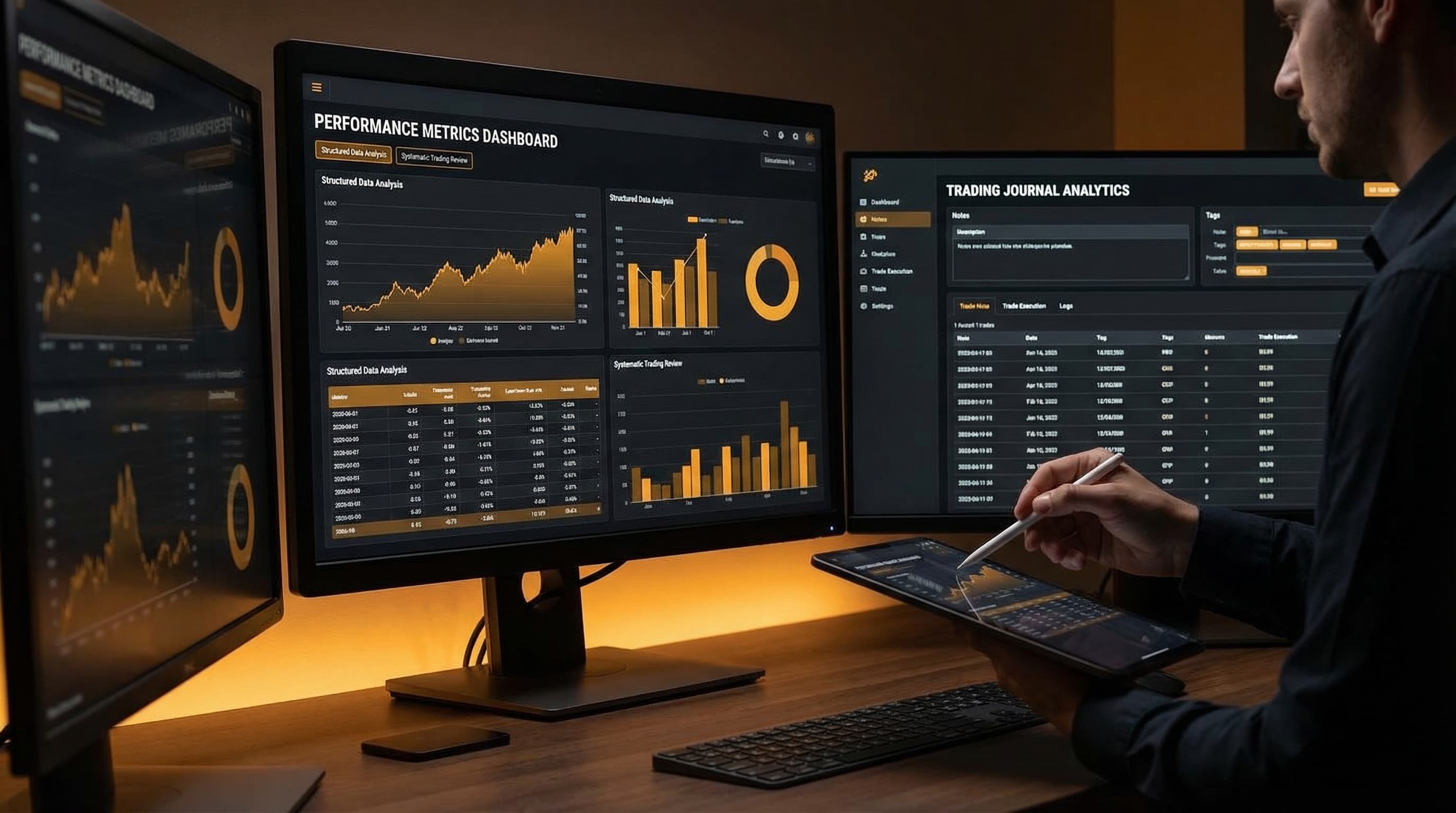
How to Review Your Trades: The Evidence-Based Method

How to Review Trades: The Core Method

Reviewing your trades means systematically examining your historical trading decisions — not just their outcomes — to identify behavioral patterns, rule violations, and statistical edges or leaks. An effective trade review has three layers: daily (process compliance), weekly (session patterns), and monthly (statistical analysis). Most traders only do informal outcome review, which produces no lasting behavior change.

  • Daily review (10-15 min): Did today's trades follow your rules? Score each on process compliance — entry criteria, sizing, timing, stop placement.
  • Weekly review (30-45 min): Look for session-level patterns — days where you overtraded, times where setups underperformed, behavioral drift across the week.
  • Monthly review (90 min): Statistical analysis. With 30+ tagged trades, you can identify meaningful behavioral patterns by condition, state, and setup type.
  • The goal: separate decision quality from trade outcome. A good decision that loses and a bad decision that wins are equally valuable data — you need both to find real edge.

Why Most Trade Reviews Produce No Behavior Change

The most common form of trade review goes like this: you open your journal or broker statement at the end of the week, scroll through your trades, nod at the winners, feel frustrated at the losers, and tell yourself to be more patient. Nothing changes. The same mistakes recur next week.

This fails because it is outcome-driven rather than process-driven. Looking at a losing trade and concluding 'I should have held longer' or 'my stop was too tight' is working backward from the result. The market noise that produced that specific outcome may have nothing to do with whether the decision was good or bad at the moment it was made.

A trade can be correctly executed and still lose. A trade can be badly executed and still win. The percentage of your trades that match each description is unknowable from reviewing individual outcomes. You can only estimate it from patterns across a statistically meaningful sample — typically 50 or more instances of the same setup or behavioral trigger. Individual trade review without aggregate pattern analysis is mostly theater.

The Process Scorecard: Judging Decisions, Not Results

Evidence-based trade review starts by separating the decision from its outcome. The question is not 'did this trade make money' but 'was the decision to take this trade, at this size, with this stop, at this time, consistent with my predefined criteria?'

This requires you to have predefined criteria — which is itself a forcing function. If you cannot answer whether a trade met your entry criteria because you do not have explicit entry criteria, that is the first problem to fix. Write them down. They do not need to be complex. 'Breakout of yesterday's high with volume confirmation, during the first 90 minutes of the session, with a stop below the previous consolidation low' is sufficient. It needs to be testable.

For each trade in your review, score it on process: did entry, sizing, timing, and stop placement all conform to your rules? A trade that scores 4/4 on process and still loses is valuable data — it tells you something about expectancy that requires a larger sample to understand. A trade that scores 2/4 and wins is a warning, not a success. Tracking process compliance separately from outcome is how you start distinguishing good decisions from good luck.

Statistical Minimums: When a Pattern Is Actually Real

One of the most costly errors in trade review is pattern recognition from too small a sample. If your last seven Wednesday morning trades were all losing, that does not mean you have a Wednesday morning problem. It means you have seven trades — far too few to distinguish signal from noise.

A rough minimum for a pattern to have statistical relevance is 30 instances, and even then the confidence interval on any ratio you compute (win rate, average expectancy) is wide. Most professional traders require 50–100 instances before treating a behavioral pattern as actionable. This is not a reason to delay reviewing — it is a reason to let your data accumulate across time while you track the emerging patterns systematically.

The mathematical tools appropriate for this analysis are the Fisher exact test (for comparing win rates between two conditions) and the Welch t-test (for comparing average profit or loss). These are used in published trading research, including the Barber and Odean studies, and are the same tests that power the Tiltless Edge Lab pattern detection — running automatically against your full trade history, not just the last 20 trades in your working memory.

Behavioral Tagging: What to Capture Beyond P&L

The reason evidence-based review produces different results than traditional review is behavioral tagging: attaching categorical context to each trade that goes beyond entry price, stop, and outcome. The context that matters most:

Emotional state at entry — was this trade taken from a calm, planned position, or following a loss, a missed opportunity, or FOMO? How many hours into your session were you? What was your account drawdown from peak at the moment of entry?

Setup quality — did this trade meet all your predefined criteria, some of them, or were you rationalizing an entry that was close but not there?

Session context — was this within your planned trading window, an extension, or a trade taken outside your normal hours?

Once you have 100 trades tagged this way, you can run comparisons that are genuinely informative: trades taken from calm state versus post-loss state, full setup versus partial setup, within-session versus extended-session. The differences in expectancy across these groups usually tell a clearer story than any chart review would.

Review Cadence: Daily, Weekly, and Monthly Layers

Effective trade review operates on three time horizons simultaneously, each serving a different purpose.

Daily review (10–15 minutes): Focus on process compliance. Did today's trades follow your rules? Score each trade on your criteria. Note emotional states that affected execution. The goal is immediate feedback on behavior, not performance optimization.

Weekly review (30–45 minutes): Look for session-level patterns. Was there a day where you consistently overtraded? A time of day where your setups were underperforming? Are you seeing more partial-setup trades this week than last? The weekly layer catches behavioral drift before it becomes a habit.

Monthly review (90 minutes): Statistical analysis. With a month of tagged trades, you can start asking meaningful questions about expectancy by setup type, time of day, session length, and market condition. This is where behavioral leaks typically become visible for the first time — not because they are new, but because the sample is finally large enough to see them clearly.

Why Automated Analysis Beats Manual Review

Manual trade review has a fatal limitation: confirmation bias. When you review your own trades, you bring to that review everything you already believe about your trading. Winning trades get reviewed as 'my analysis was right.' Losing trades get reviewed as 'the market was unusual' or 'my timing was just off.' The review confirms your existing model of yourself rather than updating it.

Automated analysis has no beliefs to confirm. It computes the actual win rate on every behavioral category in your trade history and reports what the numbers say regardless of what narrative you have constructed around them. The pattern that hurts most to see — revenge trading after losses, FOMO entries before major moves, fatigue-driven holds through key levels — is exactly the pattern that manual review is least likely to surface, because your brain actively suppresses it.

The evidence-based traders who consistently outperform their peers are not smarter or better at chart reading. They are better at seeing their own data clearly. That requires either extreme self-awareness (rare) or tools that compute objectively what memory filters out. Tiltless connects to your exchange via read-only API and runs these behavioral scans automatically. You can start for free and see your first pattern within minutes of connecting.

Related Resources

FAQ

?How many trades do I need before reviewing for patterns?

You can start a process review (did I follow my rules?) from the first trade. But pattern analysis — identifying whether a behavioral category is statistically affecting your performance — requires a minimum of 30 instances of the same condition, and ideally 50–100 for reliable conclusions. Active traders typically accumulate this sample within 2–4 weeks. If you trade infrequently, aggregate across months.

?Should I review winning trades or just losing ones?

Both — but weight them differently. Losing trades tell you where your process broke down. Winning trades tell you what conditions are most favorable for your edge. The most useful review question for winners is: 'Was this executed according to my full criteria, or did I deviate and get lucky?' A win from a deviation is not a reason to repeat the deviation — it is a reason to tighten your rules to prevent luck from masking poor execution.

?What is the single most important thing to track in a trade review?

Setup quality versus process compliance. For every trade: did it fully meet your predefined entry criteria? Then compare the expectancy of fully-compliant trades against partial-criteria trades. This single comparison explains more about the gap between your actual and potential performance than almost any other metric. In most trader data, full-criteria trades outperform partial-criteria trades by a margin large enough to change your behavior permanently.

?How does Tiltless automate trade review?

Tiltless connects to your exchange via read-only API, imports your full trade history, and runs automatic behavioral analysis including tilt detection, revenge sequence identification, time-of-day performance, session fatigue scoring, and Edge Lab pattern mining using Fisher exact and Welch t-tests. Your daily briefing summarizes the last session. Your Edge Lab shows patterns across your full history. The review happens automatically — you review the output and decide what to fix.

Let Your Data Do the Review

Connect your exchange. Tiltless automatically identifies your behavioral patterns, surfaces your biggest leaks, and shows you exactly which habits are costing you money.

How to Review Your Trades: The Evidence-Based Method | Tiltless