
Updated: 2026-03-06

What Is Tilt in Trading? 5 Signs You Are Trading Emotionally

Kahneman and Tversky's prospect theory, published in Econometrica in 1979, established one of the most replicated findings in behavioral economics: losses are experienced approximately twice as intensely as equivalent gains. A $500 loss does not merely cancel a $500 profit — it generates roughly double the emotional weight. This asymmetry is the engine behind trading tilt. Tilt is the behavioral state where your decision-making has shifted from your predefined rules to your recent profit and loss. When you are in tilt, you are not reacting to price action or setup quality — you are reacting to the pain of being wrong. FCA and ESMA mandatory risk disclosures consistently show that 74–78% of retail derivative accounts lose money in any given quarter. Researchers who study this population find that the losing majority are not systematically worse at picking direction. They are systematically worse at following their own rules — particularly in the trades that come immediately after a loss.
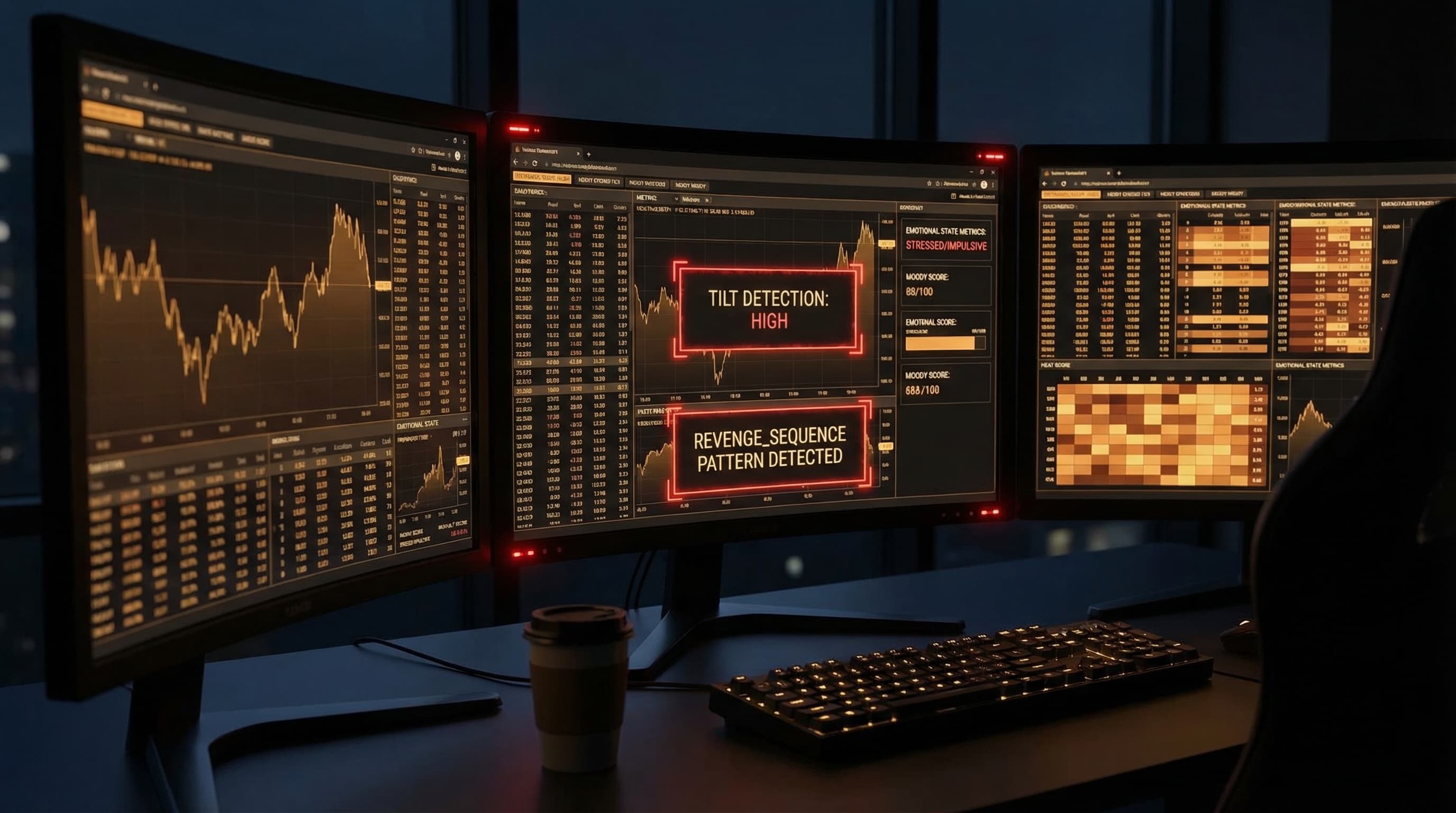
What Is Tilt in Trading? 5 Signs You Are Trading Emotionally

What Is Trading Tilt?

Trading tilt is a behavioral state in which a trader's decision-making has shifted from predefined rules to emotional recovery urgency — almost always triggered by a recent loss. When in tilt, traders take lower-quality entries, increase position sizes, and extend sessions beyond their plans. The name comes from poker, where it describes the deterioration of a player's strategy following a bad beat.

Tilt is not the same as feeling emotional. Every trader has an emotional response to losses — that is normal and expected. Tilt is what happens when that emotional response begins to govern execution. You can feel frustrated and still follow your rules. You are in tilt when you no longer do.

The insidious aspect of tilt is that it rarely feels like a breakdown from the inside. The tilting trader is not aware they have changed their decision framework. They experience themselves as responding rationally to the market. They have a narrative for every trade: 'this setup is actually better than my usual criteria,' or 'I just need one trade to get back to flat.' The narrative feels coherent because the emotional pressure driving it is invisible to them in the moment.

Tilt vs FOMO vs Revenge Trading: Key Differences

Tilt, FOMO, and revenge trading are related but distinct behavioral states. Confusing them leads to the wrong intervention. Here is how they differ:

  • Tilt: triggered by losses — decision-making shifts from rules to recovery urgency. The trader breaks their own rules. Most common symptom: position size increases, session extends, strategy deviates.
  • FOMO (fear of missing out): triggered by watching gains happen without participation — driven by regret anticipation, not loss. The trader chases entries they would normally skip. Most common symptom: late entries at worse prices, compressed risk/reward.
  • Revenge trading: a specific subset of tilt — an immediate re-entry after a stop-out, placed within minutes, driven by the impulse to recover that specific loss. Most common symptom: second trade appears within 5-15 minutes of a stop-out at larger or equal size.
  • Key difference: FOMO is about missing a winner. Tilt and revenge trading are about reacting to a loser. Tiltless scores all three separately in your behavioral analysis — because the intervention for each is different.

Sign 1: You Entered a Trade Immediately After a Stop-Out

The most common and most destructive tilt behavior is the revenge trade: an entry that comes within minutes of being stopped out, driven by the impulse to recover the loss rather than a genuine setup trigger.

Revenge trades almost universally violate entry criteria in at least one dimension. The position may be in the opposite direction without a confirmed reversal signal. The timing may be wrong — entered between key levels rather than at one. The size may be larger than your standard risk. The revenge trade is not a trade in the strategic sense. It is a withdrawal from an account you are trying to replenish.

If you review your trade history and find a consistent pattern where trades taken within 15 minutes of a stop-out have a materially lower win rate than your overall average, you have behavioral evidence of revenge trading. This is exactly the kind of pattern that statistical analysis of your historical data can surface — and that you cannot see clearly from memory alone, because memory is contaminated by how the trades felt, not what they objectively produced.

Sign 2: Your Position Size Increased After a Loss

Martingale-style thinking — increasing size to recover faster — is one of the most mathematically dangerous patterns in trading. It is also one of the most emotionally natural. When you are down, a larger position seems to 'make sense' because it means you return to flat faster if you are right.

The problem is that the motivation for increasing size is recovery urgency, not edge strength. Your edge on the next trade is statistically independent of the result of the last trade. The market does not owe you a win because you just took a loss. If anything, emotional state research suggests your decision quality is likely to be lower immediately following a loss — exactly when you are most tempted to size up.

Kahneman and Tversky (1979) demonstrated that people under loss conditions systematically take on more risk in an attempt to return to a reference point. In trading, this shows up directly as position size creep after drawdowns. Your account equity becomes the reference point. Any distance below it triggers risk-seeking behavior — the neurological opposite of what the moment actually requires.

Sign 3: You Stopped Waiting for Your Setup

Every trader who has worked long enough has a setup — a combination of conditions that historically produces positive expectancy. When calm, you wait for those conditions. When in tilt, you begin rationalizing entries that are close but not quite there.

This is the most subtle of the five signs because it does not look like a breakdown from the inside. You tell yourself you are being flexible. You tell yourself the market context is different today. But the data usually tells a different story: win rate on trades where you deviated from setup criteria is measurably lower than on trades that fully satisfied them.

If you tag your trades with a binary 'full setup / partial setup' field, you will typically find within a few hundred trades that partial setups underperform full setups by more than enough to justify the patience required. Most traders know this intellectually. Tilt makes them ignore what they know.

Sign 4: You Extended Your Session After Saying You Were Done

Fatigue compounds tilt. A trading session that extends beyond its planned end-time because 'I just need to get back to even' is running two risk multipliers simultaneously: an emotional state pushing toward poor decisions, and a cognitive state (fatigue) that reduces the ability to recognize and correct those decisions.

The trader who logs off down $800 and then resumes trading an hour later 'just to see if anything comes back' is not making an evidence-based decision. They are making a pain-avoidance decision. The $800 loss is already realized. Whether they trade for another hour does not change that. But the next hour of trading while tilted can absolutely make things worse.

For most traders, trades executed in extended sessions — beyond the originally planned end time — have some of the worst expectancy in their full data set. The late-session recovery attempt is statistically one of the highest-cost behavioral patterns that active traders exhibit.

Sign 5: You Switched Strategies Mid-Session

When a strategy is not working on a given day, the evidence-based response is to stop trading that strategy and wait for conditions that favor it. The tilt-driven response is to abandon it and try something different — usually something you have heard about, seen someone else use, or tried briefly in the past.

Mid-session strategy switching is almost never adaptive. It is reactive. The new approach has unknown performance characteristics in your hands, in this market condition, at this time of day. You are adding unknowns to an already unfavorable emotional state.

The profitable minority among active traders — the 22–26% who are consistently ahead across a full year — almost universally share one behavioral characteristic: they have clear rules for when to stop, and they follow those rules regardless of where their P&L sits. Not because they have no emotion, but because they have pre-committed to a structure that operates independent of how they feel in the moment.

How to Detect Your Own Tilt Patterns in Your Trade Data

The challenge with tilt is that its presence is invisible during execution and only visible in retrospect — but only if you are looking at the right data. Memory alone is unreliable. You will remember the times tilt led to a recovery, and forget or rationalize the times it made a bad day significantly worse.

Detecting tilt behaviorally requires looking for statistical patterns in your historical trades around specific triggers: trades that came within N minutes of a stop-out, trades where size was larger than your average, trades executed outside your planned session window, trades tagged as deviations from your entry criteria.

The Tiltless Edge Lab runs these patterns against your connected trade history automatically, using Fisher exact tests and Welch t-tests to determine whether the patterns are statistically meaningful or noise. Instead of asking 'did I tilt last Tuesday,' you can ask 'what is my win rate on trades executed within 10 minutes of a loss, across 600 trades?' The answer, in most accounts, is uncomfortable enough to change behavior permanently.

Related Resources

FAQ

?Is trading tilt always bad?

Tilt refers specifically to the state where decision-making has shifted from rules to emotional recovery urgency. In that strict definition, yes — tilt reliably harms performance. It is distinct from trading with emotion (normal) or trading with high motivation (often positive). If a loss makes you more focused and disciplined, that is not tilt. If it makes you start breaking rules, it is.

?How do I know if I'm currently in tilt?

The most reliable real-time signal is asking: 'Would I take this trade if I were flat today?' If the honest answer is no — if the trade only makes sense because of what happened in the last 30 minutes — you are likely in tilt. Secondary signals include session length exceeding your plan, position size outside your standard range, and an internal narrative focused on recovery rather than setup quality.

?Can tilt be prevented?

Completely preventing tilt is not realistic. The neurological response to loss is involuntary. What can be prevented is acting on tilt. Pre-commitment mechanisms — hard daily loss limits, maximum trade count rules, mandatory breaks after stop-outs — reduce the opportunity for tilt-driven decisions to occur. The most effective prevention is behavioral: knowing your specific tilt triggers from your own historical data, not from generic advice.

?How does Tiltless detect tilt in my trades?

Tiltless computes behavioral scores including a tilt score across your connected trade history. It identifies revenge sequences (rapid entries after losses), position size anomalies, and late-session trading patterns, then tests whether these behaviors are statistically associated with worse outcomes in your specific data. You can see your tilt score in your daily briefing and get proactive alerts on Pro and Elite plans when tilt signals appear during live trading.

Find Your Tilt Patterns in Your Own Data

Connect your exchange and see your revenge trade rate, position size anomalies, and late-session performance — automatically, from your real trade history.

What Is Tilt in Trading? 5 Signs You Are Trading Emotionally | Tiltless