Updated: 2026-03-07

Best Trading Journal App in 2026: How to Choose One That Actually Improves Your Trading

A trading journal you use is worth infinitely more than a trading journal you don't. Most traders who start journaling abandon it within 60 days — not because journaling doesn't work, but because the journal they chose requires too much manual effort and returns too little insight. This guide covers what actually separates useful trading journal apps from glorified spreadsheets, and which platforms are worth your time in 2026.

Best Trading Journal App in 2026: How to Choose One That Actually Improves Your Trading

What Separates a Good Trading Journal App From a Glorified Spreadsheet

According to research by Brett Steenbarger on deliberate practice in trading, the traders who improve fastest review behavioral data alongside performance data — not just P&L. A trading journal app that only tracks entry price, exit price, and profit or loss gives you outcome data. It doesn't give you decision data. The distinction matters enormously for improvement.

Decision data answers: Did I follow my rules? What was my emotional state? Did I size this correctly? Was this setup in my playbook? These are the variables that explain performance variance — and they're the ones most journal apps don't track.

The criteria that actually matter when choosing a trading journal app:

1. Automation — Does it pull trade data automatically from your broker or exchange? Manual entry creates friction that causes traders to abandon the journal. Every manual step is a point where the habit can break.

2. Behavioral fields — Can you log emotional state, rule adherence, and setup tags? P&L-only journals are rearview mirrors. Behavioral fields are the steering wheel.

3. Pattern analysis — Does it calculate profit factor by setup, win rate by time of day, or P&L by emotional state? The insights that change behavior come from pattern analysis, not from reviewing individual trades.

4. Asset coverage — Does it support your specific markets? A crypto-only journal is useless for a futures trader, and vice versa.

5. Friction to first entry — How long does it take to log a trade after closing it? Over 2 minutes and most traders won't consistently do it.

  • Outcome data (P&L) tells you what happened; decision data (behavioral fields) tells you why — and only the second drives improvement
  • Automation is the #1 habit driver: every manual entry step is a friction point where journaling gets abandoned
  • Pattern analysis is what separates journaling apps from data archives — insights require analysis, not just storage
  • Cover your specific markets: a journal that doesn't support your asset class or broker is useless regardless of features

The Leading Trading Journal Apps Compared

**Tiltless** — Multi-asset (crypto, stocks, options, futures, forex), 8 live exchange connectors for crypto, 21 import presets for traditional brokers. Behavioral scoring (tilt, FOMO, fatigue, revenge trading detection), AI coach Madison, Edge Lab for statistical pattern mining with real hypothesis testing. Pricing: Free / $29/mo Pro / $59/mo Elite. Best for: active traders who want behavioral intelligence alongside P&L data.

**TraderSync** — Equity and options focused, broker import support, basic performance analytics, trade simulation. Pricing: starts at $29.95/mo. Best for: stock and options traders who want streamlined import and clean reporting.

**Edgewonk** — Desktop application, manual entry, deep analytical tools, no broker integration. Pricing: one-time purchase. Best for: traders who prefer manual control and want deep statistical analysis without subscription cost.

**Tradervue** — Equity-focused, broker import, basic stats, sharing features. Pricing: free tier available, paid plans from $29/mo. Best for: equity traders who want simple import and journaling without advanced analytics.

**Trademetria** — Multi-asset, broker import, performance dashboard. Pricing: starts around $19/mo. Best for: traders who want basic multi-asset coverage at lower price point.

The critical evaluation question: does the app you're considering calculate profit factor by setup type? If not, it cannot show you where your edge actually is.

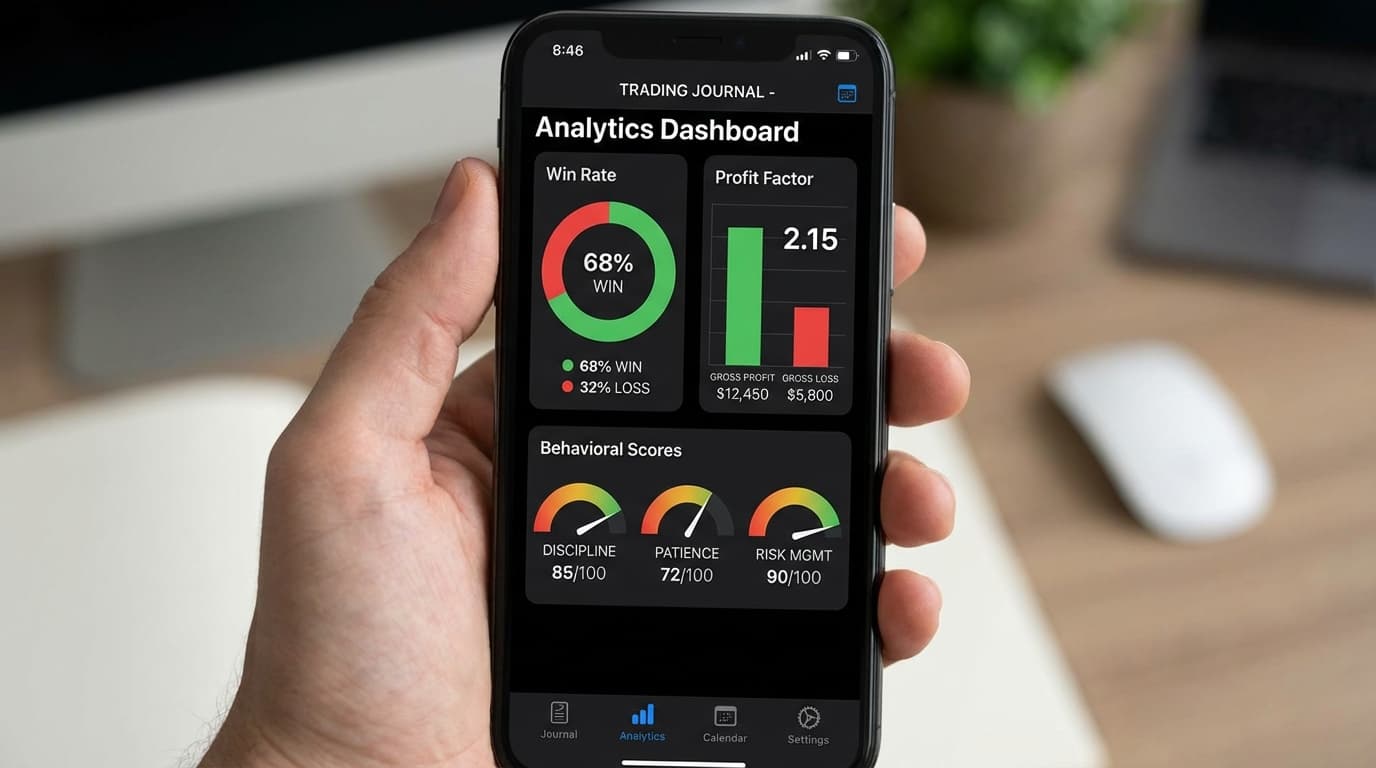
  • Tiltless: behavioral scoring + AI coach + Edge Lab — strongest on the 'why' behind performance variance
  • TraderSync: equity/options focused, clean import — good for stock traders wanting simple analytics
  • Edgewonk: manual entry, deep stats, one-time cost — best for traders who prefer control over convenience
  • Key evaluation test: does the app calculate profit factor by setup type? If no, it can't find your edge

The Journaling Habit Problem (and How to Solve It)

Research in behavioral psychology on habit formation — specifically BJ Fogg's work on Tiny Habits (2020) — shows that habits require three elements: a cue, a routine, and a reward. Most journaling habits fail at the routine step because the friction is too high.

The practical solutions for each friction point:

Friction at data entry: Choose an app with automatic broker sync or one-click CSV import. The less you need to enter manually, the more likely you are to review. Tiltless connects directly to 8 crypto exchanges and accepts CSV imports from 21 broker presets — so the trade data is already there when you sit down to review.

Friction at the review itself: Set a fixed review window — 15 minutes after the market closes or at a consistent time each evening. The review should have a defined structure: (1) check rule adherence on each trade, (2) note any behavioral patterns, (3) update your weekly profit factor by setup. A structured review takes 10-15 minutes. An unstructured one takes 45 minutes and feels overwhelming.

Friction at finding insights: Most traders don't know what to look for. An app that surfaces patterns automatically — 'your win rate drops by 40% after 3 consecutive losses' — gives you actionable insight without requiring you to know what question to ask. This is the difference between data and intelligence.

  • Fogg (2020) on Tiny Habits: habits fail at routine step when friction is too high — automatic sync eliminates entry friction
  • Fixed review window + structured 3-step review process = 10-15 minutes vs. 45-minute unstructured sessions that get skipped
  • Apps that surface patterns automatically lower the barrier to insight — you don't need to know what question to ask
  • The best journal is the one you open after every session — optimize for habit formation, not feature count

Matching Journal App to Your Asset Class

Different asset classes have different journaling requirements. An app that works well for equity traders may be inadequate for crypto or futures traders.

Crypto traders: Need exchange integration (Binance, Bybit, OKX, Hyperliquid, Coinbase) or reliable CSV import from those platforms. Also need support for perpetual futures and spot — many journal apps handle one but not both. Behavioral fields specific to crypto: 24/7 trading session logging, leverage used vs. intended, funding rate at entry.

Futures traders: Need correct contract multiplier handling (MNQ = $2/pt, NQ = $20/pt, ES = $50/pt). Apps that miscalculate P&L due to wrong multipliers are a common problem. Also need RTH vs. ETH session tagging — performance in extended hours differs significantly for most futures strategies.

Options traders: Need strategy type logging (long call, spread, iron condor), IV rank at entry, delta at entry, and DTE at entry. Options performance analysis is meaningless without the market conditions (IV environment) at the time of the trade.

Stock traders: Need sector tagging and catalyst type logging (news-driven vs. technical setup) to separate setups that have different EV profiles. Standard performance reports that mix catalyst types obscure which approaches are working.

  • Crypto: exchange integration + perpetual futures support + 24/7 session handling — most apps handle only some
  • Futures: correct contract multiplier handling is non-negotiable — P&L miscalculation from wrong multipliers is common
  • Options: IV rank + delta + DTE at entry are required — performance analysis without market conditions is meaningless
  • Stocks: sector + catalyst type logging separates setups with different EV profiles that aggregate stats obscure

Related Resources

FAQ

?What is the best trading journal app in 2026?

The best trading journal app depends on your asset class and what you want to improve. For behavioral analysis — understanding why performance varies, not just what it is — Tiltless is the most comprehensive option: it covers all asset classes with live exchange connectors, tracks behavioral scores (tilt, FOMO, fatigue), and uses statistical pattern mining to surface edge. For equity/options traders who want simpler P&L reporting, TraderSync is a strong choice. For traders who prefer manual entry with deep statistical tools, Edgewonk offers a one-time purchase model.

?Do I really need a trading journal app, or can I use a spreadsheet?

A spreadsheet can capture trade data but struggles with two things that determine whether journaling actually improves performance: behavioral tracking (emotional state, rule adherence, setup tags) and pattern analysis (profit factor by setup, win rate by time of day, performance by emotional state). Both are technically possible in spreadsheets but require significant manual formula work and discipline. The majority of traders who start with spreadsheets abandon the journal within 60 days due to the friction. An app that automates data import and surfaces patterns automatically removes those friction points.

?What should a trading journal app track?

At minimum: setup type, entry/exit price, position size, P&L, and emotional state at entry. More useful additions: rule adherence (was this setup in my playbook?), what triggered the trade, whether exit followed my plan, and market conditions at entry (volatility, session time). The most important field is often the behavioral one — 'did I follow my rules?' — because this field, tracked over 200+ trades, reveals the patterns that performance alone cannot explain.

?How much does a trading journal app cost?

Prices range from free to around $60/month. Tiltless: Free / $29/mo Pro / $59/mo Elite. TraderSync: from $29.95/mo. Tradervue: free tier, paid from $29/mo. Edgewonk: one-time purchase (no subscription). Trademetria: from ~$19/mo. The pricing question to ask: what is the cost of one bad trade taken because you didn't see a behavioral pattern in your data? A $30/month journal that prevents one $300 mistake per month returns 10x.

Try the trading journal app built around behavioral analysis

Tiltless connects to your broker or exchange, auto-imports your trades, and shows you the behavioral patterns that explain why your results vary — not just what they are.

Best Trading Journal App 2026: Compared and Reviewed | Tiltless