Updated: 2026-03-07

Crypto Futures Trading Journal: What to Track in Perpetual Markets (And Why Standard Journals Fall Short)

Crypto perpetual futures combine the highest leverage in retail trading with 24/7 market access and extreme volatility. The traders who survive long-term all share one habit: they journal every session with specificity that goes beyond what a standard trading journal provides. Standard P&L tracking is insufficient for perpetual futures — you need to track the funding rate mechanics, the leverage decision, and the behavioral conditions that produce the losses that are specific to this market structure.

Crypto Futures Trading Journal: What to Track in Perpetual Markets (And Why Standard Journals Fall Short)

What Makes Crypto Perpetual Futures Journaling Different

Crypto perpetual futures differ from traditional futures (ES, NQ, crude oil) in four ways that require different journal fields:

1. No expiration: Traditional futures expire and require rolling. Perpetuals use a funding rate mechanism — a periodic payment between longs and shorts to keep the perpetual price anchored to the spot price. The funding rate at entry is a cost that erodes profitability over multi-day holds, and it flips sign depending on market conditions. A journal that doesn't track funding rate at entry cannot accurately calculate true trade cost.

2. 24/7 market access: There is no defined session open or close. This creates two journaling requirements standard apps don't have: (a) time-of-day and day-of-week performance tracking, since crypto liquidity follows distinct patterns (US market hours, Asia hours, weekend sessions), and (b) fatigue tracking, since 24/7 access makes overtrading and late-night trading common account-destruction vectors.

3. Higher leverage than traditional futures: Retail crypto exchanges offer leverage from 3× to 100×. Most account blowups in crypto futures happen not because a strategy was wrong, but because the leverage at entry was too high relative to the stop distance — creating a position where the liquidation price was reached before the stop was.

4. Liquidation cascade risk: When large leveraged positions are liquidated, the liquidation itself creates additional selling pressure. A journal that tracks whether losses were market-driven or liquidation-cascade-driven distinguishes between strategy failure and structural market events.

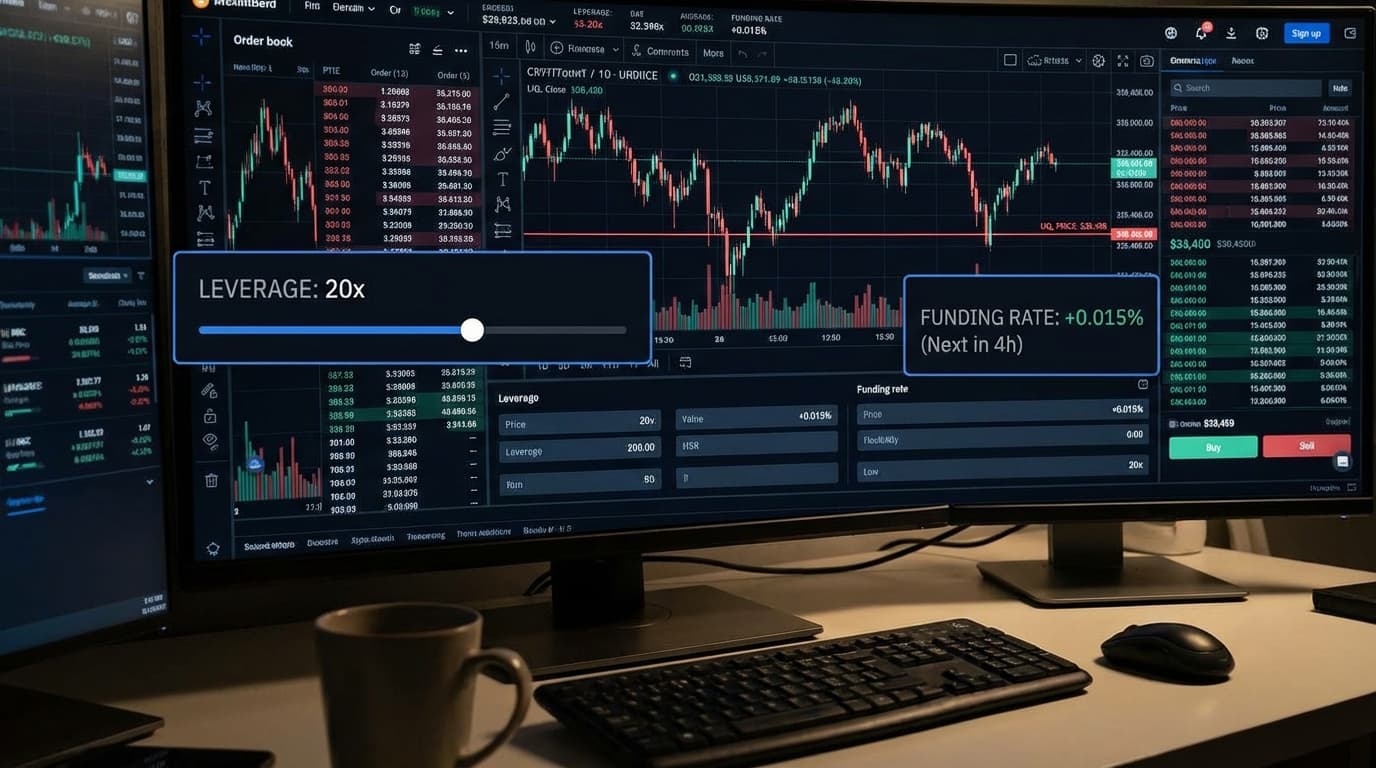
  • Funding rate at entry: a cost that erodes multi-day profitability and flips sign — essential for accurate P&L tracking
  • 24/7 access requires time-of-day + day-of-week performance tracking — crypto liquidity patterns are distinct
  • Leverage at entry vs. liquidation price: most account blowups are leverage management failures, not strategy failures
  • Liquidation cascade vs. market-driven loss: distinguishes structural market events from strategy breakdowns

The Metrics That Reveal Edge in Crypto Perpetual Futures

Standard trading metrics (win rate, profit factor) apply to crypto futures, but several additional metrics are specific to perpetual markets:

Funding-rate-adjusted P&L: Your nominal P&L on a long position held for 48 hours includes the funding payments you either paid (if you were long when funding was positive) or received (if you were long when funding was negative). Calculate funding-adjusted P&L for every multi-day hold — it frequently reduces apparent winners by 0.1% to 0.5% depending on leverage and market conditions.

Effective leverage vs. intended leverage: Traders frequently enter at their intended leverage but allow winning positions to run without reducing leverage as prices move favorably — effectively increasing leverage through position growth. Track the maximum effective leverage reached during each trade, not just the initial entry leverage.

Time-of-day P&L: Crypto markets have distinct liquidity and volatility windows. US market open (9:30am ET) typically sees highest volatility correlation with equities. Asian session (8pm-2am ET) often shows ranging behavior. Late-night trading during low-liquidity periods produces disproportionate losses in most crypto traders' journals.

BTC correlation flag: Whether a trade in an altcoin moved with BTC or independently. Altcoin moves correlated with BTC in a position taken for altcoin-specific reasons represent a thesis failure — the setup didn't play out on its own merits.

  • Funding-rate-adjusted P&L: calculate actual trade cost on multi-day holds — reduces apparent winners by 0.1-0.5%
  • Effective vs. intended leverage: track maximum leverage reached, not just entry leverage — position growth increases it
  • Time-of-day P&L: late-night low-liquidity trading is a disproportionate loss source in most crypto traders' data
  • BTC correlation flag: altcoin move correlated with BTC = thesis failure, not thesis confirmation

The Behavioral Patterns That Specifically Destroy Crypto Futures Accounts

According to research by Lo and Repin (2002) on physiological stress responses during trading, cortisol spikes after losses impair the prefrontal cortex — the brain region responsible for rational risk assessment. In crypto futures, where markets can move 10% in an hour and liquidations cascade, this impairment happens with extreme frequency and intensity.

The behavioral patterns specific to crypto futures traders:

Leverage creep after losses. A trader starts at 5× leverage. After two losing trades, they increase to 10× to recover faster. At 10×, the same adverse move that would have cost 10% of capital at 5× costs 20%. This is the mechanism behind the 'account halved in one bad session' experience that is nearly universal in new crypto futures traders.

FOMO leveraging during BTC breakouts. When BTC breaks to new highs on high volume, the impulse to add leveraged altcoin exposure is almost irresistible. The data shows this is consistently the highest-risk entry time — not the best. According to Chainalysis's 2023 research, the highest retail loss concentrations in crypto futures occur during and immediately after parabolic market moves.

Holding through exchange-scheduled maintenance. Most crypto exchanges schedule maintenance windows. Holding an open leveraged position through a maintenance window where you cannot manage it is not trading — it is gambling. A journal field for 'known maintenance windows during hold period' surfaces this risk before it becomes a loss.

  • Leverage creep after losses: 5× to 10× after two losses doubles the damage of the same adverse move
  • FOMO leveraging on BTC breakouts: Chainalysis (2023) — highest retail loss concentrations occur during parabolic moves
  • Cortisol after crypto losses (Lo & Repin, 2002): impaired prefrontal cortex manages risk worse at high-leverage + high-volatility intersection
  • Maintenance window risk: holding leveraged positions through scheduled maintenance is unmanaged risk — log and avoid

Building a Crypto Futures Journal That Catches What Standard Apps Miss

The minimum viable crypto futures journal fields that standard trading apps don't include:

Entry leverage and maximum leverage reached: Record both. The gap between them on winning trades tells you how much you allowed leverage to creep. On losing trades, the maximum leverage reached often explains why the loss was larger than expected.

Funding rate at entry (positive/negative/near-zero): A simple flag is sufficient. Positive funding means longs are paying shorts — a cost for long positions and a potential edge for shorts in ranging markets. Near-zero funding is neutral. This field takes 10 seconds to record and prevents the 'I lost money even though the price went my way' confusion that occurs when funding costs are not tracked.

Liquidity condition flag: High liquidity (US market hours, major announcement aftermath), normal liquidity, or low liquidity (late night, weekend in quiet conditions). Low-liquidity entries have wider effective spreads and higher slippage — the same setup has worse expected execution.

Post-trade emotional state: Not at entry — at exit. The emotional state after a significant gain or loss in crypto futures is the most predictive variable for the quality of the next trade. Immediate follow-up trades after large crypto futures wins or losses are statistically the worst-performing trades in most traders' journals.

  • Entry leverage + max leverage reached: the gap on winning trades reveals leverage creep; on losses, explains oversize
  • Funding rate at entry (positive/negative/near-zero): 10-second field that resolves the 'price went my way but I lost' confusion
  • Liquidity condition flag: same setup has worse expected execution in low-liquidity windows
  • Post-exit emotional state: immediate follow-up trades after large crypto moves are statistically worst-performing

Related Resources

FAQ

?What should I track in a crypto futures trading journal?

Beyond standard fields (entry/exit, size, P&L), crypto futures journals should track: (1) entry leverage and maximum leverage reached during the trade, (2) funding rate at entry (positive/negative), (3) time of day and day of week, (4) liquidity condition (US hours, Asian hours, low-liquidity window), (5) whether the move was BTC-correlated or asset-specific, and (6) post-exit emotional state. The most commonly missed is funding rate — it's a real cost that erodes profitability on multi-day holds and confuses P&L analysis when untracked.

?What is the funding rate in crypto futures and why does it matter for journaling?

The funding rate is a periodic payment between long and short positions in perpetual futures, designed to keep the perpetual price anchored to the spot price. When funding is positive, longs pay shorts (a cost for long positions). When negative, shorts pay longs. Funding payments typically occur every 8 hours at 0.01% to 0.1% per period, depending on market conditions. For multi-day holds with leverage, these payments meaningfully affect profitability — a 3-day hold with 10× leverage at 0.05% funding per 8h costs 0.45% of position value just in funding. Tracking funding rate at entry prevents the confusion of trades that lost money despite price moving favorably.

?Does Tiltless support crypto futures journaling?

Yes. Tiltless connects directly to Binance, Bybit, OKX, Hyperliquid, and other major crypto exchanges via live API connectors, automatically importing your perpetual futures trades including position size, entry/exit prices, and P&L. The behavioral journaling layer — leverage tracking, emotional state, setup tags — is added on top of the auto-imported data, so you're reviewing and annotating rather than manually entering.

?What leverage should I use in crypto futures?

The Kelly Criterion applied to crypto futures typically produces leverage recommendations of 2-5× for strategies with typical retail edge profiles. The practical heuristic: size your position so that your intended stop-loss distance from entry represents 1-2% of your total account. If your stop is 2% from entry and you want to risk 1% of account, your effective leverage is 0.5× — far lower than the 10-50× many retail traders use. The most common crypto futures journaling insight: the vast majority of large losing trades involve leverage significantly above what the Kelly fraction would prescribe.

Auto-journal your crypto futures trades with live exchange connections

Tiltless connects directly to Binance, Bybit, OKX, Hyperliquid, and more — auto-importing your perpetual futures trades and adding the behavioral layer that standard crypto reporting misses.

Crypto Futures Trading Journal: What to Track and How | Tiltless