
Updated: 2026-03-07

Kelly Criterion for Traders: The Optimal Position Sizing Formula (And Why You Shouldn't Use Full Kelly)

The Kelly Criterion is the mathematically optimal formula for position sizing — the fraction of your capital that maximizes long-run growth rate given your edge. Most traders either ignore it or misuse it. Both are expensive. Ignoring it means sizing arbitrarily, leaving growth on the table or taking on excessive ruin risk. Misusing it — by applying the full formula without accounting for parameter estimation error — results in ruinous volatility. Here is what the formula actually says and the practical version that produces optimal results without blowing up accounts.
Kelly Criterion for Traders: The Optimal Position Sizing Formula (And Why You Shouldn't Use Full Kelly)

What the Kelly Criterion Actually Says

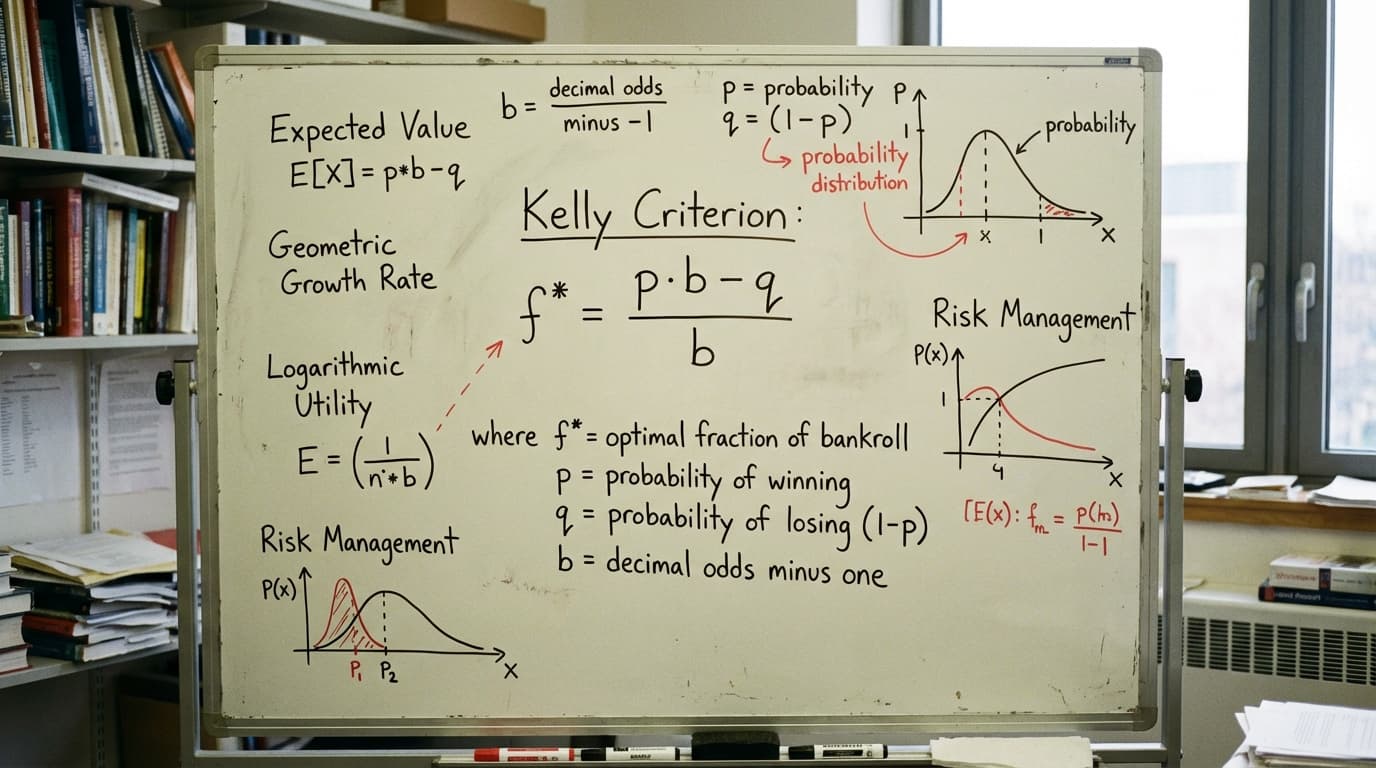
The Kelly Criterion was developed by John L. Kelly Jr. at Bell Labs in 1956 as a formula for maximizing the long-run growth rate of a series of repeated bets. The formula: f* = (p × b − q) / b, where f* is the optimal fraction of capital to risk, p is the probability of winning, q is the probability of losing (1 − p), and b is the net odds received (ratio of average win to average loss).

Simplified for trading: f* = Win Rate − (Loss Rate / Win-to-Loss Ratio)

Example: A strategy with 55% win rate and 1.5:1 win-to-loss ratio: f* = 0.55 − (0.45 / 1.5) = 0.55 − 0.30 = 0.25, or 25% of capital per trade.

At full Kelly, a trader with this edge maximizes the long-term growth rate of their account. Kelly proved mathematically that betting more than f* produces lower long-run growth than betting exactly f*, and that overbetting the Kelly fraction introduces ruin risk that eventually dominates any short-term outperformance.

The critical insight: a strategy with zero or negative edge has a Kelly fraction of zero or negative — meaning Kelly is also a diagnostic tool. If your Kelly fraction is zero, you have no edge to size.

  • Kelly (1956) formula: f* = Win Rate − (Loss Rate / Win-to-Loss Ratio) — the mathematically optimal risk fraction
  • At full Kelly, long-run growth rate is maximized — overbetting full Kelly reduces long-run growth and introduces ruin risk
  • Example: 55% win rate, 1.5:1 R:R → f* = 25% of capital per trade at full Kelly
  • Kelly is also a diagnostic: zero or negative Kelly fraction = no edge to size — stop and build edge first

Why Full Kelly Is Too Aggressive for Most Traders

Edward Thorp — who applied Kelly to blackjack and later to financial markets — documented in his 2006 work on practical Kelly applications that full Kelly produces severe drawdowns that are psychologically intolerable for most practitioners, even when it is mathematically optimal in the long run.

The reason is variance. At full Kelly, the theoretical worst-case drawdown before recovery can exceed 50% — even for a strategy with positive expected value. For a retail trader, a 50% drawdown often triggers risk-of-ruin behaviors: abandoning the strategy, oversizing to recover, or quitting trading entirely. The mathematically optimal path becomes the practically disastrous one.

The standard solution: Half Kelly. Betting half the Kelly fraction produces roughly the same long-run growth rate as full Kelly (the relationship between Kelly fraction and growth rate is quadratic, not linear — reducing from 1.0f to 0.5f reduces growth modestly), while cutting the variance by approximately 75%.

For the 55% win rate, 1.5:1 example above: half Kelly gives f* = 12.5%. A 100-trade drawdown at this size would be approximately 20-25% — severe, but manageable without behavioral deterioration.

The additional reason for half Kelly: parameter estimation error. Your win rate and average win/loss are estimates from a finite sample. If your true edge is 10% lower than estimated, full Kelly becomes overbetting. Half Kelly provides insurance against parameter estimation error while preserving most of the growth advantage.

  • Thorp (2006): full Kelly produces 50%+ theoretical worst-case drawdowns — psychologically intolerable for most traders
  • Half Kelly: ~75% variance reduction with modest long-run growth cost — the standard practical recommendation
  • Half Kelly for the 55%/1.5:1 example: 12.5% per trade, ~20-25% worst-case drawdown vs. ~50% at full Kelly
  • Parameter estimation error: your win rate is an estimate — half Kelly provides insurance against being wrong

How to Calculate Your Kelly Fraction from Your Trade History

The Kelly Criterion is only as accurate as the data it runs on. A 20-trade sample is too small — statistical noise dominates. The minimum meaningful threshold is 100 trades per setup type, with 200+ providing confidence worth acting on.

Step 1: Separate your trades by setup type. Kelly fractions are strategy-specific, not portfolio-wide. Your momentum breakout strategy has a different edge profile than your mean reversion setup, and calculating a single Kelly fraction across all trades produces a meaningless average.

Step 2: For each setup category with 100+ trades, calculate: win rate, average win (in R, where R = 1× your average loss), average loss. Using R multiples rather than dollar amounts makes the calculation portable across different position sizes.

Step 3: Apply the formula: f* = Win Rate − (Loss Rate / Avg Win in R). This gives you the full Kelly fraction. Apply half Kelly (f*/2) in practice.

Step 4: Convert the Kelly fraction to a position size. If your half Kelly is 10% and your account is $50,000, you are risking $5,000 per trade — which, combined with your stop-loss distance in the specific trade, gives you the number of shares or contracts.

Step 5: Recalculate quarterly. Your edge profile changes as markets evolve and as your execution quality improves or degrades. A Kelly fraction calculated on 12-month-old data may no longer reflect your current edge.

  • Minimum 100 trades per setup type — 200+ for confident Kelly application
  • Calculate Kelly separately per setup — mixing setup types produces a meaningless average fraction
  • Use R multiples (risk-normalized units) not dollar amounts — makes the fraction portable across position sizes
  • Recalculate quarterly — edge profile changes as markets evolve and execution quality shifts

The Behavioral Reality of Position Sizing

According to research by Barber and Odean (Journal of Finance, 2000), retail traders systematically oversize during winning streaks and undersize during losing streaks — the opposite of what rational risk management prescribes. This behavioral deviation from optimal sizing costs the average retail trader 2 to 3 percentage points of annual return.

Kelly-based position sizing is the antidote — but only if implemented as a rule rather than a guideline. The practical implementation:

Pre-calculate your Kelly fraction per setup before the trading session. During the session, the position size is not a decision — it is a lookup. Setup type determines Kelly fraction, Kelly fraction determines risk, risk combined with stop determines size. No real-time discretion.

Track actual position size vs. intended Kelly size on every trade. The ratio of actual to intended is your 'behavioral sizing score.' A score consistently above 1.0 indicates overconfidence-driven oversizing. A score consistently below 1.0 indicates fear-driven undersizing. Both destroy returns relative to optimal Kelly sizing.

The most common discovery from tracking this score: traders oversize after winning sessions and undersize after losing sessions — at exactly the wrong times. Winning sessions correlate with positive momentum, where additional edge may exist. Losing sessions often represent mean reversion opportunities. Behavioral sizing does the opposite of what the data warrants.

  • Barber & Odean (2000): traders oversize on wins, undersize on losses — behavioral deviation costs 2-3% annual return
  • Kelly as a rule, not a guideline: pre-calculate size before session, no real-time discretion during session
  • Track actual vs. intended Kelly size: behavioral sizing score reveals overconfidence (>1.0) and fear (<1.0) patterns
  • Most common discovery: traders oversize after wins, undersize after losses — exactly the wrong behavioral pattern

Related Resources

FAQ

?What is the Kelly Criterion in trading?

The Kelly Criterion is a mathematical formula that calculates the optimal fraction of capital to risk per trade to maximize long-run account growth. The formula: f* = Win Rate − (Loss Rate / Win-to-Loss Ratio). A strategy with 55% win rate and 1.5:1 average win-to-loss ratio gives f* = 0.25, or 25% of capital per trade. In practice, most traders use Half Kelly (f*/2) to reduce variance while preserving most of the growth advantage.

?Should I use full Kelly or half Kelly for trading?

Half Kelly for almost all practical trading situations. Full Kelly is mathematically optimal for long-run growth but produces severe drawdowns (50%+) that most traders cannot hold through psychologically, leading to behavioral deterioration that undermines the edge. Half Kelly reduces variance by approximately 75% at a modest long-run growth cost, and provides insurance against parameter estimation error — your win rate and average win/loss are estimates from finite samples, and half Kelly absorbs the impact of being wrong by 10-15%.

?How do I calculate my Kelly Criterion for a specific trading strategy?

Step 1: Collect at least 100 trades for the specific setup type. Step 2: Calculate your win rate and average win-to-loss ratio (in R, where 1R = your average loss). Step 3: Apply the formula: f* = Win Rate − (Loss Rate / Avg Win in R). Step 4: Use half of this result as your practical Kelly fraction. Step 5: Multiply your Kelly fraction by your account size to get the dollar risk per trade, then use your stop-loss distance to determine position size. Recalculate quarterly as your edge profile evolves.

?What happens if I overbet the Kelly Criterion?

Kelly proved mathematically that betting more than the optimal Kelly fraction reduces long-run growth — the more you overbett, the lower your long-run returns. In the extreme case (betting 2× Kelly or more), overbetting produces near-certain ruin over a large enough sample, even with a positive-edge strategy. The Kelly Criterion has an interesting symmetry: anything above 0× and below 1× Kelly increases returns over a no-risk baseline, but 1× Kelly is the maximum — above it, returns decline back toward zero and eventually become negative.

Calculate your Kelly fraction automatically from your trade history

Tiltless computes your win rate and profit factor per setup type from your actual trade data — the inputs you need to calculate Kelly sizing for each strategy you trade.

Kelly Criterion Trading: Optimal Position Sizing Explained | Tiltless