Updated: 2026-03-07

Expected Value in Trading: The Formula That Reveals Whether Your Strategy Has Real Edge

Win rate tells you how often you win. Expected value tells you whether you should be trading your strategy at all. Most traders track the first number obsessively. Almost none calculate the second — which is why most traders can't distinguish a real edge from a lucky run of variance. Here is the formula that separates profitable strategies from expensive mistakes, and the behavioral factors that destroy positive expected value in traders who have it.

Expected Value in Trading: The Formula That Reveals Whether Your Strategy Has Real Edge

What Is Expected Value in Trading?

Expected value (EV) is defined as the average outcome you can expect from a repeated decision over many iterations. In trading, it is the mathematical answer to the question: if I take this setup 100 times under identical conditions, what is my average result per trade?

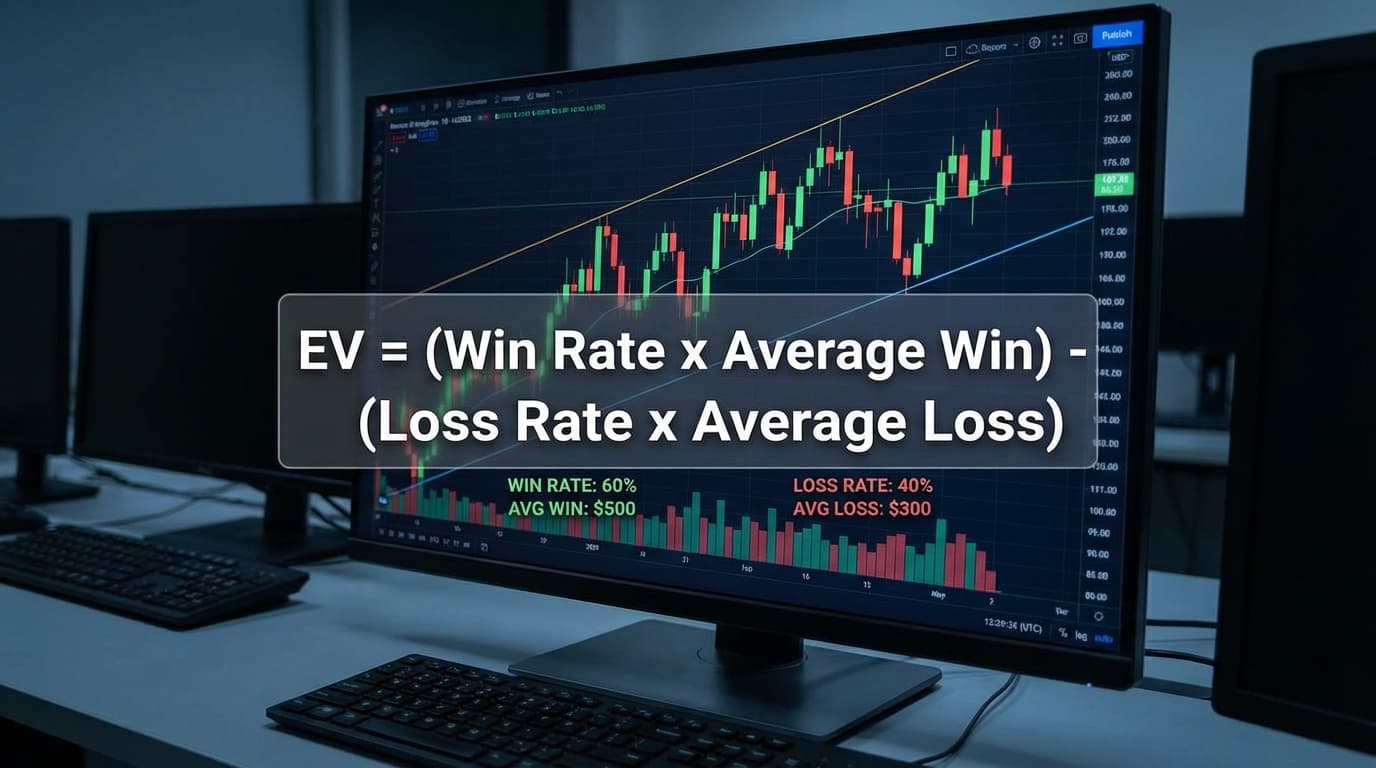
The formula: EV = (Win Rate × Average Win) − (Loss Rate × Average Loss)

Example: A strategy with a 45% win rate, $300 average win, and $200 average loss: EV = (0.45 × $300) − (0.55 × $200) = $135 − $110 = +$25 per trade

A positive expected value (+$25 here) means the strategy is mathematically profitable over a large sample. A negative EV means it is a losing strategy regardless of how good it feels. A zero EV means it breaks even before costs — meaning transaction costs make it a losing strategy.

Critical implication: a strategy with a 35% win rate and an average win-to-loss ratio of 4:1 has an EV of +$75 per trade — significantly more valuable than a 60% win rate strategy with $100 average wins and $200 average losses (EV = -$20). Win rate without the full EV calculation is essentially meaningless.

  • EV formula: (Win Rate × Avg Win) − (Loss Rate × Avg Loss)
  • Positive EV = mathematically profitable over large sample; negative EV = losing regardless of feel
  • Zero EV breaks even before costs — transaction costs make zero-EV strategies net losers
  • A 35% win rate with 5:1 R:R has higher EV than a 60% win rate with 1:2 R:R — win rate alone misleads

Why Expected Value Matters More Than Win Rate

According to research by Brad Barber and Terrance Odean (Journal of Finance, 2000), retail traders obsess over win rate partly because of a behavioral bias: wins and losses are not equal in psychological weight. Winning feels good. Losing feels bad. Traders naturally try to maximize the frequency of the good feeling — even when doing so destroys expected value.

The win rate trap: A trader who cuts winners early to lock in the psychological win increases their win rate while simultaneously destroying their positive EV. The math works against them even as the wins feel more frequent.

Specific example: A trader with a 40% win rate, $400 average win, and $150 average loss has an EV of +$70 per trade. If that trader starts cutting winners early to maintain a 60% win rate — reducing average wins to $150 — their EV becomes: (0.6 × $150) − (0.4 × $150) = $90 − $60 = +$30. They increased their win rate and cut their expected value by more than half.

The flip side of the disposition effect — described by Shefrin and Statman (1985) as the tendency to sell winners too early and hold losers too long — is that it systematically destroys EV even for traders whose underlying strategy is sound. Tracking EV per setup type makes this destruction visible.

  • Win rate is psychologically salient because wins feel good — traders optimize for frequency over EV
  • Cutting winners early to boost win rate simultaneously destroys positive expected value
  • Disposition effect (Shefrin & Statman, 1985): premature winner exits + held losers = EV destruction
  • Calculate EV per setup — it reveals where behavioral execution is eroding a structurally sound strategy

How to Calculate Your Expected Value by Setup

The EV calculation is only as useful as the data it runs on. A dataset of 20 trades is too small to draw reliable conclusions — statistical noise dominates at that sample size. The minimum meaningful threshold is 50 trades per setup type, with 100+ being sufficient for reasonable confidence.

Step 1: Categorize your trades by setup. You cannot calculate meaningful EV across all trades mixed together — a scalping setup and a breakout setup have completely different EV profiles and mixing them obscures both. Tag every trade with its setup type.

Step 2: For each setup category with 50+ trades, calculate: (1) win rate, (2) average winning P&L, (3) average losing P&L. Your journal should pull these numbers automatically from your trade data.

Step 3: Apply the EV formula per setup. Rank your setups by EV. This ranking is your actual edge map — it shows which approaches are worth scaling and which are producing drag.

Step 4: Check EV by condition. Time of day, market session, volatility regime — these modifiers frequently reveal that a setup with positive EV in one condition has negative EV in another. A strategy that works in the first hour of RTH may systematically lose in the last hour.

Step 5: Recalculate quarterly. EV is not static. Market regimes change, your execution changes, setup quality varies with volume. A positive-EV setup can drift negative over time without you noticing — until you do the math.

  • Minimum 50 trades per setup type for meaningful EV calculation — 100+ for higher confidence
  • Calculate EV separately per setup category — mixing all trades obscures which setups have edge
  • Check EV by condition: time of day, session, volatility — EV often concentrates in specific windows
  • Recalculate quarterly — EV drifts as market regimes and execution quality change

The 3 Behavioral Factors That Destroy Positive EV

Many traders have a strategy with genuinely positive expected value that consistently underperforms that EV in practice. The gap is almost always behavioral. Three factors account for the majority of EV destruction in retail traders:

1. Inconsistent execution. A strategy with +$50 EV delivers that EV only when applied consistently to qualifying setups. Skipping setups that feel uncertain, taking setups that don't qualify, or executing at the wrong size all distort the realized EV away from the calculated EV. The strategy's EV is an average — but only if you take every qualifying trade.

2. Tilt-driven sizing. According to Barber and Odean's research on overconfidence, traders increase position size during winning streaks — often at exactly the moment regression to the mean is most likely. A 2× position on a normal setup doubles the P&L variance without changing the EV per unit. A string of large losses from oversized positions can statistically wipe out months of smaller EV gains.

3. Early exits on winners. This is the mechanism of the disposition effect translated into EV terms. If your strategy's +$50 EV is calculated based on an average win of $200, but behavioral pressure to lock in gains causes you to exit at $120 on average, your realized EV per trade drops significantly. The strategy didn't change. The execution did.

Tracking realized EV versus calculated EV is the diagnostic. When they diverge, the gap is behavioral — and that is fixable.

  • Inconsistent execution: EV is an average that requires taking every qualifying trade — cherry-picking destroys it
  • Tilt-driven sizing: 2× position doubles variance without increasing EV per unit — losses from oversizing erase gains
  • Early exits: if avg win is $200 in your EV calc but you exit at $120, realized EV falls proportionally
  • Realized EV vs. calculated EV: the gap between them is behavioral — measure it to find what to fix

Related Resources

FAQ

?What is expected value (EV) in trading?

Expected value in trading is the average profit or loss per trade you can expect over many iterations of a setup. The formula: EV = (Win Rate × Average Win) − (Loss Rate × Average Loss). A positive EV means the strategy is mathematically profitable over a large sample. A negative EV means it loses money on average, regardless of short-term results. EV is the most important single metric for evaluating whether a trading strategy has genuine edge.

?How many trades do I need to calculate expected value?

At minimum 50 trades per setup type for preliminary signal, and 100+ for meaningful confidence. At fewer than 50 trades, statistical variance dominates the results — a lucky 20-trade sample can show a positive EV for a strategy that is genuinely negative, and vice versa. Calculate EV by setup category separately, not across all trades mixed together, and recalculate quarterly as market conditions and your execution evolve.

?Can I have a positive expected value with a low win rate?

Yes. A strategy with a 35% win rate and an average win-to-loss ratio of 4:1 has an EV of: (0.35 × $400) − (0.65 × $100) = $140 − $65 = +$75 per trade. Many trend-following and breakout strategies operate with win rates between 30-45% while maintaining strong positive EV through large average wins. The key variable is the risk-reward ratio, not the win rate — and optimizing for win rate at the expense of R:R frequently destroys EV.

?What is the relationship between expected value and profit factor?

Profit factor (gross profit / gross loss) and expected value are related measures of edge. A profit factor above 1.0 indicates positive EV; below 1.0 indicates negative EV. Profit factor is often easier to calculate (it doesn't require converting to per-trade terms) while EV gives you a dollar figure per trade that's more intuitive for position sizing and scaling decisions. Use both: profit factor for quick evaluation, EV for scaling and sizing calculations.

Calculate your expected value by setup automatically

Tiltless computes your EV, profit factor, and win rate per setup type from your trade data — so you can see which strategies have real edge and which are costing you money.

Expected Value in Trading: Calculate EV and Find Your Real Edge | Tiltless