
Updated: 2026-03-06

How to Use Statistics to Find Your Real Trading Edge (Not Gut Feeling)

Every active trader believes they have an edge. The research suggests most are wrong. Barber and Odean's 2000 analysis of 66,465 brokerage accounts at a major US discount broker (Journal of Finance) found that the most active traders — those most likely to believe in their edge — underperformed passive investors by 6.5% per year on average net of transaction costs. A smaller 2011 study of Taiwanese day traders (Barber, Lee, Liu, Odean) found that fewer than 1% of day traders were consistently profitable over a 15-year period. The gap between perceived edge and actual statistical edge is one of the most consistent findings in behavioral finance. This post explains how to close that gap using the same statistical methods that quantitative traders use — applied to your own trade history, without a PhD.
How to Use Statistics to Find Your Real Trading Edge (Not Gut Feeling)

What Is a Trading Edge? The Statistical Definition

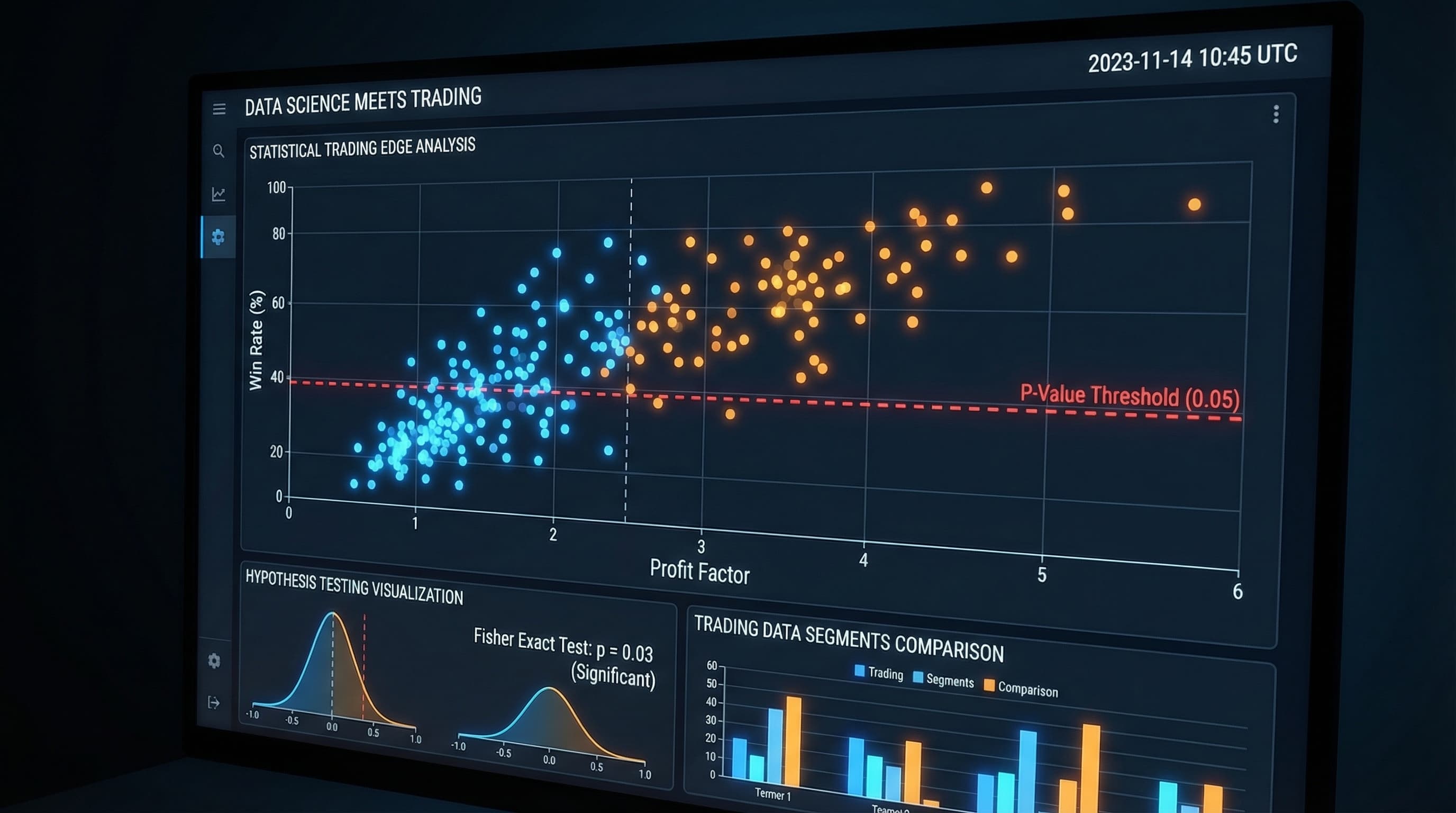
A trading edge is a systematic, repeatable advantage that produces above-chance returns with a probability that cannot be explained by random variation alone — confirmed by statistical hypothesis testing across a sufficient sample of trades. In everyday trading conversation, 'edge' is used loosely to mean a sense that a setup works. Statistically, it means something precise and testable: a win rate and expectancy combination that produces a p-value below 0.05 in a Fisher exact test or Welch t-test. Without this threshold, a profitable run of 30 trades is statistically indistinguishable from luck.

The difference matters enormously, because the same strategy can appear to have an edge over 50 trades but have no edge at all — the performance being entirely explained by luck.

  • Expectancy: the average profit or loss per trade, weighted by win rate. A 60% win rate with a 1:1 average win/loss ratio has the same expectancy as a 40% win rate with a 2:1 ratio. Neither number alone tells you if you have an edge.
  • Statistical significance: a p-value below 0.05 means there is less than 5% probability that your results occurred by chance. Without this threshold, a profitable run of 20 trades is meaningless — a coin flip run of 20 heads is possible.
  • Sample size: the minimum sample size to detect a moderate effect size at 80% statistical power is typically 80–100 completed trades. Many traders draw conclusions from 10–20 trades — statistically, this is no better than random.
  • Consistency: an edge that exists in one market condition but disappears in another is not an unconditional edge — it is a conditional edge. Knowing the conditions is as important as knowing the edge exists.

Fisher Exact Test: The Right Tool for Win Rate Analysis

The Fisher exact test is the standard statistical method for comparing win rates between two groups — for example, comparing your win rate when you trade within 30 minutes of a session open versus trades taken later in the session. It answers the question: is the difference between these two win rates statistically significant, or could it be random variation?

  • Fisher exact test is specifically designed for categorical data (won/lost) in small-to-medium sample sizes — exactly the data traders have
  • A p-value below 0.05 from a Fisher exact test means there is less than 5% probability the win rate difference between your two groups occurred by chance
  • Example: you have 120 trades, 60 in the morning session (40% win rate) and 60 in the afternoon (62% win rate). Fisher exact test tells you whether that 22-percentage-point difference is statistically significant
  • Edge Lab in Tiltless runs Fisher exact tests automatically across your data segments — by time of day, instrument, session type, position size, and behavioral state

Welch t-Test: The Right Tool for P&L Analysis

While Fisher exact test compares win rates, the Welch t-test compares average P&L between groups — which is often more informative because it accounts for the magnitude of wins and losses, not just their frequency.

  • Welch t-test is preferred over Student's t-test when comparing groups of different sizes or with different variance — common in trader data
  • A p-value below 0.05 means the average P&L difference between your two groups is statistically significant
  • Example: your average P&L on trades placed within 15 minutes of a stop-out is -$82, versus -$12 on all other trades. Welch t-test tells you if this -$70 difference is statistically reliable or noise
  • Using both Fisher exact test and Welch t-test together gives you a complete picture: is the win rate different AND is the P&L different? Both confirming significance strengthens the conclusion.

How to Segment Your Trades for Edge Analysis

The output of edge analysis is only as good as the segmentation. Comparing 'all trades' against each other produces no useful information. You need to split your trade population into groups that test a specific hypothesis. The best hypotheses are behavioral — they test whether your performance changes under specific conditions that you have some ability to control.

  • Time-based segments: morning vs afternoon, first 30 minutes vs rest of session, day of week
  • State-based segments: first trade of session vs subsequent trades, trades after a stop-out vs baseline, trades on days following a losing session
  • Sizing segments: standard size vs larger size vs smaller size — this tells you if sizing decisions improve or hurt expectancy
  • Market condition segments: high vs low volatility, trending vs ranging market, high vs low volume
  • Instrument segments: by symbol, sector, or asset class — your edge may exist in some instruments but not others

How Many Trades You Need for Reliable Conclusions

This is where most traders go wrong. Drawing conclusions from small samples is the primary source of false edge beliefs. The research is clear on minimum requirements for reliable statistical inference in trading contexts.

  • For Fisher exact test at 80% power with a 10-percentage-point effect size: you need approximately 130 trades per group — 260 total minimum for a two-group comparison
  • For Welch t-test at 80% power with a moderate effect size: approximately 50–80 trades per group
  • Practical minimum for any edge claim: 100 completed trades in the test group, with a comparable control group
  • Edge Lab displays sample size and confidence intervals for every analysis result — if a finding has insufficient sample size, the system flags it clearly rather than presenting it as a confirmed pattern
  • The right response to insufficient data is to trade for longer in your test conditions — not to lower your statistical threshold

How Tiltless Edge Lab Runs This Analysis Automatically

Edge Lab in Tiltless implements Fisher exact test and Welch t-test across 12 behavioral and situational dimensions automatically, using your imported trade history. You do not need to be a statistician to use it — the system runs the tests, flags significant findings, and presents them as actionable insights with p-values and confidence intervals.

  • Free tier analyzes 3 dimensions: session timing, instrument type, and account state
  • Pro tier unlocks all 12 dimensions: adds behavioral state (tilt, FOMO, fatigue, revenge), position sizing, market regime, setup type, and more
  • Each finding is presented with p-value, effect size, sample size, and a plain-language interpretation
  • Impact simulation shows you the estimated P&L improvement if you fixed a specific behavioral leak — based on your actual trade history, not theoretical assumptions
  • Findings that do not meet statistical significance (p > 0.05) are shown separately as trends to monitor with more data

Related Resources

FAQ

?How many trades do I need before Edge Lab analysis is useful?

Edge Lab produces reliable statistical findings with 100+ completed trades. With fewer than 50 trades, the confidence intervals are too wide to draw actionable conclusions — though Edge Lab will still show directional trends. Most active traders accumulate 100+ trades in 4–8 weeks of normal trading activity. If you trade options with longer holding periods, import your full history going back 6–12 months to build a sufficient sample.

?What is the difference between a real edge and a lucky streak?

A real edge produces statistically significant results when tested with Fisher exact test or Welch t-test (p < 0.05) across a sufficient sample size. A lucky streak cannot be distinguished from random chance at a statistically significant level. A 60% win rate over 20 trades has a p-value of approximately 0.12 — not statistically significant. The same 60% win rate over 100 trades has a p-value of approximately 0.05, approaching the significance threshold. Over 200 trades, p < 0.01 — statistically strong evidence of edge.

?Can I have an edge in some conditions but not others?

Yes, and this is by far the most common finding in trader data. Most traders do not have an unconditional edge — they have a conditional edge that exists in specific circumstances (certain times of day, certain market conditions, certain instrument types) and disappears or reverses in others. Identifying the conditions where your edge is strongest is the primary goal of segmentation analysis. Edge Lab is specifically designed to surface these conditional patterns.

?What does p-value mean for a trader?

A p-value is the probability that your results occurred by random chance. A p-value of 0.05 means there is a 5% chance the pattern you see is random variation — a 95% chance it represents a real systematic pattern. A p-value of 0.01 means 1% chance of randomness. The standard threshold for claiming statistical significance is p < 0.05. At p < 0.01, the evidence is strong. At p > 0.10, the pattern is not statistically distinguishable from noise regardless of how compelling it looks.

Run Statistical Edge Analysis on Your Trade History

Connect your exchange or import your CSV. Edge Lab runs Fisher exact test and Welch t-test across 12 behavioral dimensions and shows you where your edge is real — and where it is not.

How to Find Your Real Trading Edge with Statistics | Tiltless