
Updated: 2026-03-06

Funded Trader Daily Routine: What the 5% Who Stay Funded Actually Do

Fewer than 10% of traders who pass prop firm evaluations retain their funded accounts beyond 90 days. The gap between those who do and those who do not is not strategic — it is structural. The traders who stay funded have built a daily operational routine that treats trading as a behavioral system, not a series of individual decisions. Kahneman and Tversky's 1979 research on decision-making under uncertainty identified that people with defined pre-commitment systems make materially better decisions under pressure than those who rely on in-the-moment judgment. ESMA and FCA risk disclosures confirm that 74–78% of retail derivative traders lose money in any given quarter — the majority of whom have the same strategies as the profitable minority. Strategy is not the differentiator. Routine is.
Funded Trader Daily Routine: What the 5% Who Stay Funded Actually Do

Pre-Session (30 Minutes Before the Open)

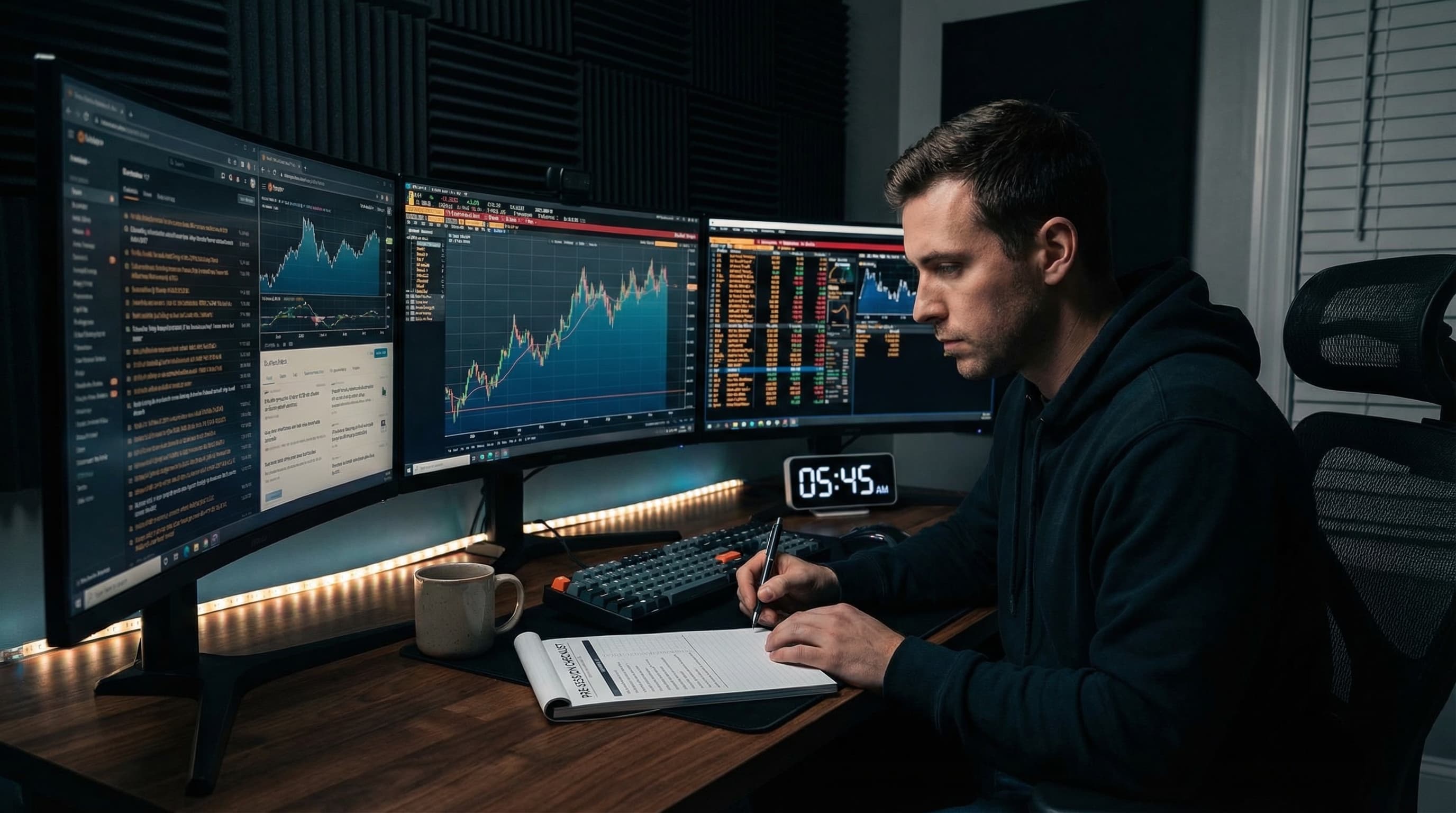
The most important trading decisions are made before the market opens, not during the session. The 30 minutes before the open are not for analysis — they are for behavioral preparation. A trader who enters the session with clear rules and a checked behavioral state makes categorically better in-session decisions than one who opens the platform without preparation.

  • Review yesterday's behavioral scores, not P&L. Specifically: tilt, FOMO, fatigue. A score above 7 in any category is a yellow flag for today's session.
  • Set today's daily loss limit in writing before you open the platform. Do not rely on memory — write it on paper or in a note. The physical act of writing creates pre-commitment.
  • Define your session end time. Time-based session limits outperform P&L-based limits because they remove the loss-recovery incentive to extend.
  • Identify today's one behavioral focus. Not a P&L target — a behavioral rule. 'No re-entries within 15 minutes of a stop-out' is a behavioral focus. 'Make $500' is not.
  • If yesterday was a losing day with a tilt score above 6, reduce size by 25% for the first two trades of today's session as a behavioral reset mechanism.

During the Session: Rule Execution Over Optimization

In-session, the job is execution — not optimization. Funded traders who lose their accounts almost universally describe the same sequence: they started improvising from their rules because conditions seemed to warrant it. The improvisation that costs accounts is almost always preceded by a feeling of certainty, not doubt. The during-session routine creates structural interruptions that prevent improvisation from compounding.

  • After every stop-out: a mandatory 10-minute pause before the next trade. Set a phone timer. This is not a suggestion — it is a rule. It interrupts the revenge sequence before it starts.
  • After 2 consecutive losses in any session: mandatory review of your daily loss limit remaining and your behavioral state. If tilt score feels elevated (self-assessed 6+), reduce size 50% for the rest of the session.
  • After a large winning trade: this is when overconfidence risk peaks, not after losses. The behavioral response to a big win is to increase size on the next trade. Do not. Maintain your standard position size.
  • 30 minutes before your session end time: review your open positions. Close any trade you would not enter fresh at this moment. Do not hold trades into your session close that are in uncertain state.

Post-Session Review (10 Minutes, Same Day)

The post-session review is the single highest-leverage habit in funded trading. Barber and Odean's 2000 analysis of 66,465 brokerage accounts found that the most active traders underperformed passive investors by 6.5% per year — driven primarily by execution decisions made under degraded behavioral states. The post-session review identifies those states before they compound into the next session's performance.

  • Review your behavioral scores for the session: did any metric (tilt, FOMO, fatigue) spike above your personal threshold? What trade triggered it?
  • Identify the one trade from today that most deviated from your rules. Not the worst P&L trade — the most off-rule trade. These are different.
  • Write down one behavioral commitment for tomorrow. It should be specific and falsifiable: 'I will stop after 2 consecutive losses regardless of P&L remaining in my limit.'
  • Check your funded account's proximity to the trailing drawdown threshold. If you are within 2% of the limit, tomorrow's session should be half-size regardless of today's outcome.

Weekly Review (Sunday, 20 Minutes)

The weekly review operates at a level above daily reviews — it identifies patterns across sessions rather than within sessions. Most behavioral leaks are not visible in a single session. They are sequences: a losing Monday leading to a Tuesday recovery attempt leading to a Wednesday oversize position leading to a Thursday breach. The weekly review catches these sequences.

  • Review behavioral scores across all 5 sessions of the week. Is there a pattern to which days or which market conditions precede elevated tilt or FOMO?
  • Calculate your week's consistency score: what percentage of trades met your entry criteria? What percentage of sessions ended at or before your planned time? This is your behavioral compliance rate.
  • Review your proximity to the funded account's maximum drawdown. If you are more than 50% through the maximum drawdown at any point in the week, next week's position size should be reduced 25% automatically.
  • Identify next week's behavioral focus based on this week's most common deviation. One focus per week, not three.

The Tools That Support This Routine

The routine described above requires data that most traders do not have readily available without a behavioral journal. Knowing your tilt score, your behavioral compliance rate, and your post-loss win rate requires either laborious manual logging or a system that computes these automatically from your trade history. The traders who maintain this routine consistently use tools that remove the friction of data collection — because friction is the primary reason routines fail.

  • Automatic behavioral scoring: a system that computes tilt, FOMO, fatigue, and revenge scores from your raw trade data without manual tagging. Manual journaling fails because it requires the most effort at the moment of lowest motivation (after a bad session).
  • Session briefings: an automatic daily summary that surfaces your behavioral scores, pattern deviations, and session-level statistics. The 10-minute post-session review is only feasible if the data is presented to you, not assembled by you.
  • Edge Lab pattern analysis: a statistical engine that identifies which behavioral conditions correlate with your best and worst performance. Pattern recognition at the data level confirms or refutes your intuitions about what is costing you.
  • Tilt and FOMO alerts: real-time signals that fire when your behavioral scores enter the ranges that historically precede your worst sessions. The earlier the alert, the more effective the intervention.

Related Resources

FAQ

?How long should a pre-session routine take?

30 minutes is the optimal target for most active traders. Less than 15 minutes is insufficient to genuinely review behavioral state and set meaningful rule commitments. More than 45 minutes creates analysis paralysis and can paradoxically increase anxiety. If your pre-session routine is taking longer than 30 minutes, the problem is usually that you are trying to do market analysis (which should be done the night before) rather than behavioral preparation (which should be done morning-of).

?What is the biggest mistake funded traders make with their daily routine?

Treating the routine as a P&L optimization tool rather than a behavioral management tool. The daily routine is not designed to help you make more money on good days — it is designed to limit the damage on bad days and prevent behavioral degradation from compounding across sessions. The most common routine failure is skipping the post-session review on losing days, when it is least enjoyable but most valuable.

?How do I know if my daily routine is working?

Measure your behavioral compliance rate, not your P&L. Behavioral compliance rate is the percentage of sessions where: you stopped at your daily loss limit, your position sizes stayed within your standard range, you did not take re-entries within your mandatory pause window, and you ended the session at your planned time. A compliance rate above 80% consistently predicts stable performance. A compliance rate below 60% predicts eventual account breach regardless of short-term P&L.

?Can Tiltless automate the behavioral review part of this routine?

Yes. Tiltless computes tilt, FOMO, fatigue, and revenge scores automatically from your trade data and presents them in a daily session briefing. The briefing surfaces your one most-deviant trade, your behavioral score trends, and your edge-relevant patterns — the core content of both the post-session and weekly review. The pre-session checklist (daily loss limit, session time, behavioral focus) is a manual commitment you make, but Tiltless provides the data that informs it.

Build Your Funded Trader Daily Review Loop

Connect your exchange and Tiltless automatically generates your daily session briefing — behavioral scores, pattern deviations, and the one trade to learn from. No manual journaling required.

Funded Trader Daily Routine: What the 5% Who Stay Funded Actually Do | Tiltless