
Updated: 2026-03-06

Topstep Evaluation Tips: What Your Trade Data Reveals About Pass or Fail

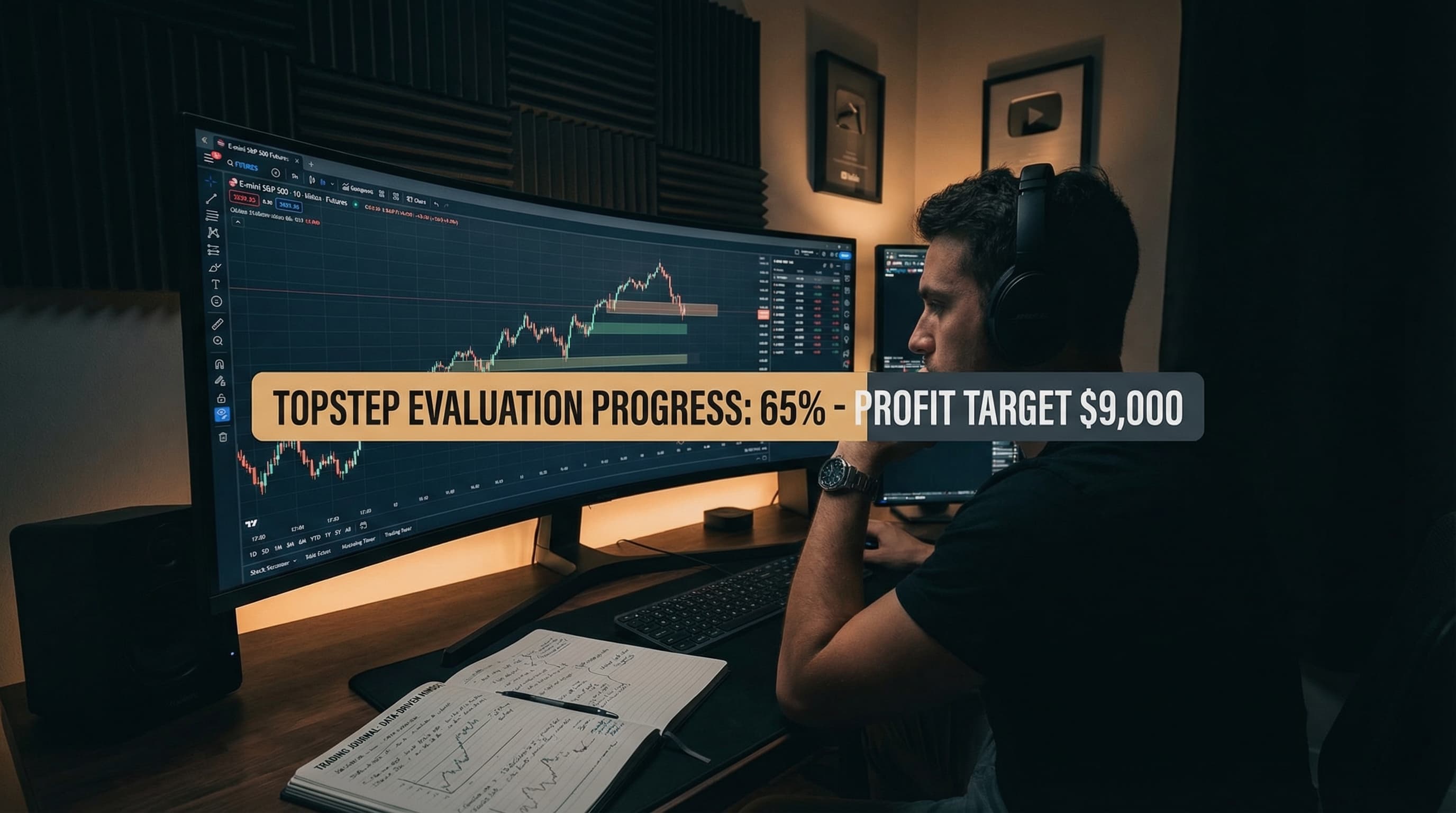
Fewer than 10% of traders who pass a Topstep evaluation retain their funding beyond 90 days. That statistic does not describe a strategy failure rate — it describes a behavioral consistency failure rate. Kahneman and Tversky's 1979 research on loss aversion demonstrated that losses feel approximately twice as painful as equivalent gains feel good. In an evaluation context, where every trading day carries consequences for funding status, that emotional asymmetry is amplified. Traders who could manage their behavior in normal conditions find it harder to do so when the stakes are tied to real funding. This post covers what Topstep's evaluation actually measures, which behavioral patterns produce the most failures, and how to audit your own data before your next attempt.
Topstep Evaluation Tips: What Your Trade Data Reveals About Pass or Fail

What Topstep Actually Tests (Beyond Strategy)

The Topstep Combine is commonly described as a performance evaluation, but it is more accurately described as a behavioral consistency test. The explicit rules — daily loss limit, trailing drawdown, minimum trading days — are filters that eliminate traders who cannot manage risk mechanically under pressure. But the implicit filter is behavioral: traders who pass are those whose performance in an evaluation context does not diverge significantly from their baseline. Research from ESMA and FCA mandatory risk disclosures consistently shows that 74–78% of retail derivative traders lose money in any quarter. Most of those traders have strategies that produce positive expectancy in isolation. The failure is not the strategy — it is the execution degradation under pressure. Topstep's evaluation is specifically designed to surface that degradation.

  • Daily loss limit: forces you to stop when behavioral risk is highest (after losses)
  • Trailing drawdown: creates asymmetric pressure — losses cost more than gains recover
  • Minimum trading days: prevents lucky streaks, requires consistent execution over time
  • Consistency rule: the most commonly failed rule — often misunderstood

The Consistency Rule Decoded

Topstep's consistency rule requires that no single day account for more than a defined percentage of your total profits (typically 30–40% depending on the account). On its surface this looks like a performance metric. In practice, it is a behavioral metric. Traders fail the consistency rule in one of two ways: they have a monster day early that inflates the benchmark making all subsequent days look inconsistent, or they have a drawdown and then swing for the fences to recover, producing one large outlier day that disqualifies them. Both failure modes are behavioral, not strategic. The monster-day problem is caused by outsizing during what feels like a high-conviction day — a behavior that produces large variance. The recovery-swing problem is a direct expression of loss aversion: the pressure of a drawdown activates recovery urgency, which drives oversizing and extended sessions.

  • Do not treat any single day as a 'go big' opportunity — consistent sizing prevents consistency rule violations
  • After a drawdown, reduce size, not increase it — recovery swings are the #1 consistency rule killer
  • Track your best single-day P&L vs total P&L daily — if one day is approaching 30%, scale back immediately
  • Your real edge compounds from consistent small wins, not outlier days

The 3 Behavioral Patterns That Fail Most Evaluations

Analysis of trader behavior in evaluation contexts consistently surfaces three patterns that do not appear, or appear rarely, in traders' pre-evaluation histories. They are present in the data — they simply were not consequential enough to notice before the evaluation raised the stakes.

  • Revenge sequences: a stop-out triggers an immediate re-entry at larger size. In normal trading, this might cost 1.5R instead of 1R. In an evaluation, it can breach the daily loss limit in two trades.
  • Late-session recovery trading: a trader who is down on the day extends their session and takes lower-quality setups to get back to flat. This is the single most common cause of daily loss limit breaches in evaluation contexts.
  • Drawdown panic: as the trailing drawdown threshold approaches, position sizing becomes erratic. Some traders size down so far they cannot recover; others size up catastrophically. Both are expressions of the same threat-response behavior.

How to Run a Pre-Evaluation Behavioral Audit

Before starting your next Topstep Combine, run a behavioral audit on your last 60 trading days of data. The questions to answer are not 'what is my win rate' or 'what is my average R' — those numbers tell you about your strategy. The questions that determine evaluation success are behavioral.

  • What is your win rate on trades placed within 15 minutes of a stop-out? If this is materially lower than your baseline, you have a revenge trade problem that will be amplified under evaluation pressure.
  • What is your P&L per trade in the last 30 minutes of your session when you are already down? If it is significantly worse than your session average, late-session recovery trading will cost you during the evaluation.
  • What does your sizing look like after drawdown days versus normal days? Inconsistent sizing under pressure shows up clearly in the data.
  • What is your largest single-day profit as a percentage of total profit over 20 days? If any single day exceeds 35%, you are at risk of the consistency rule even before evaluation pressure.

The Daily Review Process for Evaluation Success

Funded traders who pass evaluations and retain funding share one habit that traders who fail typically lack: a daily review loop that takes less than 10 minutes and produces a specific behavioral commitment for the next session. The review is not about reviewing outcomes — it is about reviewing behavioral state. Barber and Odean's 2000 analysis of 66,465 brokerage accounts found that the most active traders underperformed passive investors by 6.5% per year. The primary driver was not bad strategy selection — it was frequency of execution under conditions where behavioral state was degraded. A daily review loop interrupts that cycle.

  • Check your behavioral scores from the prior session (tilt, FOMO, fatigue, revenge) — one elevated score is a warning for the next session
  • Identify the one trade from yesterday that most deviated from your rules — commit to a specific rule for today
  • Set your daily loss limit before the session opens — write it down, not just think it
  • Define your session end condition: time-based, P&L-based, or behavioral-state-based (e.g., stop after 2 consecutive losses)

How Tiltless Surfaces Evaluation-Relevant Patterns

Tiltless connects to your practice account or live account via read-only API access and automatically computes the behavioral scores and pattern analyses that determine evaluation success. You do not manually tag trades or fill in fields — the system computes tilt, FOMO, fatigue, and revenge scores from your actual trade behavior, then surfaces them in your daily briefing. Edge Lab runs Fisher exact test and Welch t-test on your trade history to identify which behavioral states produce statistically significant performance deviations. If your post-loss win rate is 29% lower than your baseline with p < 0.05, that is a fact, not a feeling. Knowing that before your evaluation is worth more than any strategy adjustment.

Related Resources

FAQ

?What is the most common reason traders fail the Topstep Combine?

Consistency rule violations and daily loss limit breaches account for the majority of Combine failures. Both are behavioral failures, not strategic ones. Consistency rule violations typically happen from oversizing on recovery days or having one outsized win day early. Daily loss limit breaches typically happen from revenge sequences after stop-outs or extended late-session trading when already down. Neither is fixed by a better strategy — both require behavioral audit and structural rules before the next evaluation.

?Should I trade the same size during the Topstep evaluation as I normally would?

Yes, and this is counterintuitive. Most traders reduce size during evaluations to play it safe, then increase size when they feel confident — which is exactly when behavioral risk is highest. Consistent position sizing is both the safest behavioral strategy for passing the evaluation and a requirement for passing the consistency rule. Define your standard sizing before the evaluation starts and do not deviate from it based on daily P&L.

?How many trading days should I use before starting the Topstep evaluation?

You need enough historical data to answer the pre-evaluation behavioral audit questions with statistical confidence. For most active futures traders, 60 days of data (roughly 500+ trades) provides sufficient sample size for Edge Lab to identify significant behavioral patterns. If you have fewer than 30 trades in your history, you do not yet have enough data to know whether your post-loss behavior is materially worse than your baseline. Get more data in a simulator before committing to an evaluation.

?Does Tiltless work with Topstep practice accounts?

Tiltless imports data from 21 broker and platform formats, including NinjaTrader, TradingView, and other platforms commonly used for futures practice trading. You can import your Topstep Combine simulation data via CSV export and run the full behavioral analysis before starting a live evaluation. Free tier supports this import with no credit card required.

Audit Your Behavior Before Your Next Topstep Evaluation

Connect your practice account or import your trade history. Tiltless computes the behavioral scores that predict evaluation success — tilt, revenge, fatigue, consistency — from your actual trade data.

Topstep Evaluation: The Trade Data Patterns That Determine Pass or Fail | Tiltless