
Updated: 2026-03-06

How to Pass the FTMO Challenge: The Behavioral Checklist That Actually Works

FTMO is the largest retail prop trading firm by volume, processing tens of thousands of evaluation applications every month. Their challenge pass rate — the percentage of traders who successfully complete the evaluation — is estimated at 5–15% depending on challenge size and market conditions. The funded-account retention rate, meaning traders who remain funded beyond 90 days, is substantially lower. Community data and trading forum aggregations consistently suggest fewer than 10% of funded traders retain their capital beyond the first three months. What kills funded accounts is rarely the strategy. FCA and ESMA mandatory risk disclosures show that 74–78% of retail derivative traders lose money even without FTMO's consistency rules, daily drawdown limits, and maximum loss thresholds. The behavioral problems were already there. The FTMO structure just makes them expensive to have.
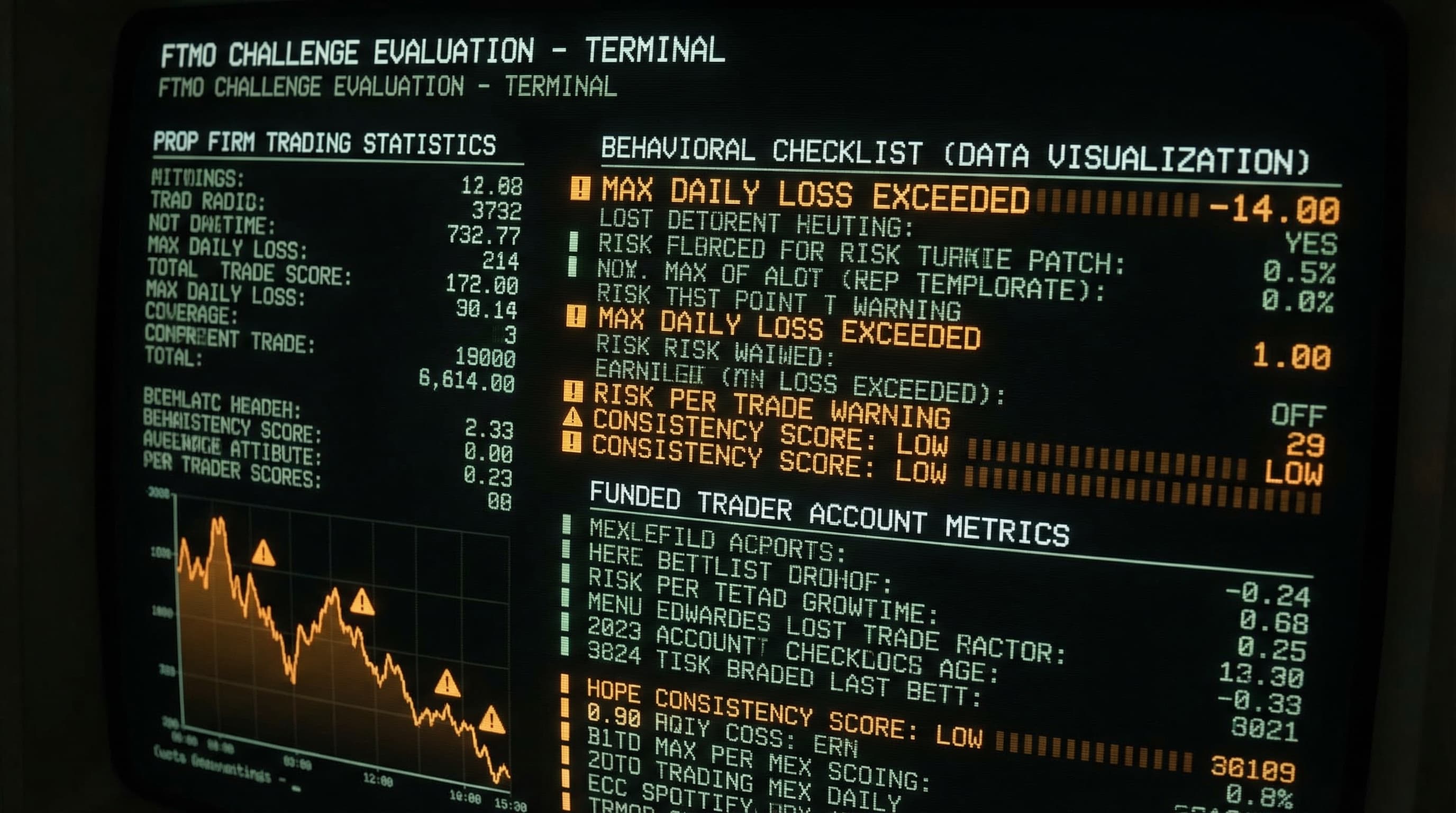
How to Pass the FTMO Challenge: The Behavioral Checklist That Actually Works

What the FTMO Challenge Actually Tests

Most traders approach the FTMO challenge as a strategy test. If their entries are good enough, they will pass. This framing is wrong, and it explains why technically competent traders fail repeatedly.

The FTMO challenge tests behavioral consistency under multiple simultaneous constraints: a profit target that creates urgency, a daily drawdown limit that creates anxiety, a maximum loss threshold that creates fear, and a consistency rule that flags overconcentration. These constraints do not evaluate your strategy. They evaluate how your decision-making changes when you have something real to lose.

Kahneman and Tversky's prospect theory (1979) established that people under real-stakes loss conditions make systematically different decisions than in simulated or low-stakes environments — specifically, they take more risk to avoid realizing a loss. This is exactly the behavior that terminates funded accounts. The trader who passes the FTMO challenge is not necessarily a better trader. They are a trader whose behavioral stability holds when the pressure is on.

The 5 Behavioral Patterns That Fail FTMO Accounts

Analysis of failed funded accounts — drawn from community disclosures, trading forums, and trader interviews — consistently reveals five behavioral patterns.

Revenge trading after daily drawdown approaches: A trader takes a morning loss, gets close to the daily limit, and then takes a larger afternoon trade to recover. The afternoon trade breaks the daily limit. This pattern appears in the majority of FTMO account terminations.

Late-evaluation sizing: As the evaluation deadline approaches with the profit target not yet hit, lot sizes increase. The trader is trying to compress time. Larger lots mean each adverse move hits the maximum loss faster.

Session extension past planned cutoff: On days running behind the profit curve, traders extend sessions into unfamiliar market hours, taking trades they would not normally take. Fatigue compounds behavioral risk.

Consistency rule gaming attempts: Traders try to front-load profits or smooth them artificially. These attempts often violate the consistency rule by accident.

Abandoning the strategy under pressure: Three consecutive stop-outs trigger a methodology switch. The new approach is being tried with real evaluation stakes for the first time.

The Pre-Evaluation Behavioral Audit

The highest-leverage thing you can do before paying for an FTMO evaluation is audit your existing trade history for the five failure patterns. You want to know, from real trade data, whether these behaviors exist in your trading — before they cost you evaluation fees.

The audit requires at least 60–90 days of trade history from your personal or paper account. For each of the following, compute a specific number, not a feeling:

Revenge trade rate: What percentage of your trades were taken within 15 minutes of a stop-out? What was the win rate on those trades compared to your baseline?

Session extension behavior: On days where you started with a loss, how often did you extend beyond your planned session cutoff? What was your win rate in the extended portion?

Sizing consistency: What is the standard deviation of your lot sizes across sessions? Does size variance increase on losing days?

Strategy deviation rate: What percentage of trades fully met your entry criteria? What was the difference in expectancy between full-criteria and partial-criteria trades?

If any of these metrics show material degradation under adverse conditions, that is your FTMO failure pattern — and it needs to be fixed before the evaluation, not after.

Daily Rules for the Evaluation Period

The traders who consistently pass FTMO challenges apply the same operational rules regardless of where their P&L sits.

Hard daily cutoffs at 60%: Stop trading when you hit 60% of the maximum daily loss — not 100%. This leaves margin for the account to breathe and prevents a single bad session from ending the challenge.

Mandatory break after stop-outs: After any trade that stops out, take a minimum 20-minute break before re-entering the market. This is not about discipline in the abstract — it is about allowing the neurological arousal response to loss to subside before your next decision.

No sizing changes during the evaluation: Your lot size should be fixed for the evaluation period based on account size and risk percentage. Not adjusted based on how the challenge is going. Sizing changes under evaluation pressure are almost always driven by urgency, not by legitimate volatility differences.

Evaluation-end buffer: In the final three days of the evaluation period, if you have already hit the profit target, stop trading. If you are short of the target with three days left and it is mathematically unlikely, stop. Late-evaluation panic trading fails more accounts than any other single behavior.

How to Use Trade Data to Prepare for Your FTMO Evaluation

The most effective FTMO preparation is running a behavioral audit on your existing trade history before you pay for the evaluation. The data will tell you what your gut cannot: whether your decision quality degrades under the specific conditions FTMO imposes.

Tiltless Edge Lab runs the behavioral audit automatically against your connected trade history. It identifies revenge sequences (rapid entries after losses), position size variance by account state, session extension patterns on losing days, and setup deviation rates — all with statistical significance testing so you know which patterns are real and which are noise.

The daily briefing gives you a behavioral score at the start of each session. The tilt score tells you your behavioral state going into the day based on recent data, not feelings. If you enter an FTMO session with a high tilt score from the previous day, you have evidence-based grounds for reducing size or taking the day off — before the evaluation fees make that information expensive. Free to start, no credit card required.

Related Resources

FAQ

?What percentage of traders pass the FTMO challenge?

FTMO does not publish official pass rates. Community-aggregated data suggests challenge pass rates between 5% and 15% depending on challenge size and market conditions. More significantly, funded-account retention beyond 90 days is estimated below 10% — meaning the majority of traders who pass the evaluation still lose their funded status within three months.

?Why do traders fail FTMO even with a good strategy?

The FTMO structure tests behavioral stability under pressure, not strategy quality. A good strategy executed with panic position sizing, revenge trading after losses, or late-session desperation entries will fail the daily drawdown limit or consistency rule. The strategy is fine. The behavior under constraint is the variable that determines evaluation outcomes.

?How long should I trade a personal account before attempting FTMO?

Long enough to accumulate 60–90 days of real trade history that you can audit for behavioral failure patterns. You need at least 30 instances of each behavioral category (trades after losses, extended sessions, sizing on losing days) to draw statistically meaningful conclusions. Most active traders hit this within 4–8 weeks.

?Does Tiltless work with FTMO accounts?

FTMO provides demo accounts for evaluation trading. These can be connected to Tiltless via supported platform import (MT4/MT5 export, or direct broker API where available). The behavioral analysis applies regardless of whether the account is funded or in evaluation — the patterns Tiltless detects are account-type agnostic.

Run Your Pre-Evaluation Behavioral Audit

Connect your existing trade account and see the behavioral patterns that would fail the FTMO consistency rules — before you pay $150–400 to find out.

How to Pass the FTMO Challenge: The Behavioral Checklist | Tiltless