
Updated: 2026-03-06

Forex Trading Journal: Track Currency Pairs, Sessions, and Behavioral Patterns

Forex trading has a distinct problem that other markets do not: the market runs 24 hours a day, five days a week, across three major sessions with completely different liquidity and volatility profiles. A forex trader who works only during the London-New York overlap is trading a fundamentally different instrument than the same trader working the Asian session — different spreads, different participation, different behavioral demands. A forex trading journal that ignores session structure is capturing data without context. This guide covers what forex traders specifically need to track, which behavioral patterns dominate forex accounts, and how to build a journal that maps to how currency markets actually work.
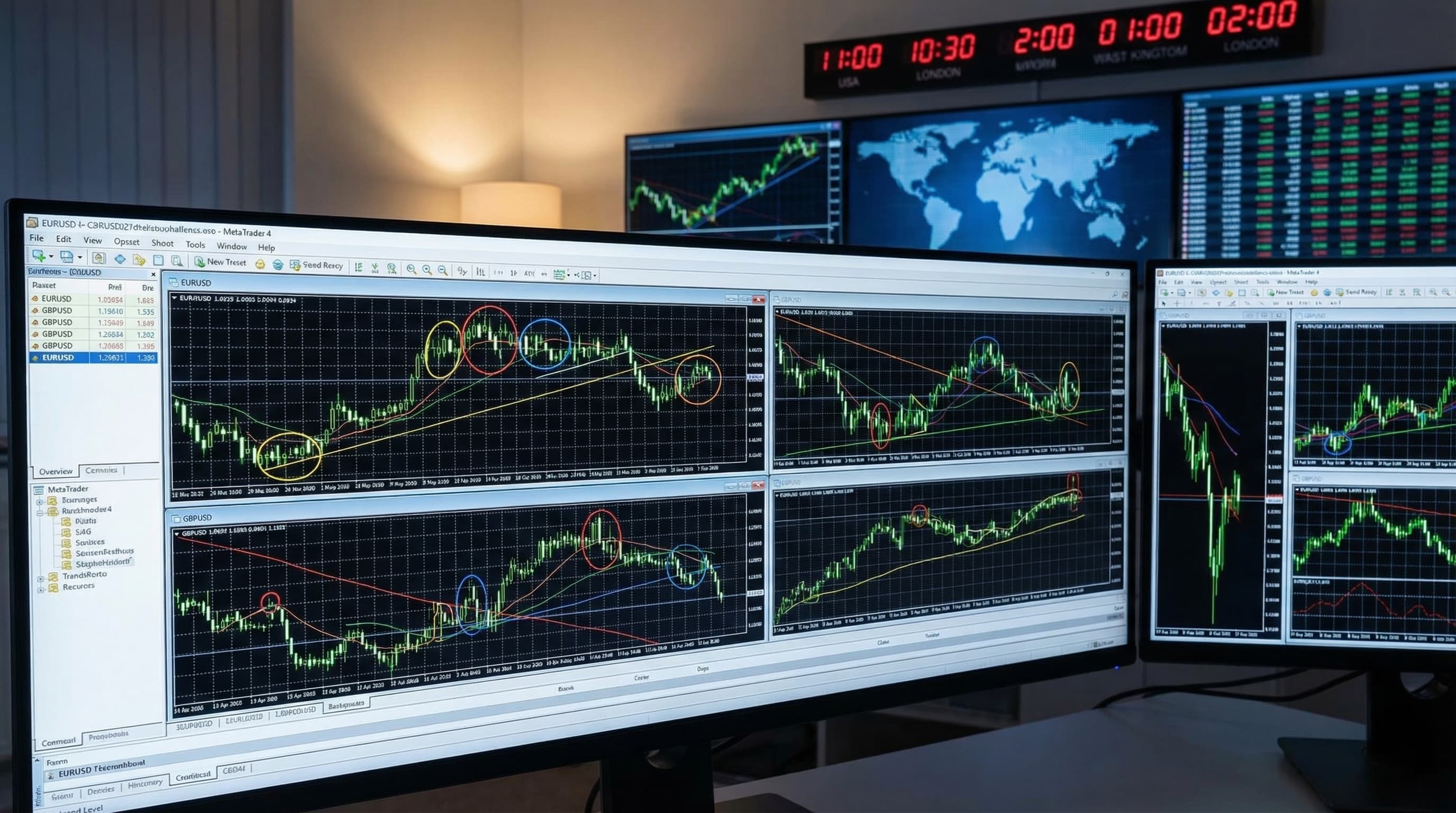
Forex Trading Journal: Track Currency Pairs, Sessions, and Behavioral Patterns

Why Forex Trading Requires Session-Aware Journaling

Currency markets have three primary sessions: Asian (Tokyo), European (London), and North American (New York). Each has distinct characteristics.

The Asian session (00:00-09:00 UTC) is characterized by lower volatility, range-bound price action, and dominance of JPY pairs. Spreads are wider, breakouts are more likely to fail, and momentum strategies underperform. Range and mean-reversion approaches have historically better outcomes.

The London session (07:00-16:00 UTC) is the highest-volume forex session, accounting for roughly 35% of daily turnover. Major pairs have tight spreads, institutional participation is highest, and breakout and trend strategies outperform. The London open is the most important daily price event for EUR, GBP, and CHF pairs.

The London-New York overlap (13:00-16:00 UTC) is the highest-volatility window of the week. It is also where most retail forex traders lose money — not because their strategies are wrong for this period, but because they bring Asian-session range-trading habits into a breakout-trending environment and vice versa.

A forex journal that does not tag each trade with its session has no way to identify this mismatch.

Metrics Forex Traders Must Track

A complete forex journal captures these fields on every trade:

  • Currency pair: EURUSD, GBPUSD, USDJPY, AUDUSD, etc. Win rate and average R vary significantly by pair — most traders have an edge on 2-3 pairs and give it back on the rest
  • Session at open: Asian, London, NY, or London-NY overlap. The single most important segmentation axis for forex traders
  • Entry time (UTC): precise timestamp, not just 'morning' or 'afternoon'. Allows granular session analysis
  • Spread at entry: the bid-ask spread paid at execution. For scalpers and short-term traders, spread cost is a material fraction of the trade's expected value
  • Lot size and account risk percentage: position size as a fraction of account equity at the time of entry. Inconsistent sizing is the most common forex trader error
  • Setup type: breakout, trend continuation, range fade, news trade, session open play, support/resistance level. Required for strategy-level analysis
  • Fundamental catalyst: whether the trade was taken around a scheduled news event (NFP, CPI, FOMC, central bank decisions). News trades behave differently from technical trades
  • Pip stop and pip target: the stop distance and target in pips, not just dollars. Normalizes across different lot sizes and allows consistent R-multiple calculation

Session Analysis: The Core Forex Journal Insight

The highest-value analysis in a forex journal is win rate and average R segmented by session. This is where most forex traders discover their actual edge — and where they discover they are actively destroying it.

The typical pattern that appears in forex journal data: a trader has a genuine edge during the London session (62% win rate, average R of 0.8) that evaporates completely during the Asian session (44% win rate, average R of -0.3). Net result: the profitable London trades are offset by the unprofitable Asian session trades. The total P&L looks roughly breakeven or slightly negative. The solution is not a better strategy — it is simply stopping Asian session trading.

This specific diagnosis is only available if you have session-tagged trade data. Without it, the trader sees a 50% win rate and searches for strategy improvements that do not exist.

Behavioral Patterns Specific to Forex Traders

Forex creates behavioral patterns distinct from equities or crypto:

  • News event overtrading: trading immediately before or during high-impact events (NFP, CPI) where spreads widen and fill quality deteriorates. Win rate during news windows is typically 15-25% lower than non-news periods, but the psychological pull of 'big moves' is strong
  • Sunday gap trading: the market reopens each Sunday with a gap from Friday's close. Many traders try to trade the Sunday gap fade without accounting for the reduced liquidity and wider spreads of the Asia open — a structurally bad-EV trade
  • Account currency confusion: traders who measure P&L in pips rather than account currency misread their actual performance. A 30-pip win on 0.01 lots and a 30-pip win on 1.0 lot are reported identically in pip terms but differ by 100× in dollar impact
  • Revenge trading across sessions: taking a loss during the London session and continuing to trade into the NY session and Asia open trying to recover, progressively entering worse volatility environments with declining mental state
  • Correlation blindness: simultaneously holding EURUSD long and GBPUSD long treats them as independent trades, but both pairs are 75-85% correlated — the trader has effectively doubled their EUR exposure without recognizing it

Connecting Your Forex Broker to a Journal

Tiltless imports forex trading data from the major forex-capable platforms via CSV and statement exports:

  • MetaTrader 4 (MT4): Account History export as CSV — covers all spot forex trades, lot sizes, entry/exit prices, swap costs, and commission
  • MetaTrader 5 (MT5): Deals report export — same data with additional fields including execution quality
  • cTrader: Trade History export with full execution data
  • Interactive Brokers (IBKR): Flex Query with forex-specific field mapping including all spot and CFD forex instruments
  • Oanda, FXCM, Pepperstone, IC Markets: statement exports compatible with Tiltless import format
  • All major and minor pairs supported; exotic pairs tracked under the 'other' segment with full data captured

Spread Cost Analysis: What Most Forex Traders Ignore

Spread cost is the forex equivalent of commission — and for retail traders on variable-spread brokers, it is often more significant than they realize.

For a typical retail account trading EURUSD with a 1.2 pip average spread, a position with a 15-pip target needs to travel 16.2 pips in your favor just to break even. That changes the actual win rate needed for profitability significantly.

A forex journal that tracks spread at entry for each trade allows a spread-adjusted analysis: what is your win rate and average R after accounting for spread cost? Many strategies that appear profitable on a raw P&L basis are negative expected value once spread cost is factored in. This is particularly true for scalping strategies and high-frequency trading approaches on wider-spread brokers.

Spreads also vary by session — EURUSD during the Asian session averages 1.5-2.5 pips on retail brokers versus 0.5-0.8 pips during the London session. A complete forex journal shows whether you are consistently taking spread-heavy trades during low-liquidity periods.

Related Resources

FAQ

?What should I track in a forex trading journal?

Track: currency pair, session at entry (Asian/London/NY/overlap), entry time (UTC), spread at entry, lot size as account risk percentage, setup type, and any fundamental catalyst. The most important analysis is win rate and average R segmented by session — most forex traders have a genuine edge in one session that is offset by losses in others they should not be trading.

?Which forex broker formats does Tiltless import?

Tiltless imports from MT4 (Account History CSV), MT5 (Deals report), cTrader, IBKR Flex Query, Oanda, FXCM, Pepperstone, and IC Markets statement exports. All major and minor pairs are supported. Exotic pairs are tracked with full data under the 'other' segment.

?How do I calculate R-multiple for forex trades?

R-multiple = actual profit or loss ÷ initial risk (in account currency). Initial risk = lot size × pip stop × pip value. For a standard lot EURUSD trade with a 20-pip stop, initial risk is approximately $200. If the trade closes at +40 pips, R = +2. Tracking R-multiple rather than pips normalizes performance across different position sizes and makes strategy evaluation accurate.

?Should I journal forex trades taken during news events separately?

Yes. High-impact news events (NFP, CPI, FOMC, central bank decisions) create structurally different trade conditions: wider spreads, slippage, and whipsawing price action. If you take trades during these windows, tag them separately. Most traders who analyze their news trades find their win rate during news is 15-25% lower than their baseline — a specific, correctable behavioral pattern.

Track Your Forex Trades Automatically

Tiltless imports from MT4, MT5, cTrader, IBKR, and Oanda. Session analysis, spread cost tracking, and behavioral pattern detection — all automatic.

Forex Trading Journal: Track Sessions, Pairs, and Behavioral Edge | Tiltless