
Updated: 2026-03-06

Futures Trading Journal: Track Sessions, Behavior, and Edge

Futures trading is session-based, leverage-heavy, and behaviorally amplified. The same emotional patterns that cost a stock trader a few percent can cost a futures trader their account — not because futures traders are less disciplined, but because the instrument magnifies every decision. A futures trading journal that only tracks P&L is a ledger, not a journal. The journal that actually improves performance tracks session timing, leverage exposure, and the behavioral patterns that cluster around key futures market dynamics: the RTH open, the overnight session, rollover periods, and news events.
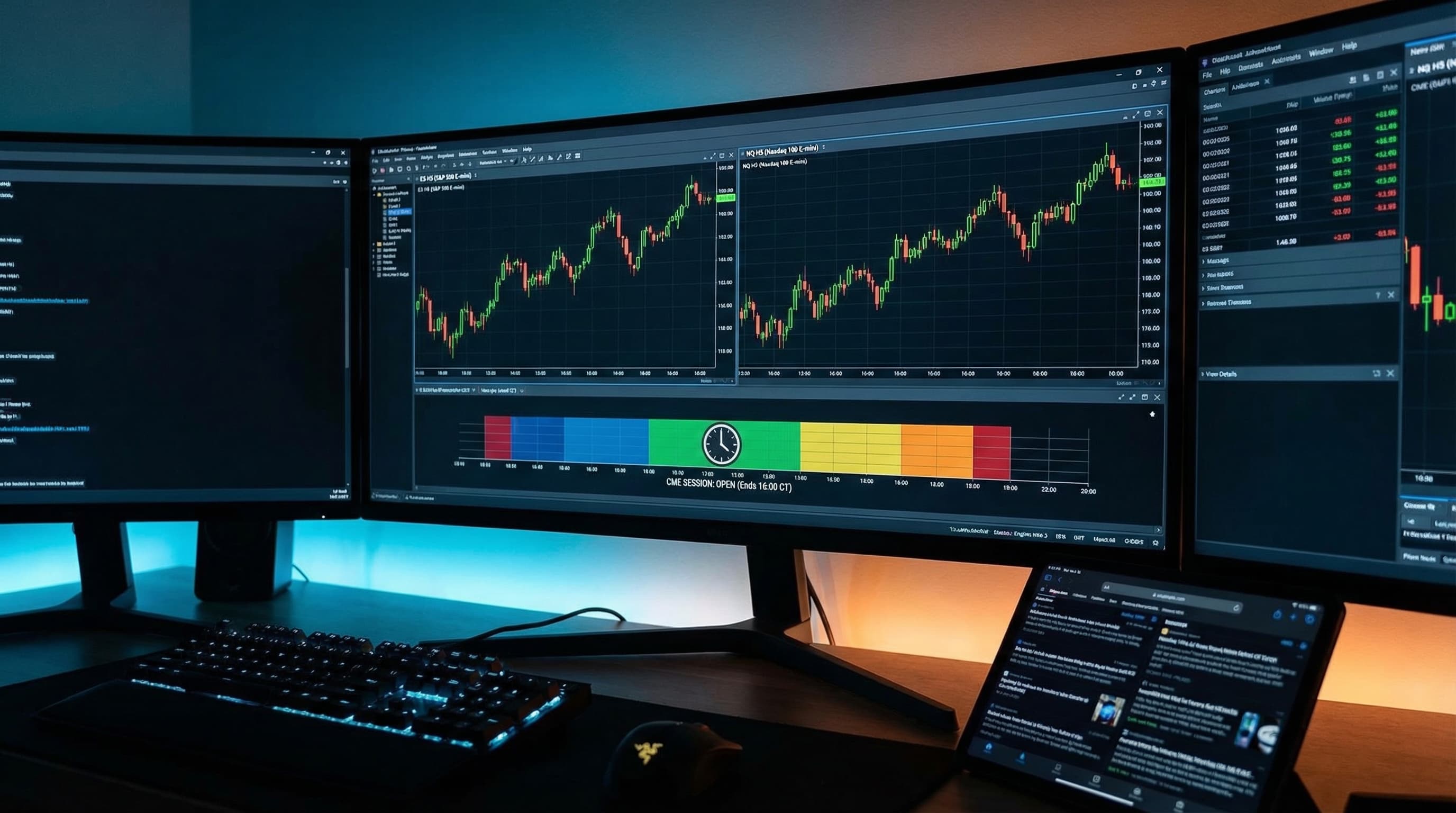
Futures Trading Journal: Track Sessions, Behavior, and Edge

Why Futures Trading Requires Different Journaling

Three characteristics make futures journaling structurally different from equities or crypto journaling.

Leverage exposure is the defining risk variable. A single ES contract controls $250,000 of notional value. At a $500 margin requirement, that is 500:1 effective leverage. Margin-to-notional ratio must be tracked explicitly — it determines whether your risk per trade is consistent or whether you are inadvertently taking 3× the risk on some trades.

Session structure creates timing patterns. The futures market has distinct behavioral regimes: the 9:30 ET RTH open (highest volatility), the 10:30-12:00 grind, the 13:00-14:30 consolidation, and the 15:00-16:00 close. Most futures traders have dramatically different win rates at different session times — but only discover this by tracking it.

Rollover creates calendar risk. Quarterly contract rollovers (ES, NQ, CL, GC) produce basis distortions and volume shifts. A journal must track the specific contract traded, not just the underlying.

Key Metrics Futures Traders Must Track

A complete futures journal captures these fields on every trade:

  • Contract: ES, NQ, RTY, MES, MNQ, CL, GC, ZB, etc. Micro vs. standard contracts produce different behavioral patterns due to size psychology
  • Session time: open time in ET. The most important segmentation axis — win rate at 9:31 vs. 10:45 vs. 14:30 reveals structural timing edges or leaks
  • Session type: RTH (regular trading hours) vs. overnight (globex). Fundamentally different characteristics requiring separate analysis
  • Notional exposure: contract multiplier × price × contracts. Normalizes P&L across trades with different contract sizes
  • Account margin used: percentage of account margin consumed. Tracks whether leverage is consistent across sessions
  • Setup tag: opening range breakout, VWAP reclaim, gap fill, trend continuation, reversal, news trade
  • Contract month: which quarterly contract was traded — critical during rollover weeks when both volume and basis behavior shift

Session Timing Analysis: Where Most Futures Traders Find Their Edge

The highest-value analysis in a futures journal is win rate and average P&L segmented by session time. This is the single data point that most directly improves futures trading performance.

The pattern that appears most frequently: traders have a strong edge in the first 90 minutes of RTH (9:30-11:00 ET), near-random or negative edge during 11:30-13:00, and recovering edge at 14:00-15:00. Yet most distribute their trades evenly throughout the day — losing money during their statistically worst period at the same frequency as their best.

With 100+ trades tagged by session time, you can set a specific rule: no trades between 11:30-13:30 ET. Discipline based on your own performance data is categorically different from discipline based on a rule you read in a trading book.

Overnight Gap Behavior and RTH Open Strategy

Overnight gaps create systematic behavioral patterns in futures traders. The most common traps:

Gap fade temptation: immediately shorting a gap higher before the market has established whether institutions are continuing the overnight trend or returning to prior value. Gap fades have better historical outcomes when the gap is small (under 0.3% of underlying) and the overnight session was orderly.

Chasing the gap fill: going long after a lower open expecting a fill, without checking whether the overnight session established new support or whether the gap is a continuation signal.

A futures journal tracking overnight high/low at the time of each RTH trade shows clearly which patterns are costing you the most.

Leverage Amplification and Revenge Trading in Futures

Revenge trading in futures is more destructive than in any other market because leverage amplifies position size, not just the emotional impulse.

Common pattern: trader loses 2 ES points ($100/contract), then doubles size on the next trade trying to recover — now risking $200/contract on a trade made with worse emotional clarity. The math means a 2-point stop on a 2-contract position only recovers the dollar amount of the original loss, not the psychological sense of resolution.

Tiltless behavioral scoring tracks the sequence of position sizes across consecutive trades. Increasing size after losses — the signature of revenge trading — triggers an alert before the drawdown compounds. For futures traders, where a single bad sequence can produce multi-thousand dollar drawdowns in minutes, this behavioral detection is the highest-value feature of automated journaling.

Connecting Your Futures Broker to a Journal

Tiltless imports futures trade data from the major futures platforms:

  • Thinkorswim (TD Ameritrade/Schwab): futures activity via Account Statement CSV including ES, NQ, RTY, CL, GC, and all CME/CBOT products
  • NinjaTrader: trade performance export compatible with Tiltless import format
  • Interactive Brokers (IBKR): Flex Query with futures-specific field mapping for all global exchanges
  • Tradovate: CSV export with contract, session, and fill data
  • Topstep, Apex, FTMO: prop firm funded account exports for traders in evaluation or funded phases
  • All micro contracts (MES, MNQ, MYM, M2K) recognized alongside standard contracts

Futures Journaling for Prop Firm Traders

Prop firm futures traders must track performance not just for profitability but for drawdown rule compliance. Most funded accounts have daily loss limits, maximum trailing drawdown, and consistency rules.

The behavioral patterns that cause prop firm failures: revenge trading after hitting 50% of the daily loss limit, size escalation near the end of evaluation period, and over-trading during low-conviction sessions.

A futures journal tracking trades against rule boundaries — current P&L vs. daily limit, current drawdown vs. maximum trailing drawdown — makes these failure patterns visible before they become account-ending. Tiltless shows real-time rule exposure for prop traders who import their funded account data.

Related Resources

FAQ

?What should I track in a futures trading journal?

Track: contract (ES, NQ, MES, etc.), session time in ET, session type (RTH vs. overnight), notional exposure, setup tag, and exit reason. The single most valuable analysis is win rate and average P&L by session time — most futures traders have dramatically different performance across session windows and only discover this through journal data.

?Which futures brokers does Tiltless support for import?

Tiltless imports futures data from Thinkorswim, IBKR (Flex Query), NinjaTrader, Tradovate, and prop firm formats including Topstep and Apex. All CME, CBOT, NYMEX, and COMEX products are supported including ES, NQ, RTY, CL, GC, ZB, and all micro contracts.

?How does session timing analysis work for futures traders?

Tiltless logs the open time of each futures trade and segments your performance by 30-minute session windows. After 50+ trades, patterns become visible: win rate during 9:30-10:00 vs. 11:30-13:00 vs. 14:00-15:00. Most futures traders have a strong statistical edge in one or two windows and near-random or negative edge in others.

?Can I use Tiltless for a prop firm evaluation account?

Yes. Import your prop firm evaluation trades via the broker export format. Tiltless tracks behavioral patterns — revenge trading sequences, size escalation, over-trading signals — that are the primary causes of prop evaluation failures. Topstep and Apex account statements can be uploaded directly.

Track Your Futures Trades Automatically

Tiltless imports from Thinkorswim, IBKR, NinjaTrader, and Tradovate. Session timing analysis, behavioral scoring, and prop firm drawdown tracking — all automatic.

Futures Trading Journal: ES, NQ, CL Behavioral Tracking | Tiltless