Updated: 2026-03-07

How to Backtest a Trading Strategy: A Practical Guide for Active Traders

Every trader has backtested a strategy that looked perfect on paper and then lost money in real trading. The backtest showed a 70% win rate and 3:1 risk/reward. The live account showed something entirely different. This happens because most traders backtest incorrectly — they cherry-pick their test period, curve-fit their parameters, ignore execution costs, and confuse historical pattern-fitting with actual predictive edge. This guide covers how to backtest a trading strategy correctly, what common mistakes to avoid, and how to use your trading journal to validate whether your backtest results hold in live markets.

How to Backtest a Trading Strategy: A Practical Guide for Active Traders

What Backtesting Is — and What It Cannot Tell You

Backtesting is the process of applying a set of trading rules to historical price data to simulate what would have happened if you had followed those rules in the past. It is a necessary step in strategy development. It is not sufficient on its own.

What backtesting can tell you: Whether a set of rules would have produced positive expectancy on a specific dataset over a specific time period. Whether the rules are internally consistent (they can be defined precisely enough to apply systematically). Roughly what the drawdown characteristics of the strategy look like under historical conditions.

What backtesting cannot tell you: Whether the edge will persist in future market conditions. How you will execute the strategy under real psychological pressure. Whether the market conditions in your test period are representative of current conditions. How your performance will differ from the simulation due to execution, slippage, and real-time decision-making.

According to a study by Harvey, Liu, and Zhu published in The Review of Financial Studies (2016), more than half of all published backtested trading strategies fail to deliver their promised returns in live trading. The researchers attributed this primarily to overfitting — strategies that are tuned to fit historical data rather than capture a genuine market inefficiency.

The right mindset for backtesting: treat it as hypothesis generation, not proof. A backtest tells you 'this rule set had positive expectancy on this dataset.' Your job is then to figure out whether that pattern reflects a persistent market inefficiency or a historical artifact.

  • Backtesting reveals historical pattern-fit, not future performance guarantee
  • Overfitting is the primary reason backtested strategies fail live — avoid parameter optimization on the same data you test on
  • Execution costs (slippage, commissions, spread) must be included or results are meaningless
  • Treat backtests as hypothesis generators, not proof of edge

The Correct Backtesting Process

Step 1 — Define the rules precisely before looking at data. Write down your entry criteria, exit criteria (both profit target and stop loss), position sizing rules, and any filters (time of day, market condition, volatility threshold). Vague rules cannot be backtested reliably. 'Buy when RSI is oversold' is not a rule. 'Buy at the next bar open when the 14-period RSI closes below 30 on a 15-minute chart, with a stop 1 ATR below the entry bar low and a target 2 ATR above entry' is a rule.

Step 2 — Split your data into training and test sets. This is the most commonly skipped step and the most important. Use 60-70% of your available historical data to develop and tune your rules. Reserve the remaining 30-40% as an out-of-sample test set that you do not touch during development. Only run your final rules against the test set once. If you evaluate your rules against the full dataset, you will inevitably overfit — you will find rules that work on that specific data, not rules that capture a persistent edge.

Step 3 — Include all execution costs. Your backtest must account for commissions, spread (the difference between bid and ask), and slippage (the difference between the price you expected to fill at and the price you actually filled at). For high-frequency strategies, slippage alone can eliminate a marginally positive backtest. Use conservative estimates — assume fills at worse than the mid-price, especially for limit orders in illiquid markets.

Step 4 — Run on out-of-sample data. Once your rules are finalized, run them against the test set you held back. If performance degrades dramatically on the test set compared to the training set, the strategy is likely overfit. A robust edge should hold reasonably well on both sets.

Step 5 — Forward test before risking real capital. Paper trade or trade minimum size for 50-100 trades before committing full capital. A live forward test validates that you can actually execute the rules in real-time — something no backtest can confirm.

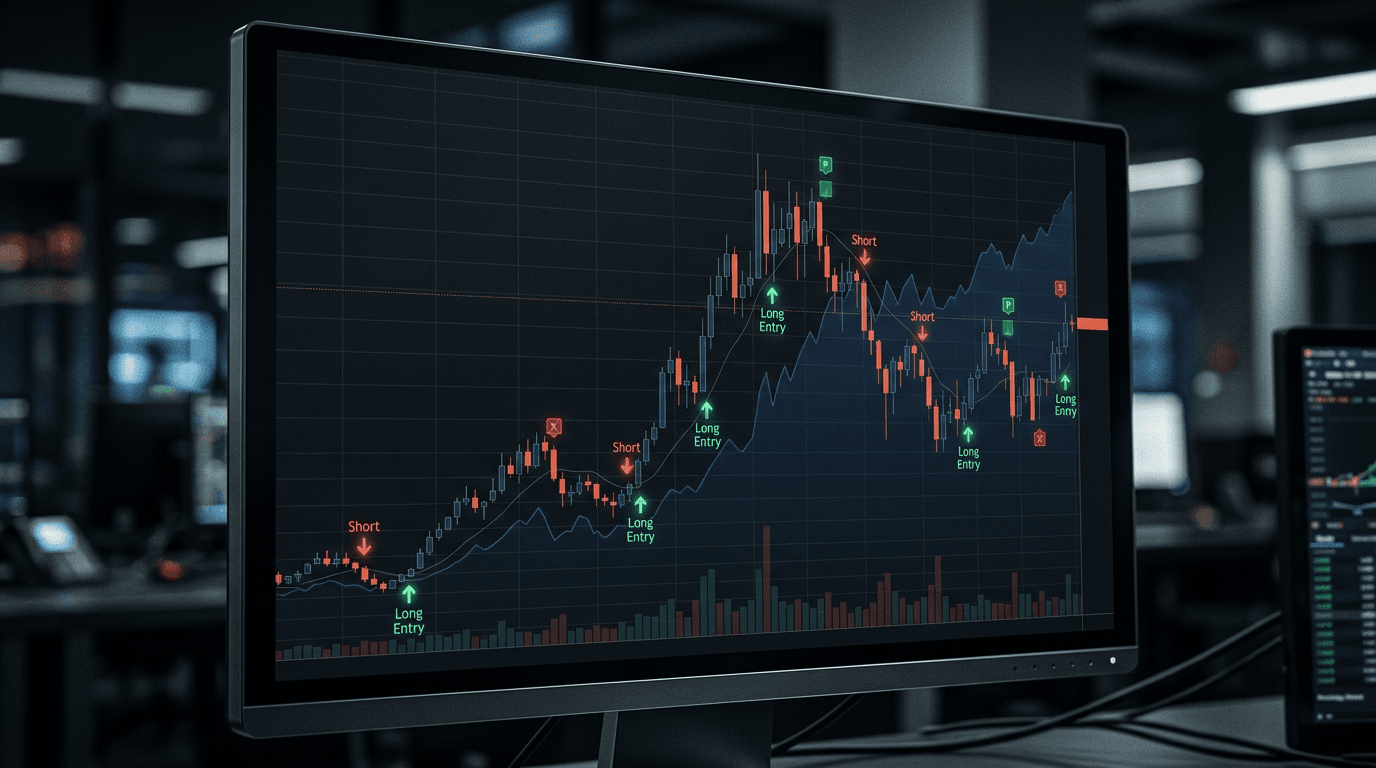
  • Write precise rules before looking at data — vague rules produce unreliable backtests
  • Split data: 60-70% training, 30-40% out-of-sample test held back until final validation
  • Include commissions, spread, and slippage — missing these makes results meaningless
  • Validate on out-of-sample data before trusting any backtest result

The Most Common Backtesting Mistakes

Look-ahead bias: Using information in your rules that would not have been available at the time of the trade. A common example: using closing price to trigger a trade that executes at the closing price. In real trading, you cannot know the closing price until the bar is closed, at which point you can only trade at the next bar's open. Look-ahead bias systematically overstates backtest performance.

Survivorship bias: Testing a strategy on current market constituents without accounting for companies (or coins, or contracts) that went bankrupt, delisted, or dropped out of the relevant index during your test period. A backtest on the current S&P 500 components using historical data implicitly includes only the survivors — the companies that made it. The strategy would have looked worse if you had included the companies that failed.

Overfitting / curve-fitting: Adjusting your rules, parameters, or filters until the backtest looks good, then treating that as validation. Every additional parameter you optimize gives the strategy more degrees of freedom to fit the historical data — and less likelihood of holding out of sample. A strategy with 3 parameters that produces 60% win rate is more trustworthy than a strategy with 15 parameters that produces 75% win rate.

Ignoring regime changes: A strategy that worked in a trending market from 2019-2021 may not work in a mean-reverting market in 2022-2024. Markets cycle between regimes. Testing only on a favorable regime produces false confidence. Test across multiple market conditions — trending, choppy, high-volatility, low-volatility — to understand the strategy's behavior across the cycle.

  • Look-ahead bias: using information not available at trade time inflates results
  • Survivorship bias: testing on current constituents ignores historical failures
  • Overfitting: each additional parameter increases historical fit and reduces future validity
  • Regime change: a strategy that worked in one market condition may not work in another

Using Your Trading Journal to Validate Backtest Results

A trading journal bridges the gap between backtest simulation and live performance. After you have backtested a strategy and begun forward testing, your journal becomes the validation mechanism.

Tag every trade with the strategy or setup it belongs to. After 50+ live trades, compare your live win rate, average R, and expectancy to the backtest projections. A well-designed strategy should show live results within a reasonable range of the backtest — not identical, but in the same order of magnitude.

Track execution quality separately from strategy quality. If your backtest assumed fills at the mid-price and your live trades are filling at worse prices, that is an execution problem, not a strategy problem. Your journal should separate these: did the setup appear correctly (strategy) and did you execute the plan (execution)?

Identify the gap between backtest and live performance. The most common causes of underperformance relative to backtest: worse-than-modeled execution, trading outside the strategy's defined conditions (the setup appeared but it was not a clean example), and psychological deviation (you scaled out early, moved your stop, or did not take the signal because you were anxious). A journal with behavioral tagging makes these causes visible.

  • Tag every live trade by strategy/setup to compare live vs. backtest expectancy
  • Separate execution quality from strategy quality in your review
  • Track psychological deviations (early exit, stop movement) as a separate performance category
  • 50+ live trades required before drawing meaningful comparisons to backtest results

Related Resources

FAQ

?How many trades should a backtest have to be statistically meaningful?

A minimum of 100-200 trades across a variety of market conditions before drawing conclusions. Fewer trades have too much variance — a 70% win rate on 20 trades is consistent with chance. The more trades and the more varied the market conditions, the more confidence you can place in the result.

?What is the best software for backtesting trading strategies?

For manual backtesting: TradingView's strategy tester, Thinkorswim's ThinkScript backtester. For systematic/code-based backtesting: Python with Backtrader, vectorbt, or Zipline. For professional multi-asset testing: Quantlib, Lean (by QuantConnect). The right tool depends on whether your strategy is rules-based and automatable or requires discretionary judgment.

?Can you backtest discretionary trading strategies?

Only partially. Discretionary strategies involve context-dependent judgment that cannot be fully codified into rules. You can manual backtest by reviewing historical charts and recording what you would have done at each point — but this is subject to hindsight bias. The best validation for discretionary strategies is a forward test with detailed journaling.

?Why do backtested strategies fail in live trading?

The primary reasons are: overfitting to historical data, execution costs that were underestimated, market regime changes between the test period and live trading, and psychological factors (inability to follow the rules under real P&L pressure). The last factor is never captured by a backtest and must be addressed through a forward test with a trading journal.

?How do I know if my backtest results are curve-fitted?

Run the final rules on an out-of-sample test set you held back during development. If performance drops dramatically on the test set, the strategy is likely curve-fitted. Also check: how many parameters were optimized? More than 3-4 parameters on fewer than 500 trades is a warning sign. Test on multiple market regimes — a robust edge should work in trending and choppy conditions, not just one.

Validate your strategy with real data

Tiltless compares your live trading results to your expectations — surfacing where your execution diverges from your strategy and helping you close the gap between backtest and reality.

How to Backtest a Trading Strategy: Step-by-Step Guide for Traders