
Updated: 2026-03-07

Trade Management Strategies: The 60% of Trading Most Traders Ignore

Most traders spend 90% of their preparation time on entries: the setup, the trigger, the entry price. They spend almost no time thinking systematically about what happens after they enter. This is backwards. According to trade-level analysis of active retail traders, entry quality accounts for roughly 40% of P&L variance. Trade management — the decisions made after entry — accounts for the remaining 60%. The trader who identifies the right direction but manages the trade poorly will be a losing trader. The trader who has a mediocre entry but manages the trade with precision will compound profits over time. Trade management is also where most behavioral patterns express themselves most destructively. FOMO, tilt, and revenge don't usually cause bad entries — they cause bad management of otherwise valid positions.
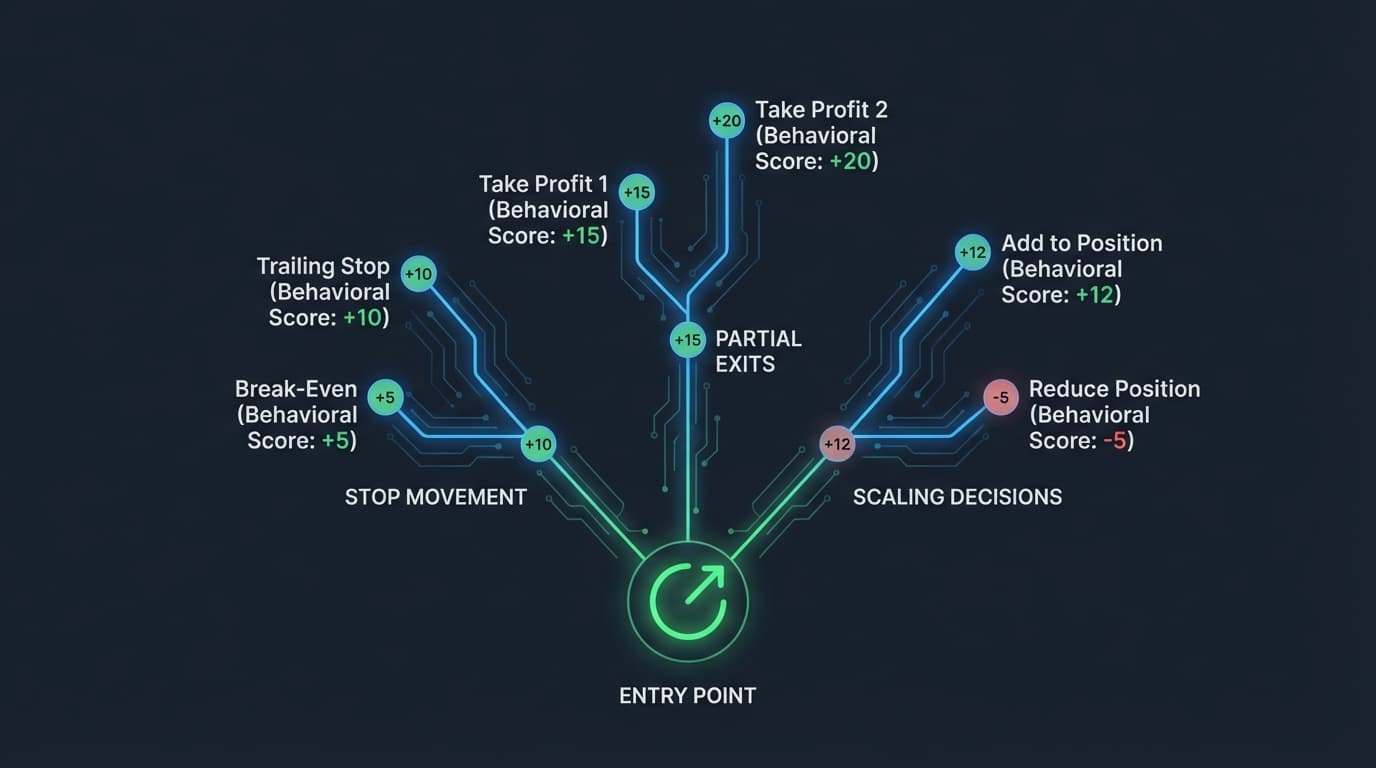
Trade Management Strategies: The 60% of Trading Most Traders Ignore

The 5 Trade Management Styles and Their Behavioral Profiles

There is no universally correct way to manage a trade. The right approach depends on your strategy, your psychological profile, and your market. But these are the five most common management styles, each with distinct behavioral strengths and failure modes.

**1. Set and forget** Stop and target defined at entry. No adjustments. Trades run to completion or stop out. *Behavioral strength:* Eliminates management decisions and the emotional errors they create. *Failure mode:* Misses the flexibility to react to changing market structure.

**2. Trail and scale** Partial profit taking at 1R, trail remaining position to breakeven, let runner work. *Behavioral strength:* Removes initial loss risk on remaining position, reduces anxiety. *Failure mode:* Runners frequently get stopped out at breakeven before target is hit.

**3. Time-based exit** Close position at a defined time if target not reached (e.g., EOD, end of session). *Behavioral strength:* Eliminates overnight risk, forces clarity. *Failure mode:* May close positions exactly before they move.

**4. Structure-based trail** Move stop only on new swing highs/lows, not by time or ATR. *Behavioral strength:* Lets the market define the exit rather than arbitrary levels. *Failure mode:* More complex to execute consistently; prone to moving stops on minor structure.

**5. Full discretion** Manage each trade based on in-the-moment read. *Behavioral strength:* Maximum flexibility. *Failure mode:* Maximum exposure to emotional decision-making.

Where Behavioral Patterns Show Up in Trade Management

Entries are made in advance, with a plan, usually with lower emotional stakes. Management decisions are made in real time, with money on the line, often under stress. This is why behavioral patterns dominate trade management.

**FOMO in management:** The position is working. The move is accelerating. You add to the position beyond your planned size because you don't want to 'miss' more of the move. This is FOMO applied not to entries but to scaling decisions — and it produces some of the largest single-trade losses traders experience, because the oversized position reverses.

**Tilt in management:** A losing trade is at the stop. Instead of taking the loss, you move the stop wider because you 'know' the trade will work. This is the most expensive behavioral pattern in trading — a mechanical violation that converts defined-risk trades into undefined-risk catastrophes.

**Revenge in management:** After a stopped-out trade, you immediately re-enter the same setup at a worse price, often without a defined stop, trying to get back the loss in the same instrument. The management logic of this new trade is entirely emotional.

**Fatigue in management:** Late-session positions get managed sloppily — stops moved arbitrarily, partials taken too early or not at all, positions held past their original timeframe because closing them requires a decision and decisions are cognitively expensive when tired.

  • Log every stop move: was it based on structure/plan or emotion?
  • Track every early exit: did the trade hit target after you closed?
  • Log every add-on: was it planned or driven by FOMO?
  • Review management decisions separately from entry quality

How to Build a Trade Management Plan That Survives Real Markets

A trade management plan made before the position is entered is more reliable than a decision made with money on the line.

The minimum viable management plan for any trade:

**Stop:** Where exactly is my initial stop? At what technical level is the trade invalid?

**Partial target:** At what price will I take partial profit? What percentage of the position?

**Stop adjustment trigger:** What specific condition (price level, pattern, time) would cause me to move my stop to breakeven or trail?

**Maximum hold time:** If my target isn't hit by X time, what do I do?

**Add-on rules (if applicable):** Under what exact conditions would I add to this position? What is my maximum total position size?

Write these down before entering. The purpose isn't to make the plan rigid — it's to make deviations from the plan visible. Every deviation from a written plan is a data point. Over time, you can analyze whether your deviations help or hurt your average outcome in each scenario.

Using Session Replay to Review Trade Management Decisions

The most effective way to improve trade management is to review your management decisions in detail, not just your entry/exit prices.

A standard trade review looks at: entry price, exit price, P&L. It answers 'what happened.'

A management review looks at: entry price, every stop move with timestamp, every partial exit with timestamp, final exit, and compares the outcome of your actual management to what would have happened with your original plan. It answers 'how did your decisions change the outcome.'

The second review is significantly more valuable — and significantly harder to do without tooling that shows you the trade timeline with every management action marked.

Tiltless session replay shows every trade in a session with the full management timeline: entry, each stop adjustment, each partial exit, final exit. The behavioral score overlay shows what your tilt and FOMO scores were during each management decision. Patterns that are invisible in a P&L report become obvious when you can see that your stop-moving consistently happens when your tilt score is above 6.

Related Resources

FAQ

?Should I use a trailing stop or a fixed target?

This depends on your strategy and psychological profile. Fixed targets are better for systematic traders and those prone to greedy management decisions. Trailing stops are better for momentum strategies where capturing large moves matters more than winning percentage. The key question is: which approach produces better expectancy in your specific trade history? That's a data question, not a preference question.

?What is the most common trade management mistake?

Moving the stop loss wider to avoid taking a loss. This converts a defined-risk trade into an undefined-risk trade and is the single most financially dangerous behavioral pattern in active trading. The loss that was manageable with the original stop becomes catastrophic when the stop is moved repeatedly. Tiltless session replay shows every stop move — traders who review this data almost universally discover they move stops more often than they consciously remember.

?How do I know if my trade management is helping or hurting my results?

Compare your actual results to what would have happened with your original plan. If you had taken every trade to its original stop and target without modification, would you have made more or less money? This 'management delta' analysis reveals whether your in-trade decisions are adding or subtracting value. Most traders who run this analysis are surprised by how much their discretionary management hurts their results.

?How can I track my trade management decisions in a journal?

Log every stop move with the reason (structure-based vs. emotional), every early exit with the outcome (did the trade hit target after you closed?), and every add-on with whether it was pre-planned. Tiltless session replay automates this tracking — every management action is captured with timestamp and behavioral context.

Review your trade management decisions

Tiltless session replay shows every management decision you made with behavioral context — and whether those decisions helped or hurt your outcome.

Trade Management Strategies | How to Manage Trades After Entry