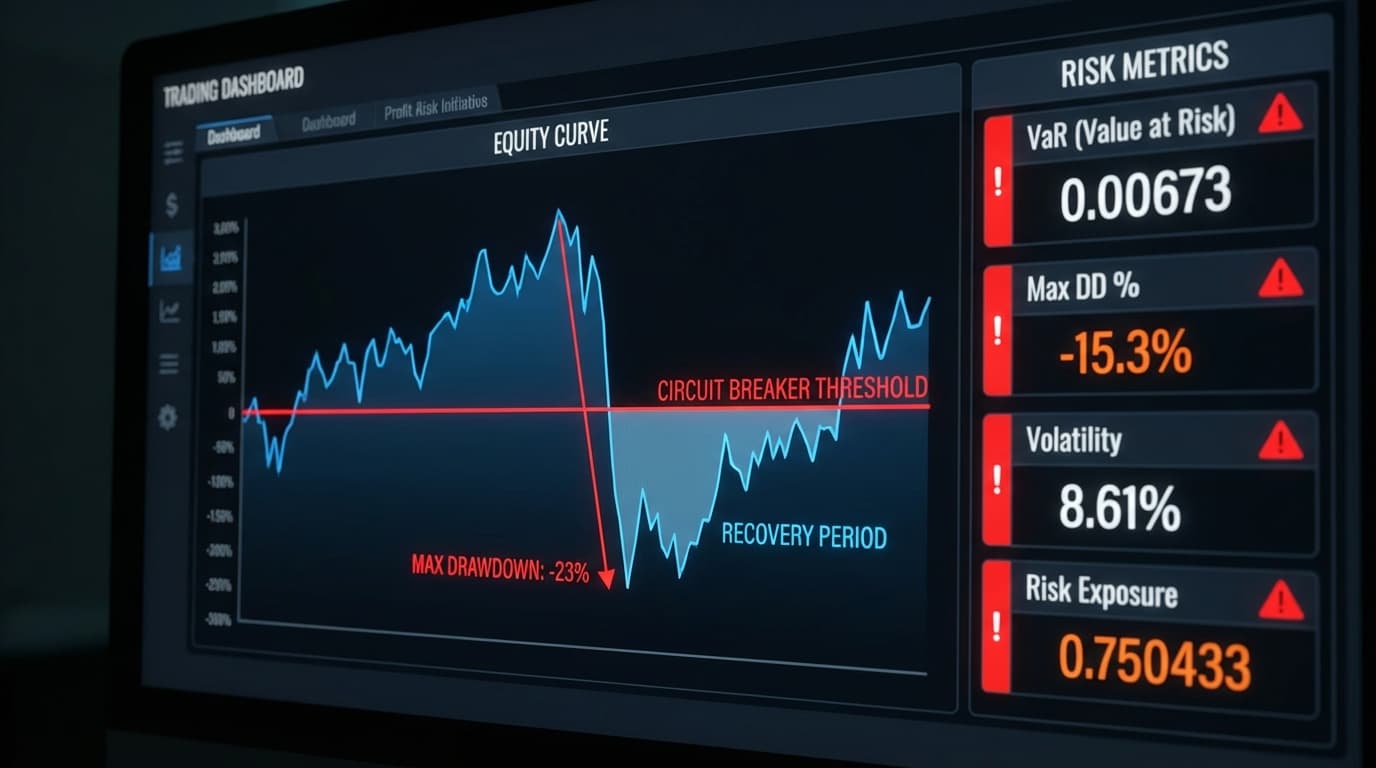
The most actionable application of max drawdown is not measuring it after the fact — it is using it as a real-time circuit breaker before a bad day becomes a bad month.
A drawdown circuit breaker is a pre-committed rule that triggers a change in behavior (reduced size, trading pause, or full stop) when a defined drawdown threshold is hit. The rule must be defined in advance, when you are thinking clearly — not in the moment when you are down and tempted to recover losses.
A practical three-tier circuit breaker system works as follows. At Tier 1, when you reach 50% of your daily max loss, cut position size by 50%, slow down, and only take high-conviction setups. At Tier 2, when you hit 100% of your daily max loss, stop trading for the day, log the session, and review what happened before tomorrow's open. At Tier 3, if your account drawdown hits 50% of your weekly max loss mid-week, step back and review your week before continuing — consider whether the market environment has changed or whether your psychology is compromised.
For monthly or rolling drawdown, a common professional protocol is: if your account drawdown exceeds 50% of your historical max drawdown, reduce all position sizes by 30-50% until you have recovered. This prevents a drawdown from spiraling into a new, larger one.
The psychological value of a circuit breaker is as important as the financial protection. Knowing that you have a defined stopping point removes the in-session anxiety about how bad things could get. That reduced anxiety itself improves decision quality in sessions leading up to the threshold.