
Updated: 2026-03-06

Options Trading Journal: What to Track Beyond P&L

A stock trader's journal does not work for options. The metrics are different, the behavioral patterns are different, and the failure modes are different. Options traders who adapt a generic trade journal template end up with a log of P&L numbers that tells them nothing about why their strategies succeed or fail. This guide covers the specific metrics options traders need to track, the behavioral patterns most common in options accounts, and how to build a journal that actually improves your results.
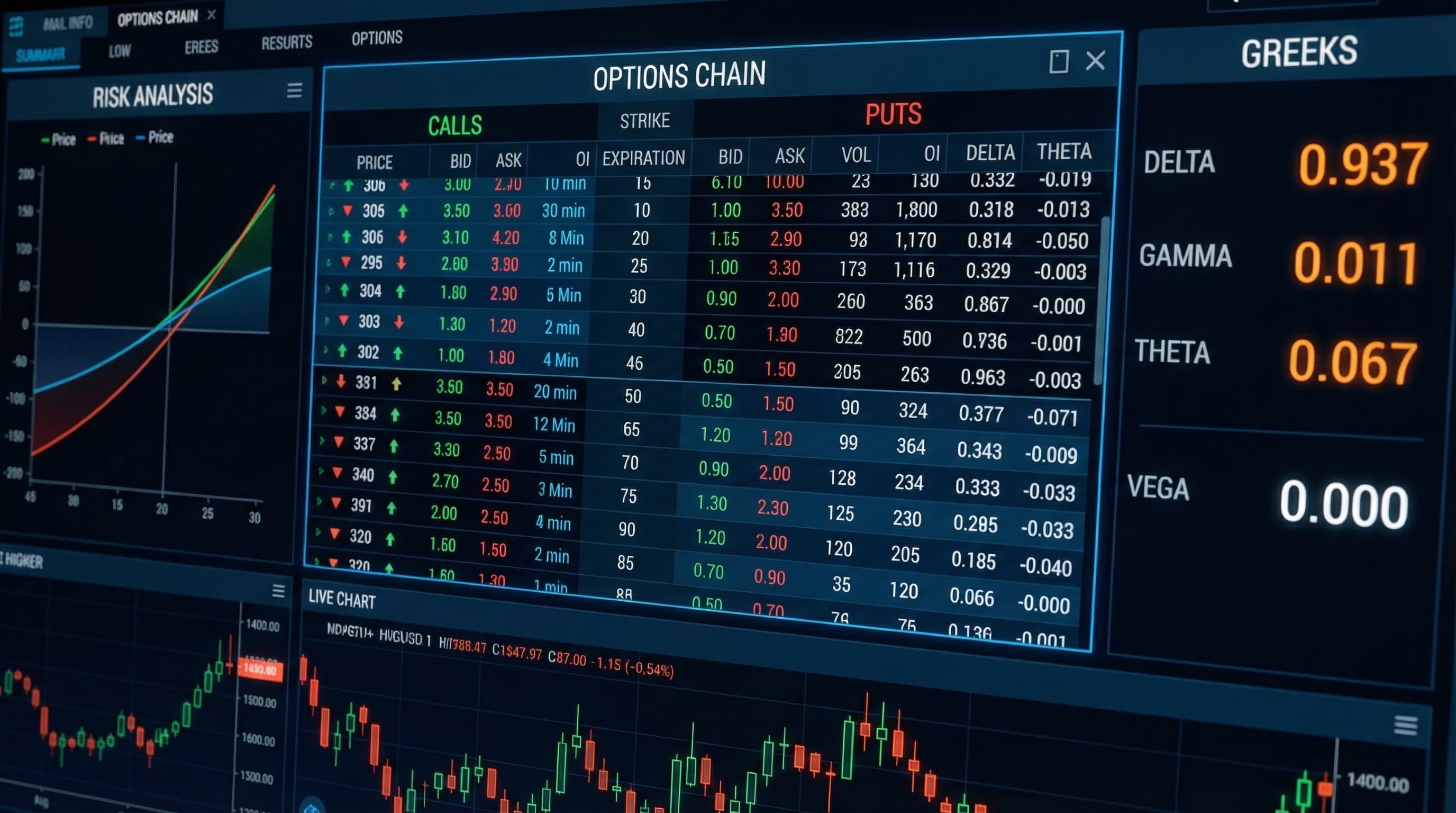
Options Trading Journal: What to Track Beyond P&L

Why Generic Trading Journals Fail Options Traders

A generic journal records entry price, exit price, size, and P&L. For a stock or futures trader, this is a reasonable starting point. For an options trader, it is nearly useless.

Options P&L is driven by multiple variables simultaneously: directional move, time decay (theta), implied volatility change (vega), and Greeks interaction at every price point. A trade can lose money even when the directional thesis is correct — if IV collapses after entry, theta decays faster than delta accumulates, or the position was sized incorrectly given the premium risk.

Without capturing the option-specific context at entry, you cannot explain why a trade made or lost money. You are logging outcomes with no causal data.

The Metrics Options Traders Must Track

These are the fields that separate an options journal from a basic trade log:

  • IV Rank (IVR) at entry: percentile rank of current implied volatility vs. past 52 weeks. Selling premium above IVR 50 and buying below IVR 30 is a core edge — tracking IVR at entry shows whether you execute this consistently
  • IV at entry and exit: raw implied volatility at open and close, letting you calculate IV change (vega P&L component) separately from directional move
  • Delta at entry: your directional exposure when you opened the position. Reveals whether you consistently take too much or too little directional risk
  • Theta at entry: daily time decay income (or cost) at position open. Critical for premium sellers tracking whether collected theta justifies the risk taken
  • DTE at entry and exit: days to expiration at open and close. Most strategies have specific DTE windows with statistically different outcomes
  • Exit type: expired worthless, closed at profit target (50% of max), closed at loss limit, rolled, or assigned. Distribution of exit types reveals whether you manage trades correctly
  • Strategy tag: covered call, cash-secured put, vertical spread, iron condor, long call, long put, calendar, diagonal. Performance varies dramatically by strategy

Behavioral Patterns Unique to Options Traders

Options create behavioral traps that do not exist in other asset classes:

  • IV expansion chasing: buying options after a large move when IV has already spiked, paying elevated premium for continuation that has lower statistical probability
  • Letting winners become losers: premium sellers collecting 40% of max profit but holding for 100%, then closing at a loss. The 50% profit target rule exists because this pattern is so common
  • Gamma risk at expiration: holding short options through expiration weekend to collect the last few cents of theta, exposing the account to outsized gamma risk
  • Assignment avoidance paralysis: failing to manage a tested position because of psychological resistance to assignment, resulting in larger losses than a defined exit rule would have produced
  • Undefined risk in volatile regimes: selling naked strangles or short puts in high-VIX environments where correlation between IV and realized move increases

Connecting Your Options Broker to an Automatic Journal

Manual entry of options trades is particularly error-prone. A single options leg requires: underlying, expiration, strike, call/put, buy/sell, quantity, price, and all Greeks. Multiply that by multi-leg spreads and the burden is prohibitive.

Tiltless imports options trade data from 21 broker formats automatically:

  • Thinkorswim (TD Ameritrade/Schwab): full options chain data via CSV export including all Greeks at fill
  • tastytrade: direct import of options activity including strategy grouping
  • Interactive Brokers (IBKR): Flex Query import with options-specific field mapping
  • Webull, Robinhood, Schwab, Fidelity: CSV imports with options activity parsing
  • All multi-leg strategies (spreads, condors, calendars) recognized as single positions rather than individual legs

How to Analyze Your Options Performance by Strategy

The most valuable analysis for an options trader is win rate and average P&L segmented by strategy type. Most options traders have a profitable strategy they execute inconsistently, mixed with unprofitable strategies they run out of boredom or FOMO.

For example: your iron condors have a 68% win rate with average P&L of +$142. Your long calls have a 31% win rate with average P&L of -$89. The data tells you clearly where your edge is and where you are giving it back.

Beyond strategy segmentation, IV rank analysis shows whether you enter premium-selling strategies in favorable volatility environments. If short puts entered above IVR 50 have 72% win rate and those entered below IVR 30 have 44% win rate, you have a specific, data-derived rule to enforce.

DTE Management: The Analysis Most Options Traders Miss

Theta decay accelerates in the final 21 days before expiration. This is mathematically known. What most options traders lack is data on their own exit behavior relative to this curve.

A DTE analysis tracks: the DTE at which you typically open positions, the DTE at which you actually close them versus your plan, and P&L distribution by DTE at close.

For premium sellers, this analysis frequently shows that closing between 21-14 DTE produces the best risk-adjusted outcomes — capturing most theta decay while avoiding the gamma acceleration zone. Without data, this is theory. With data from your own account, it becomes a personalized rule.

Related Resources

FAQ

?What should I track in an options trading journal?

Beyond P&L, track: IV rank at entry, delta at entry, theta at entry, DTE at open and close, strategy type (covered call, vertical spread, iron condor, etc.), and exit type (profit target, loss limit, expiration, roll). These fields let you analyze performance by strategy and IV environment — the two most important segmentation axes for options traders.

?How is options journaling different from stock trading journaling?

Options P&L has multiple drivers: direction (delta), time decay (theta), and volatility change (vega). A stock journal capturing only entry/exit price cannot explain options outcomes. You need Greek context at entry to understand why a trade made or lost money. Without IV rank at entry, you cannot evaluate whether your premium-selling edge is real or luck.

?What is IV rank and why does it matter for options journaling?

IV rank (IVR) is the percentile of current implied volatility relative to the past 52 weeks. IVR of 80 means IV is higher than 80% of the past year — premium is expensive, selling strategies have a statistical edge. IVR of 15 means premium is cheap, selling strategies face headwinds. Tracking IVR at every entry lets you evaluate whether you consistently enter premium-selling trades in favorable environments.

?Can Tiltless import options trades from Thinkorswim?

Yes. Tiltless imports Thinkorswim options data via CSV export. Multi-leg strategies are recognized as single positions rather than individual legs. In Thinkorswim: Monitor > Account Statement, select date range, export CSV, upload to Tiltless.

Track Your Options Trades Automatically

Tiltless imports from Thinkorswim, tastytrade, IBKR, and 18 other broker formats. See your win rate by strategy, IV environment, and DTE — all segmented automatically.

Options Trading Journal: Track Greeks, IV Rank, and Behavioral Patterns | Tiltless