Updated: 2026-03-07

Pattern Day Trader Rule: What It Is, How It Works, and Your Options

The pattern day trader rule is the single biggest regulatory barrier to retail day trading in the US. Most traders learn about it for the first time when their broker restricts their account. According to a 2000 SEC study on the effects of pattern day trader regulations, the rule reduced retail day trading activity by approximately 25% among affected accounts within 90 days of implementation — yet surveys showed most traders were unaware of the rule before they triggered it. Understanding exactly how it works, what counts as a day trade, and what legitimate options exist for traders under the $25,000 threshold is essential before placing a single intraday trade in a US margin account.

Pattern Day Trader Rule: What It Is, How It Works, and Your Options

What the Pattern Day Trader Rule Actually Is

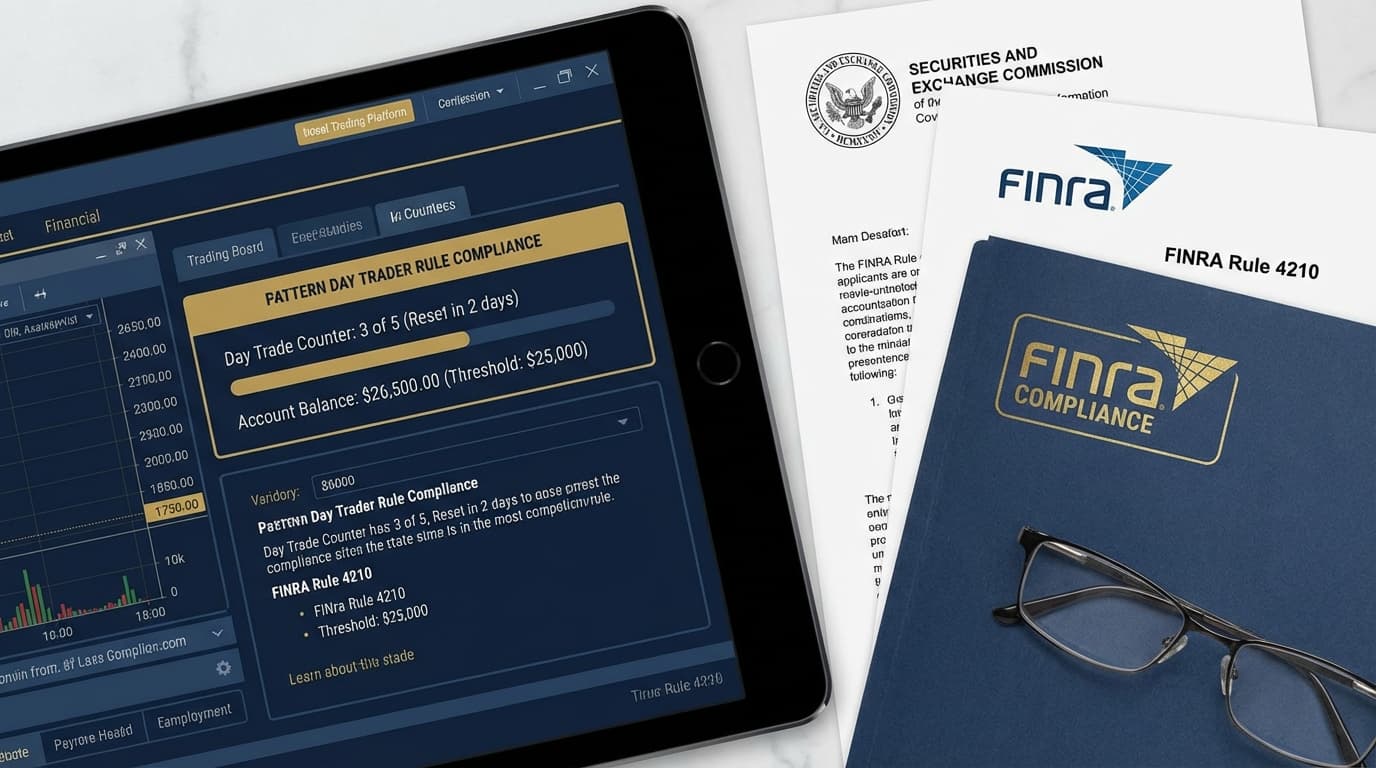
The pattern day trader rule is codified in FINRA Rule 4210. It defines a pattern day trader as any customer who executes four or more day trades within five business days in a margin account, provided those day trades represent more than 6% of the customer's total trading activity for that period.

A day trade is defined as the purchase and sale (or sale and purchase, for short selling) of the same security on the same trading day in a margin account.

Once flagged as a pattern day trader, the account must maintain a minimum equity of $25,000 at the start of each trading day. If the account falls below $25,000, the broker restricts the account to closing transactions only until the minimum is restored.

Key details most traders misunderstand:

**It applies to margin accounts only.** Cash accounts are not subject to the PDT rule. However, cash accounts have their own limitation — the T+2 settlement rule, which means funds from a sale aren't available to use again until two business days after the sale.

**The count resets every five business days, not every calendar week.** If you make 3 day trades on Monday-Wednesday, you have 1 remaining day trade for the next 5 business days starting Tuesday.

**Options day trades count.** Buying and selling an options contract on the same day in a margin account counts as a day trade against the PDT limit.

  • 4+ day trades in 5 business days in a margin account = PDT designation
  • PDT requires maintaining $25,000 minimum equity at start of each day
  • Below $25,000 = account restricted to closing positions only
  • Three violations within 90 days can result in a 90-day restriction
  • Cash accounts are NOT subject to PDT — but face T+2 settlement limits

Legitimate Options for Traders Under $25,000

The PDT rule applies specifically to US-regulated margin accounts for equities and equity options. Several legitimate alternatives exist for traders who haven't reached the $25,000 threshold.

**Option 1: Cash account trading** A cash account with any amount can trade without PDT restrictions. The trade-off: T+2 settlement means funds from equity sales take two business days to settle, limiting how frequently you can cycle capital. For active day trading, this is a significant constraint, but for swing trading it is not a meaningful limitation.

**Option 2: Futures trading** Futures contracts (ES, NQ, CL, GC, and their micro versions) are not subject to the PDT rule under any account type. You can day trade futures with $1,000-$5,000, placing trades multiple times per day. Micro futures (1/10 the size of standard contracts) allow position sizing appropriate for small accounts. CFTC data shows this is one reason futures market participation among retail traders has grown substantially since the PDT rule was implemented.

**Option 3: Forex trading** The forex market is not regulated by FINRA and has no PDT equivalent. US traders can day trade forex without the $25,000 requirement. Leverage limits are 50:1 for major pairs under CFTC regulations — still substantial risk that requires careful position sizing.

**Option 4: Funded trader / prop firm accounts** Proprietary trading firms (FTMO, Topstep, Apex Trader Funding, and others) fund traders with capital ranging from $25,000 to $500,000. Because you are trading the firm's capital through their account, not your own US brokerage account, the PDT rule does not apply. Profit splits are typically 80/20 in the trader's favor. The trade-off: evaluation challenges, profit targets, and strict drawdown rules.

**Option 5: Offshore brokers (with significant caveats)** Some offshore brokers are not subject to FINRA regulations and allow US residents to open accounts without the PDT rule. However, these accounts lack SIPC protection, regulatory oversight, and dispute resolution mechanisms available through US-regulated brokers. This path carries meaningful counterparty risk.

How to Manage Your Day Trades Within the PDT Limit

If you are actively building your account toward $25,000, managing 3 day trades per 5-day rolling window requires deliberate planning.

**Track your rolling count.** Most brokers show remaining day trades in the account dashboard, but not all do. Maintain your own count — this is non-negotiable. A simple note ("Used 1 DT on Monday, 1 on Wednesday = 1 remaining") prevents accidental violations.

**Reserve day trades for A+ setups only.** With only 3 day trades per week, position sizing and setup selection matter far more than they do with unlimited day trades. This constraint, counterintuitively, improves many traders' results by forcing higher setup standards.

**Use overnight positions to extend holding periods.** A trade entered on Monday that runs until Tuesday's open doesn't count as a day trade if you hold it overnight. You accept overnight gap risk but preserve your day trade count.

**Convert swing trades to day trades only when necessary.** If an overnight position moves strongly against you at the open, closing it counts as a day trade. Budget for this possibility when counting your weekly allowance.

A trading journal that tracks day trade count by date is the most reliable safeguard against accidental PDT violations. Tiltless shows your daily trade activity by date, so you can see exactly how many same-day round trips you've made in any rolling 5-day window.

  • Track your rolling day trade count — don't rely solely on broker displays
  • Reserve day trades for highest-conviction setups only
  • Overnight holds extend exposure without using day trade count
  • Account for potential intraday stop-outs on overnight positions
  • Building to $25,000 while using the PDT budget wisely is the primary path forward

Related Resources

FAQ

?What happens if I violate the PDT rule?

On the first violation, your broker will typically flag the account and restrict day trading for 90 days or until you bring the account above $25,000. Some brokers will remove one violation as a courtesy — but not all, and not repeatedly. Accumulating multiple PDT violations can result in permanent account restrictions or account closure.

?Can I day trade with $5,000?

Not in a US equity margin account without PDT restrictions. With $5,000 in a margin account, you can make up to 3 day trades in a 5-day rolling window. Alternatively, you can trade futures (micro E-mini S&P, micro NQ) in a futures account, which has no PDT rule and requires much less capital. Many traders use both: equities for swing trades, futures for intraday activity.

?Does the PDT rule apply to Robinhood and other commission-free brokers?

Yes. All US-regulated brokers that offer margin accounts must follow FINRA's PDT rules. The rule applies equally to Robinhood, Webull, TD Ameritrade, Schwab, Interactive Brokers, and every other US margin account broker. The only way to avoid it through a US broker is to use a cash-only account.

?Do options count toward the PDT limit?

Yes. Buying and selling an options contract on the same trading day in a margin account counts as a day trade. If you buy a call option on Monday morning and sell it Monday afternoon, that is one day trade against your PDT limit.

Track your day trades and never accidentally hit the PDT limit

Tiltless shows your trade activity by date so you can see exactly how many same-day round trips you've made in any rolling 5-day window — and plan your remaining day trades accordingly.

Pattern Day Trader Rule Explained: PDT Rule, $25,000 Requirement & Alternatives