
Updated: 2026-03-07

Scalping Trading Journal: Why Automation Is the Only Viable Approach

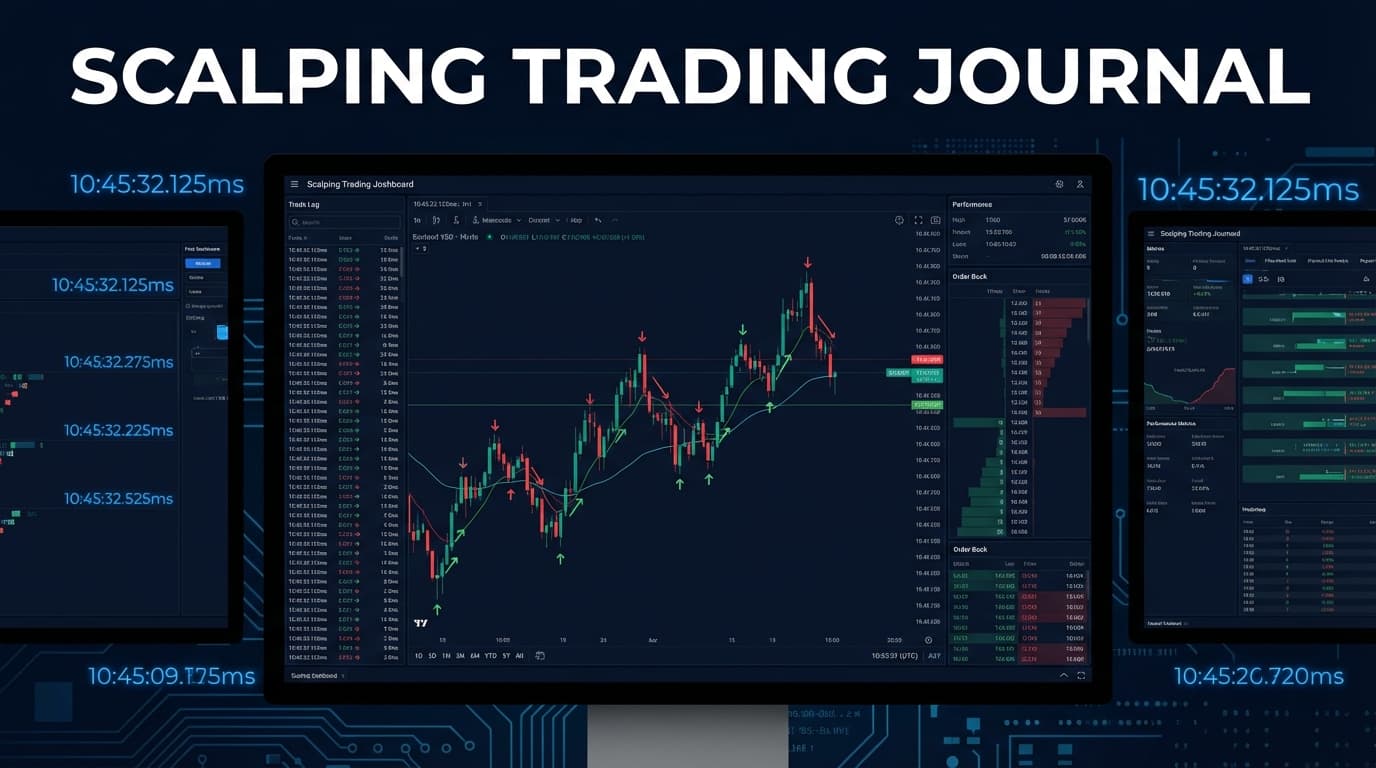
A scalper taking 100 trades per day who spends 60 seconds manually logging each trade would spend 100 minutes on trade entry alone — before any analysis, review, or improvement work. At 200 trades per day, that's over 3 hours of data entry for a 6.5-hour trading session. Manual trade logging does not work for scalpers. This is not a discipline problem; it's a math problem. The consequence is that most scalpers operate without a systematic review loop — they know intuitively that they overtrade when the market is choppy, that their win rate degrades after 60 minutes of continuous trading, and that their worst trades cluster in specific time windows. But without data, these patterns remain intuitions: unverified, unmeasured, and impossible to fix systematically. A scalping trading journal is only viable if it's automatic.
Scalping Trading Journal: Why Automation Is the Only Viable Approach

Why Scalpers Abandon Trading Journals (The Real Reason)

Scalpers abandon trading journals for one reason: friction. The moment between executing a 15-second trade and moving to the next setup is not available for trade logging. A scalper's attention is entirely on the order book, price action, and execution — not on opening a spreadsheet and entering 12 fields per trade. The traders who attempt manual logging during live scalping sessions consistently report that the logging itself caused them to miss subsequent setups or enter trades with reduced attention. Those who try to log after the session — from memory or from broker statements — produce incomplete, inaccurate data that is useless for behavioral analysis. The solution is automatic sync: a journal that pulls trade data directly from the broker or exchange in real time, with no manual input required. For crypto scalpers, live API connectors to Binance, Bybit, Hyperliquid, and other exchanges enable real-time data capture. For equity scalpers, broker integrations or daily CSV import handles the same function.

  • Manual logging during sessions causes missed setups and reduced attention to execution
  • Post-session memory logging is inaccurate for 50+ trade days
  • Automatic sync is the only viable solution for scalpers
  • Tiltless: live API sync from 8 crypto exchanges, CSV import from 21 brokers
  • Zero manual input required — trades are captured automatically in real time

Session Degradation: The Scalping Pattern Nobody Talks About

Session degradation is the consistent decline in trading performance over the course of a session as cognitive load accumulates. Research by Beilock and Carr (Journal of Experimental Psychology, 2001) demonstrated that high-skill performance under pressure is vulnerable to 'choking' as working memory load increases. For scalpers, working memory load increases continuously throughout the session: each trade adds to the cognitive stack, emotional responses to wins and losses accumulate, and the physiological stress response to sustained market attention depletes decision quality. The data pattern is stark for most scalpers: win rate in the first 30 minutes of the session is consistently higher than win rate in the final 30 minutes. Average loss size in the second half of the session is typically larger than in the first half. The 'one more trade' impulse that drives extended sessions is the behavioral signal of session degradation — not the confidence it feels like. Tiltless plots your performance by trade number and session time, making this pattern visible without any manual data collection.

  • Session degradation: performance declines as cognitive load accumulates
  • Win rate in first 30 min is typically higher than final 30 min for scalpers
  • Loss size grows in the second half of sessions — decision quality is declining
  • The 'one more trade' impulse is the signal to stop, not continue
  • Measure it: your win rate on trade 1-20 vs trade 40+ in the same session

Scalping-Specific Behavioral Patterns in the Data

Three behavioral patterns appear with high consistency in scalper data. First: revenge micro-sizing — after a losing sequence, scalpers often reduce position size to the minimum, then increase it again before they have statistical evidence of recovering edge. The data shows these 'recovery sizing' trades have lower win rates than the period they tried to escape. Second: spread-ignored entries — in fast markets, scalpers sometimes enter setups where the spread has widened significantly, reducing the effective edge below the threshold that makes the setup viable. These trades lose not because the setup is wrong but because the spread cost turned a marginally positive expected value into a negative one. Third: chop-session overtrading — in low-volatility, range-bound sessions, scalpers who rely on trend-following approaches will consistently take more trades at lower quality, trying to force moves that aren't materializing. All three patterns are identifiable through data segmentation that automatic journaling makes possible.

  • Revenge micro-sizing: reducing then re-increasing size before edge is confirmed
  • Spread-ignored entries: setup-valid trades ruined by widened spreads
  • Chop-session overtrading: forcing trend trades in range-bound conditions
  • All three detectable through session data — none detectable from memory
  • Edge Lab segments scalping performance by session volatility to catch chop trading

Building Rules From Scalping Journal Data

A scalping trading journal is useful only if it produces rules. The rules should be specific, falsifiable, and derived from your actual data — not from generic scalping advice. Common data-derived rules for scalpers: stop trading after 60 minutes of continuous session time (session degradation data supports this), no entries when realized spread exceeds 1.5x the average spread for that instrument in that session (spread cost data), flat for 15 minutes after 3 consecutive losses within a 20-minute window (revenge sequence prevention), no trading in the first 5 minutes of any session (opening volatility data). These rules feel arbitrary without data. With data — specifically, with your own performance stats for each condition — they feel obvious. The process: build the rule, test it on historical data ('what would my P&L have been if I'd followed this rule last month?'), refine, and implement.

  • Stop after 60 min of continuous trading — session degradation data supports this
  • No entries when spread exceeds 1.5x session average
  • Flat for 15 min after 3 consecutive losses within 20-minute window
  • No first-5-minute entries in any session
  • Backtest every rule against your historical data before implementing

Related Resources

FAQ

?Can I journal 100+ scalping trades per day?

Not manually — and you shouldn't try. Manual logging during scalping degrades execution quality and produces incomplete data. The correct approach is automatic sync: Tiltless connects to your exchange via read-only API and captures every trade automatically. For equity scalpers, daily CSV import from your broker captures the full trade history without manual entry.

?What is the most important metric for scalpers to track?

Win rate segmented by session time — specifically, how your win rate changes as the session progresses. Most scalpers have statistically better performance in their first 30-60 minutes than in later periods. Once you've confirmed your session degradation curve from real data, you have the basis for a hard stop rule that protects your best-performing period from being erased by later behavioral drift.

?Does Tiltless work for high-frequency crypto scalping on Binance or Hyperliquid?

Yes. Tiltless has live read-only API connectors for Binance and Hyperliquid that capture every trade automatically. For scalpers, this means 200 trades per day are imported, scored for behavioral signals, and analyzed for session degradation patterns without any manual effort. The behavioral scoring is computed from trade patterns — no manual emotion rating required.

?What is session degradation in scalping?

Session degradation is the consistent decline in trading performance as cognitive load accumulates over a session. For scalpers taking 50-200 trades, working memory load, emotional responses to wins and losses, and physiological stress accumulate throughout the session. The result: win rate declines and average loss size grows in the second half of extended sessions. Tiltless measures this by plotting performance metrics against trade number and session time.

Capture Every Scalp Trade Automatically

Tiltless syncs live from Binance, Bybit, Hyperliquid, and 5 more exchanges. 100+ trades per day captured, scored for behavioral signals, and analyzed for session degradation — zero manual logging.

Best Scalping Trading Journal in 2026 | Auto-Sync Required | Tiltless