
Updated: 2026-03-06

How to Stop Overtrading: The Behavioral Fix That Actually Works

Overtrading destroys more trader accounts than bad setups or poor entries ever will. It is the single most common behavioral pattern identified in active trader data — and it almost always goes unrecognized until the damage is done. This guide explains what overtrading actually is, what triggers it, and how to use your own trade data to identify and stop it.
How to Stop Overtrading: The Behavioral Fix That Actually Works

What Is Overtrading? The Behavioral Definition

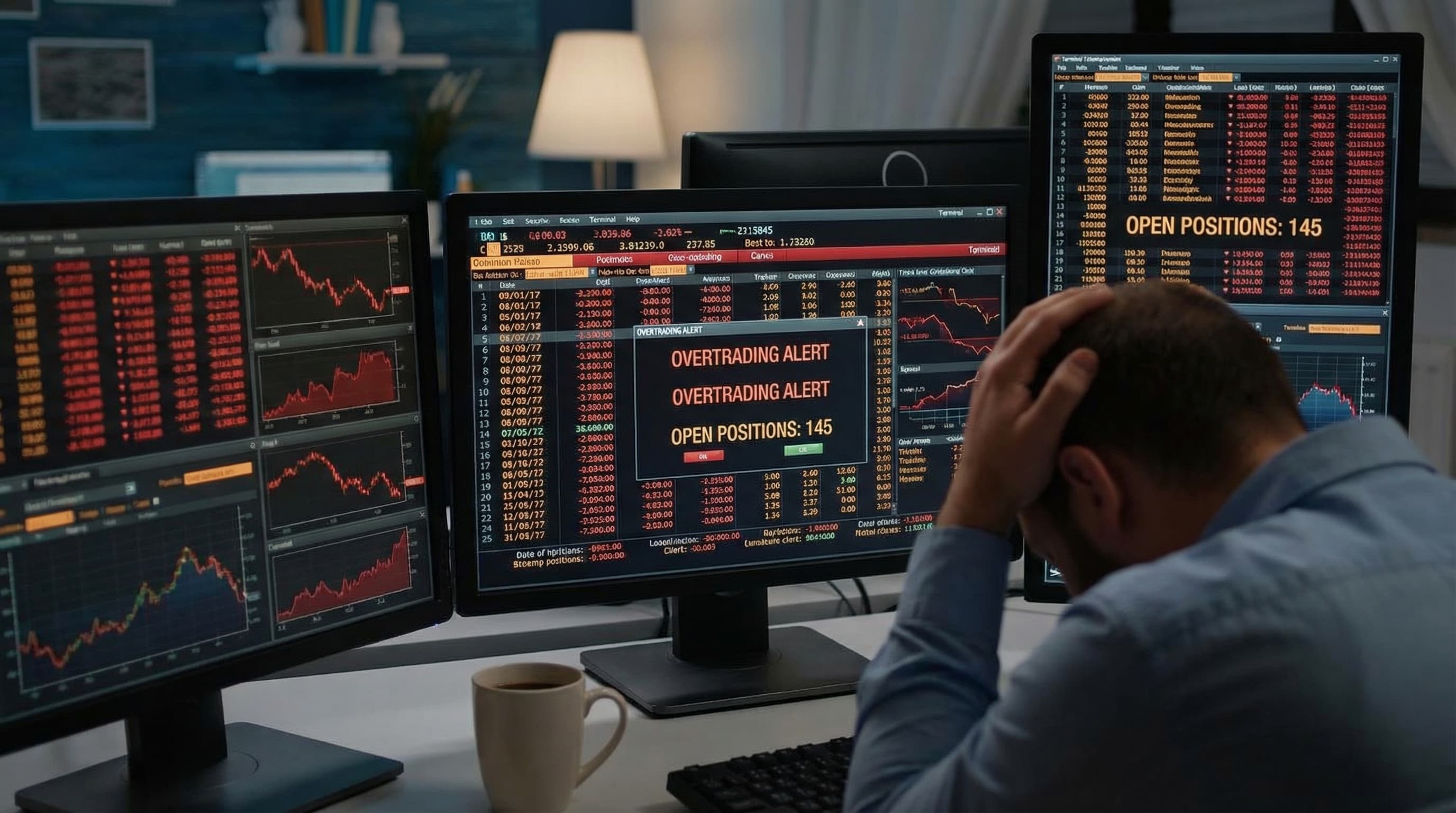
Overtrading is a behavioral pattern in which a trader executes more positions than their strategy or risk parameters justify — typically driven by boredom, FOMO, or the emotional urgency to recover a loss rather than by a valid setup signal.

The key word is behavioral. Overtrading is not defined by trade count alone. A scalper taking 50 trades per day is not overtrading if each trade meets predefined criteria. A swing trader taking 3 trades in a day is overtrading if none of them met setup conditions.

The defining features of overtrading:

  • Trades taken outside your predefined setup criteria
  • Trade frequency that increases after a loss (reactive trading, not systematic)
  • Position sizing that escalates mid-session to recover drawdown
  • Entries taken to relieve boredom or the anxiety of being out of the market
  • Win rate on 'extra' trades significantly below baseline win rate

Overtrading by the Numbers

The research on overtrading is consistent and damning. Here is what the data shows:

  • Barber & Odean (Journal of Finance, 2000): the most active trading quintile underperformed passive strategies by 6.5%/yr net of costs — primarily due to overtrading
  • Barber & Odean (2001): men overtrade 45% more than women; women outperform men by 1.4%/yr on average
  • Linnainmaa (2010): approximately 70% of individual investor trading loses money on a round-trip basis after transaction costs
  • In Tiltless user data: trades taken after a losing trade show an average 28–35% lower win rate than baseline — the hallmark signature of reactive overtrading
  • Most active retail traders execute 2–4x more trades than their strategy requires — most of the excess volume comes in the 90 minutes after a loss

The Three Root Causes of Overtrading

Overtrading is not a discipline problem. It is a trigger-response problem. The same three triggers account for the majority of overtrading across all asset classes:

  • Loss recovery urgency: After a loss, the brain shifts from 'execute my plan' to 'recover the loss.' Risk tolerance expands. Setup standards drop. This is the most dangerous trigger because it escalates — each revenge trade creates the conditions for another.
  • FOMO (fear of missing out): Watching a move happen without a position creates unbearable pressure to get in. Entries taken from FOMO are almost always late, outside the setup window, and sized too large.
  • Boredom / flat market anxiety: Low-volatility periods create 'I need to be doing something' pressure. Trades taken from boredom are typically the lowest-quality trades in any trader's dataset — taken to feel active, not because a setup exists.

How to Identify Overtrading in Your Own Data

You cannot fix overtrading by willpower alone. You need to measure it first. Here is what to look for in your trade history:

  • Win rate on trades taken within 30 minutes of a losing trade vs. your baseline win rate — if the post-loss win rate is more than 10 points lower, you have a revenge trading pattern
  • Average trade duration on losing days vs. winning days — overtraders typically decrease hold time when losing as urgency increases
  • Trade count per session on losing days vs. winning days — a 40%+ increase in trade count on losing days is a strong overtrading signal
  • P&L by session hour — overtrading often concentrates in the last 2 hours of a session as traders try to finish green
  • Setup-tagged vs. untagged trades — if you tag your setups, compare win rate on tagged vs. untagged trades; the gap is your overtrading cost

How to Stop Overtrading: Five Interventions That Work

Generic advice ('be more disciplined') does not work. These specific interventions address the behavioral root causes:

  • Mandatory 15-minute pause after any losing trade: this one rule breaks the revenge trading loop. Set a timer. Do not look at charts. The urgency feeling is real but the setup is almost always not there. Most traders who implement this reduce post-loss trade count by 60–80%.
  • Daily trade limit (not daily loss limit): pick a number — 5, 10, 20 — that represents your strategy's maximum valid setups per day. When you hit the limit, session is over. This prevents boredom trades by making the limit feel like a rule, not a preference.
  • Post-loss position sizing reduction: after any loss, automatically reduce size by 50% for the next 3 trades. This neutralizes the escalation dynamic and gives your PnL room to breathe before risking full size again.
  • Setup criteria written and printed: vague setup criteria enable overtrading. 'Looks good' is not a setup. 'Breakout above 15m resistance on 3x average volume with at least 1:2 R measured to next resistance' is. The more specific the criteria, the fewer 'valid' setups exist per day.
  • Session replay review: review your 3 most recent losing sessions and label each trade as 'setup trade' or 'emotional trade.' Calculate your overtrading cost in dollars. Seeing the number makes the behavior impossible to rationalize.

Overtrading vs. Tilt: Key Difference

Overtrading and tilt are related but distinct behavioral states that require different interventions:

  • Overtrading: a volume and frequency problem — too many trades, often outside setup criteria, typically driven by boredom or mild FOMO. Can exist without emotional escalation.
  • Tilt: an emotional escalation state — decision-making has shifted from rules to recovery urgency. Almost always includes overtrading, but also includes size escalation and risk parameter violations.
  • Key distinction: overtrading can be mild and chronic (3–4 extra boredom trades per day, small cost). Tilt is acute and severe (5x normal size, stop hunting, session ending in account blowup).
  • Fix for overtrading: rules and limits (daily trade cap, post-loss pause, hard session stop).
  • Fix for tilt: real-time behavioral detection + hard circuit breakers (position lock, session termination, mandatory cooldown).
  • Tiltless detects both: tilt score tracks emotional escalation signals; Edge Lab shows overtrading patterns in your trade history by surfacing win rate differentials on post-loss trades.

Related Resources

FAQ

?Why do I keep overtrading even when I know I should stop?

Because the trigger (loss recovery urgency or FOMO) is operating at the emotional level before the rational 'I should stop' thought fires. Knowledge of the problem does not override the trigger. What works is pre-committed rules that activate automatically — a mandatory pause timer, a daily trade limit, or automatic size reduction — so the correct behavior is built into the system rather than relying on willpower in the moment.

?How many trades per day is considered overtrading?

There is no universal number. Overtrading is defined behaviorally, not by count. You are overtrading when your win rate on the additional trades is significantly below your baseline, when trades are taken outside your setup criteria, or when trade count increases after losses. A scalper legitimately taking 50 trades per day is not overtrading. A swing trader taking 8 trades when their strategy typically produces 1–2 valid setups per day likely is.

?What is the best way to track whether I am overtrading?

Segment your trades into two categories: trades that fully met your setup criteria before entry, and trades that did not. Calculate your win rate and average R for each group. The difference is your overtrading cost in both percentage points and dollars. Most traders find their 'setup trades' are profitable and their 'other trades' are what's destroying their P&L.

?Does a daily loss limit prevent overtrading?

A daily loss limit reduces the damage from overtrading but does not stop the behavior — you can still execute 20 losing trades and stay within a $500 daily loss limit with small size. A daily trade count limit is more effective at preventing overtrading because it removes the opportunity to execute marginal trades regardless of P&L state.

See Your Overtrading Pattern in Your Own Data

Tiltless scans your real trade history and shows you exactly where overtrading is costing you — post-loss win rate, session-hour P&L concentration, and behavioral tilt scores.

How to Stop Overtrading | Behavioral Fix for Active Traders