
Updated: 2026-03-06

Trading FOMO: What It Is, Why It Happens, and How to Stop Chasing Entries

FOMO — fear of missing out — is commonly described as greed in trading. That description is wrong, and the mislabeling is one reason standard advice ('just be patient') fails to stop it. Trading FOMO is not driven by wanting more. It is driven by anticipated regret: the prospect of watching a move happen without you activates the same neurological pain response as an actual loss. Kahneman and Tversky's work on prospect theory and regret aversion (1979) established that people make systematically poor decisions specifically to avoid the feeling of having missed a winning outcome. In trading, this shows up as entries taken after a move has already started — paying a price that no longer has the original risk/reward, chasing a breakout you were flat for, entering a reversal because you watched it all the way up and could not stay out. FCA and ESMA risk disclosures show 74–78% of retail derivative traders lose money in any given quarter. FOMO-driven entries — characterized by late execution, compressed reward-to-risk, and decisions made from a watching-not-waiting state — are a significant contributor to that statistic.
Trading FOMO: What It Is, Why It Happens, and How to Stop Chasing Entries

What Trading FOMO Actually Is (Not Greed)

The standard model of trading FOMO treats it as a greed response: you see a move, you want profits, you chase. This model produces bad advice — 'control your greed,' 'be disciplined' — because it misidentifies the underlying driver.

FOMO in trading is a regret-aversion response. Your brain is not focused on the potential gain from the trade you are about to take. It is focused on the pain of not having been in a trade that has already moved in the direction you anticipated. The move validates your analysis. Missing it activates the same neural circuitry as a loss — even though you have lost nothing in cash terms.

Kahneman and Tversky documented this as regret theory: under conditions where a person believes their inaction caused them to miss a gain, they take on more risk than from a calm, uncommitted starting position. In trading, the result is an entry at a worse price, with a compressed stop distance, in a market that has already moved — exactly the conditions that produce the worst average outcomes in most traders' data.

4 Behavioral Signs of FOMO in Your Trade Data

FOMO leaves a distinctive statistical fingerprint in your trade history. Unlike tilt — which often shows up as rapid re-entries after losses — FOMO appears as a cluster of entry-quality degradations after large moves.

Late entry rate: Your entries are being taken materially after the move begins, not at or before the setup trigger. If you tag trades with 'entry at trigger' vs. 'entry after trigger,' FOMO shows up as a higher rate of after-trigger entries and a lower win rate on those trades.

Compressed risk/reward: FOMO entries have a smaller distance between entry and stop than your median trade, and a smaller potential reward because the easy move already happened. This compresses your R-multiple and reduces expectancy.

Re-entry after missing a winning trade: After a trade triggers and moves without you, your next entry is taken at a worse price in the same direction. This is textbook regret aversion — you are paying a premium to not feel like you missed it.

Time-of-day clustering near major moves: Your FOMO entries cluster in the period immediately following significant market moves — breakouts, news events, large candles — rather than during setup formation.

Why 'Just Be Patient' Fails (And What Does Work)

The universal trading advice for FOMO is patience: wait for the next setup, there will always be another trade. This advice is correct in principle and ineffective in practice because it requires willpower to override a neurological response — and willpower is a depleting resource across a full trading session.

Research on pre-commitment mechanisms demonstrates that structural constraints are far more effective than willpower for preventing predictable failures. Applied to FOMO, this means:

Pre-defining entry conditions in writing before the session starts. The constraint is not 'be patient' — it is 'I will not enter unless the price is at X with Y confirmation.' The written rule removes the decision from the moment of temptation.

Closing charts of instruments you are not in. You cannot chase a move on a chart you are not watching.

Setting alerts rather than watching ticks. If your setup requires price to return to a level, set an alert and step away. The alert fires when the setup is forming — you are not watching the move validate your missed analysis in real time.

Using limit orders rather than market orders. A limit order at your intended entry automatically enforces your entry criteria without requiring willpower in the moment.

FOMO vs. Tilt: How They Interact and Compound

FOMO and tilt are related but distinct behavioral states. Tilt is a loss-response — triggered by taking losses, produces revenge trades and increased sizing. FOMO is a regret-response — triggered by watching gains happen without participation, produces late entries with compressed risk/reward.

The dangerous interaction occurs when FOMO produces a bad entry that loses, which then triggers tilt. A missed move leads to a chased entry. The chased entry is stopped out. The stop-out triggers the revenge sequence. The revenge sequence hits the daily loss limit. This is the complete FOMO-tilt loop, and it is the most common multi-step behavioral failure pattern in active traders.

Your trade data shows this pattern clearly once you look for it: a sequence starting with a clean setup that was missed, followed by an entry at a materially different price, followed by an immediate stop-out, followed by a rapid re-entry at an even later position. Each step compounds the damage of the previous one.

How to Measure Your FOMO Score in Your Trade Data

Identifying FOMO in real time is difficult — from the inside, a FOMO entry feels identical to a confident breakout entry. Identifying it in historical data is straightforward once you know what to measure.

The key metric is entry quality relative to your setup trigger: for every trade, how far past the trigger price did you enter? The distribution of this measurement tells you your FOMO rate. If a meaningful portion of your entries occur more than a certain price distance after the trigger, you have quantifiable evidence of FOMO trading.

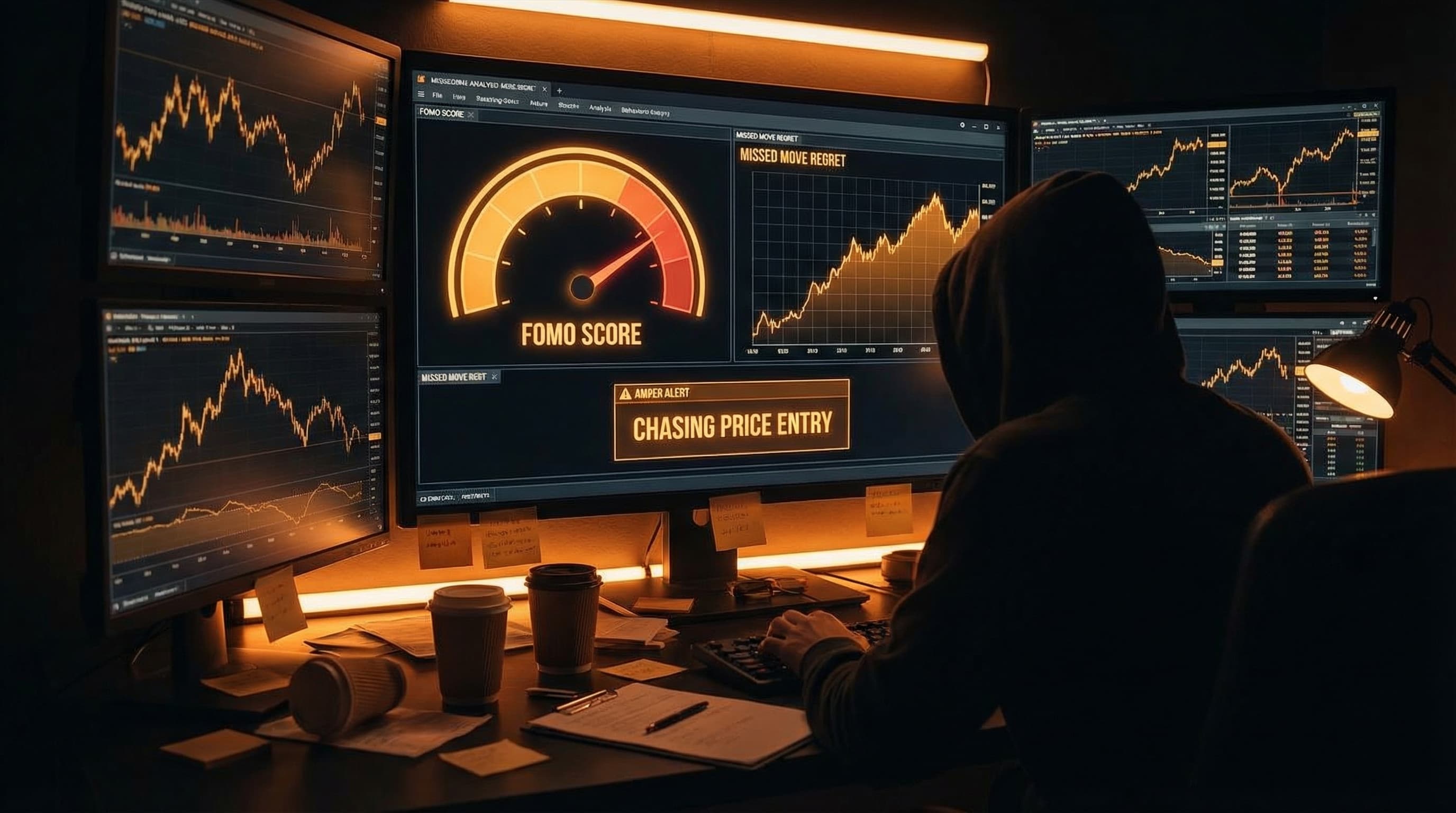
Tiltless computes a FOMO score as part of your behavioral session analysis. It identifies entries that deviate from setup timing patterns in your history, flags sequences of trades that appear in the post-move period rather than the setup period, and shows you the difference in expectancy between your on-trigger and off-trigger entries. The score appears in your daily briefing and updates after each session. The expectancy gap between 'entered at or before trigger' and 'entered after the move started' is typically large enough to explain, by itself, why a profitable-on-paper strategy produces mediocre real-money results. Start for free — connect your exchange and see your FOMO score within minutes.

Related Resources

FAQ

?Is FOMO always a bad thing in trading?

As a behavioral state defined by regret-driven decision-making, yes — FOMO reliably degrades entry quality by producing late, compressed-risk trades. The correct response to seeing a move you identified and missed is to wait for the next setup, not to enter at a worse price. High conviction at a valid trigger is not FOMO — it is urgency. FOMO specifically refers to chasing moves that have already happened.

?How is trading FOMO different from tilt?

Tilt is a loss-response: triggered by taking losses, produces revenge trades and oversizing. FOMO is a regret-response: triggered by watching gains happen without participation, produces late entries with compressed risk/reward. They interact destructively — a FOMO entry that stops out can trigger a tilt sequence. Tiltless scores both separately in your behavioral analysis, which helps you distinguish which state is driving poor performance in any given session.

?Can FOMO be permanently eliminated?

The neurological response that drives FOMO — regret aversion — is a stable human trait. What can be eliminated is acting on it. Pre-commitment mechanisms (entry orders, pre-session rules, alerts instead of live watching) remove the decision from the moment of temptation. Traders who consistently manage FOMO have structural rules that enforce their entry criteria automatically — they do not rely on willpower in the moment to override a strong emotional state.

?How does Tiltless detect FOMO in my trade history?

Tiltless computes a FOMO score based on entry timing relative to your historical setup patterns: entries taken significantly after the optimal trigger point, sequences of trades that follow large directional moves, and the correlation between entry timing and outcomes. The FOMO score appears in your session briefing and Edge Lab. It shows you the specific sessions where FOMO-driven entries occurred, and quantifies the expectancy difference between your on-pattern and off-pattern entries.

See Your FOMO Score in Your Own Trade Data

Connect your exchange and see how your entry quality changes when you are chasing moves versus waiting for your setup — automatically, from your real trade history.

Trading FOMO: What It Is and How to Stop Chasing Entries | Tiltless