
Updated: 2026-03-06

How to Set a Daily Loss Limit That You'll Actually Follow

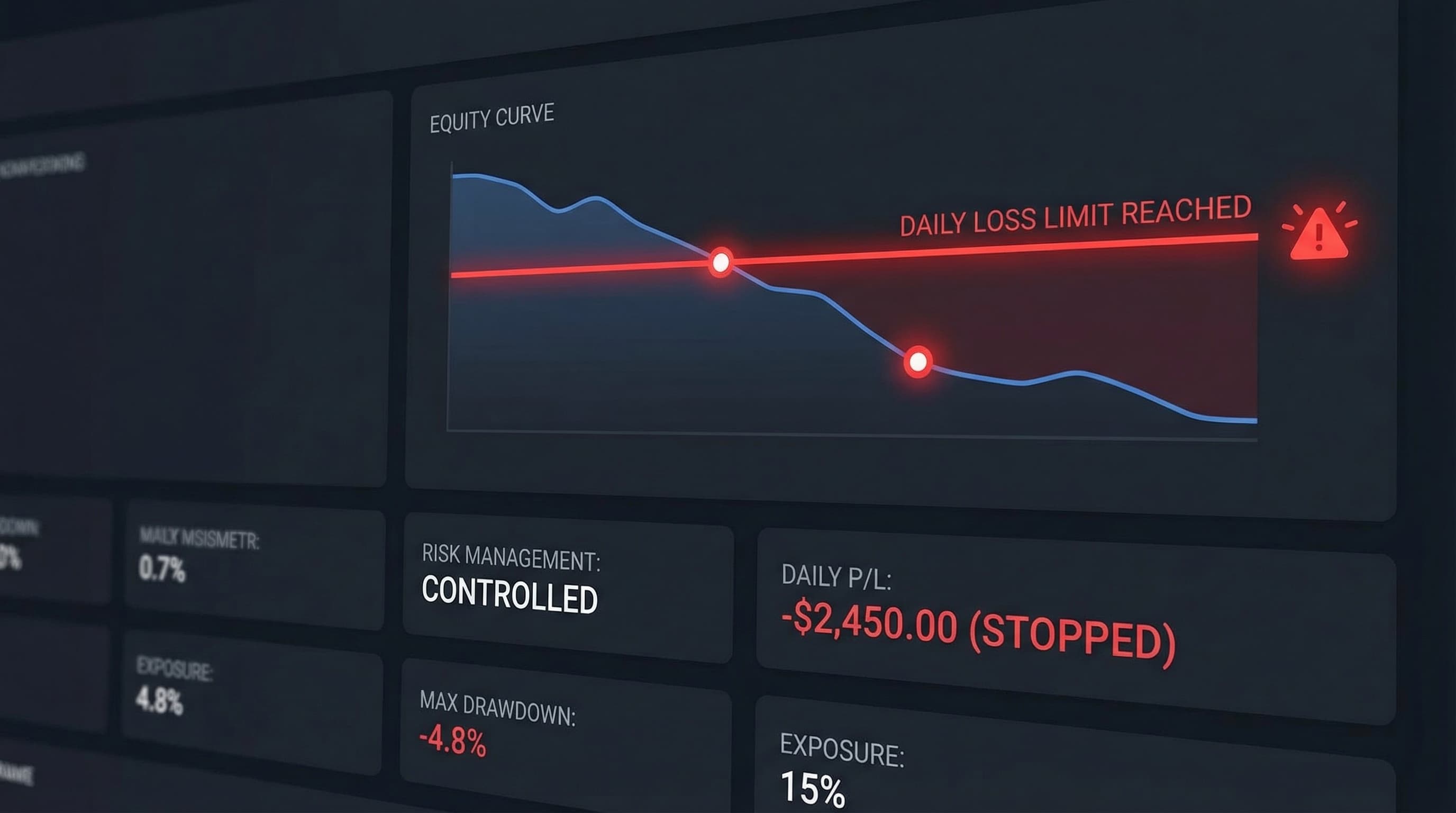
Every experienced trader will tell you to set a daily loss limit. Almost none of them can tell you what makes one actually work. The standard advice — 'stop trading when you've lost 2% of your account' — is correct in principle and fails in practice for one reason: it lives in your head, not in the system. Kahneman and Tversky's 1979 research on loss aversion demonstrates that losses feel approximately twice as painful as equivalent gains feel good. In the moment you hit your daily loss limit, your brain is under maximum emotional pressure — exactly the moment you are least capable of voluntary rule-following. The only daily loss limits that work are the ones that do not require willpower to enforce. This post covers how to set the right number and how to build the structural constraints that make the rule automatic.
How to Set a Daily Loss Limit That You'll Actually Follow

Why Daily Loss Limits Fail (It Is Not a Willpower Problem)

Traders who set daily loss limits and break them are not undisciplined. They are experiencing a predictable neurological response to accumulated losses. ESMA and FCA mandatory risk disclosures consistently show 74–78% of retail derivative traders lose money — the majority of those traders have rules they believe they follow. The gap between intended behavior and actual behavior is largest precisely when it matters most: during drawdown sessions. Three mechanisms drive the failure of mentally-held loss limits:

  • Loss aversion amplification: each additional loss makes the desire to recover feel more urgent, not less. The closer you get to your limit, the more compelling 'one more trade' becomes.
  • Reframing: the brain automatically reframes the limit as the losses accumulate. 'My limit was 2% but this setup is really good' is not a logical decision — it is post-hoc rationalization of an emotional override.
  • Session extension: traders who are down at their normal session end time frequently extend the session to recover. This removes the time boundary that acts as a natural stopping mechanism.

How to Calculate the Right Daily Loss Limit for Your Account

The right daily loss limit is not a percentage you read in a trading book. It is a function of your specific strategy's risk profile and your account's tolerance for drawdown. Barber and Odean's 2000 study of 66,465 brokerage accounts found that the most active traders underperformed passive investors by 6.5% per year — the performance gap was driven primarily by execution decisions made during losing sessions, not by bad strategy selection. The limit that protects you is the one tied to your own data.

  • Calculate your average daily losing session P&L from your last 90 days of trade history — this is your statistical baseline for a bad day
  • Set your hard limit at 1.5–2x that average — anything beyond that represents a behavioral outlier day, not a strategy day
  • For prop firm accounts: your limit must also account for the account's daily loss rule — build in a 20% buffer so you never approach the funded account limit
  • For live accounts: your limit should allow recovery within 3–5 normal winning sessions — deeper than that and compounding pressure makes behavioral errors more likely in the recovery period

Pre-Commitment Mechanisms That Actually Work

A pre-commitment mechanism is any structural change that makes the desired behavior automatic and the prohibited behavior difficult. The research on pre-commitment in financial contexts — from Thaler and Sunstein's 'Nudge' (2008) to behavioral economics applied in pension auto-enrollment — consistently shows that structural defaults outperform rules that require active, in-the-moment decision-making. For daily loss limits, effective pre-commitment mechanisms include:

  • Platform-level stop orders: set a hard close order on your account at your loss limit, triggered automatically. Most futures platforms and some crypto platforms support this. It requires no willpower because it executes whether you agree in the moment or not.
  • Session timers with alerts: set a phone alarm 30 minutes before your intended session end. When it fires, close the next trade at breakeven or better and stop for the day. The alarm creates a structural interruption that breaks the session-extension loop.
  • Pre-session written commitment: write down today's loss limit and session end time before you open the platform. Signing a contract with yourself — even mentally — increases follow-through by reducing the ease of reframing.
  • Account-level alerts: platforms like TradingView and Tiltless can send behavioral alerts when your drawdown hits a threshold. An external alert is harder to rationalize away than an internal feeling.

What Happens Behaviorally When You Hit Your Limit (and What to Do Instead)

When a trader hits their daily loss limit, they are in the behavioral state most likely to produce additional damage. The loss aversion response activates recovery urgency — the drive to get back to flat as quickly as possible. In this state, risk management deteriorates: position size increases, entry criteria loosen, and the session extends. Understanding this as a predictable biological response — not a personal failing — changes how you design your response to it.

  • When you hit your limit, close your platform immediately — the longer you stay open, the more compelling the next trade looks. Physical separation from the platform is the most effective circuit breaker.
  • Do something physically different: walk, exercise, eat. The neurological recovery from loss aversion takes 20–40 minutes and is accelerated by physical activity.
  • Review the session's trades in detail — not to second-guess them, but to document the pattern. The most valuable data you collect is what your behavior looked like in the 30 minutes before you hit your limit.
  • Set a reentry condition for tomorrow: a specific behavioral commitment based on what you observed today. 'Tomorrow I will stop after 2 consecutive losses regardless of P&L' is more actionable than 'I'll be more disciplined tomorrow.'

Why Behavioral Data Makes Your Loss Limit Real

The reason mental loss limits fail and structural ones work is that behavioral state does not respond to abstract rules — it responds to immediate, concrete feedback. When a prop firm's platform cuts your trading access because you hit the daily loss limit, you stop. When your own mental rule says 'you've hit your limit,' the counter-pressure from loss aversion is stronger. Tiltless provides a middle layer between the abstract rule and the automatic platform cut: real-time behavioral scoring that tells you when your tilt level, fatigue score, and post-loss behavior are trending toward the states that historically produce your worst sessions. The tilt alert is not a soft suggestion — it is a data-driven signal that your behavioral state is degraded, computed from your own historical patterns. A tilt score of 7.5 in your history correlates to specific P&L outcomes that you can see in your Edge Lab. That concrete link between internal state and actual P&L outcome is what makes the alert actionable in the moment willpower alone cannot be.

Related Resources

FAQ

?What percentage of my account should my daily loss limit be?

The commonly cited rule is 1–2% of account equity per day. That is a reasonable starting point, but the right number is the one derived from your own data. Calculate your average daily loss on your worst 20% of sessions from the past 90 days. Set your limit at that number plus 50%. This calibrates the limit to your actual strategy risk profile rather than an arbitrary percentage. For prop firm accounts, always verify your limit is at least 20% below the funded account's daily loss rule.

?What if I hit my daily loss limit mid-trade?

Close the trade at your target exit criteria — do not panic-exit mid-trade to hit an arbitrary number. The daily loss limit applies to completed trades. If you are in a trade when you hit your loss limit, follow your exit plan for that trade, then stop trading for the day. Using the daily loss limit as a reason to exit a trade early introduces a different behavioral distortion: premature exits driven by P&L anxiety rather than strategy.

?Should my daily loss limit change based on market conditions?

Your loss limit should be stable during normal conditions. Variable limits are psychologically harmful because they give the loss-aversion response a lever to use: 'today is volatile so my limit is higher.' If you are in a high-volatility regime, the appropriate adjustment is position size, not loss limit. A smaller position size in volatile conditions preserves the same loss limit while adapting to market conditions.

?How does Tiltless help enforce daily loss limits?

Tiltless computes real-time behavioral scores — tilt, fatigue, FOMO, and revenge — from your actual trade behavior and sends alerts when these scores enter ranges that historically correlate with your worst sessions. This provides a behavioral early-warning system that often fires before you hit your loss limit, when you are still in a state where you can voluntarily stop. Edge Lab shows you the statistical relationship between your behavioral state and P&L outcomes, making the alert concrete rather than abstract. You can also use Edge Lab to find the exact point in your losing sessions where the performance begins to degrade — the optimal stopping point is usually earlier than traders intuitively believe.

Build a Behavioral Guardrail Around Your Daily Loss Limit

Connect your exchange and see how your performance changes in the 30 minutes before you hit your worst sessions — automatically, from your real trade history.

How to Set a Daily Loss Limit That You'll Actually Follow | Tiltless