
Updated: 2026-03-07

Trading Checklist: How to Build One That Actually Improves Your Results

The surgeon doesn't wing it in the operating room. The airline pilot doesn't guess at whether the landing gear is down. The checklist isn't a sign of inexperience — it's a recognition that high-stakes decisions made under pressure are prone to the same errors regardless of expertise. A study of checklist implementation in surgery, published in the New England Journal of Medicine (Haynes et al., 2009), found that using a 19-item surgical checklist reduced major complications by 36% and deaths by 47%. The surgeons were already experts. The checklist made them more reliable in predictable ways. Trading shares the same risk profile: high-stakes decisions, cognitive pressure, emotional interference, time constraints. And most active traders operate without a checklist — relying on memory and intuition to execute consistently, which the research says doesn't work.
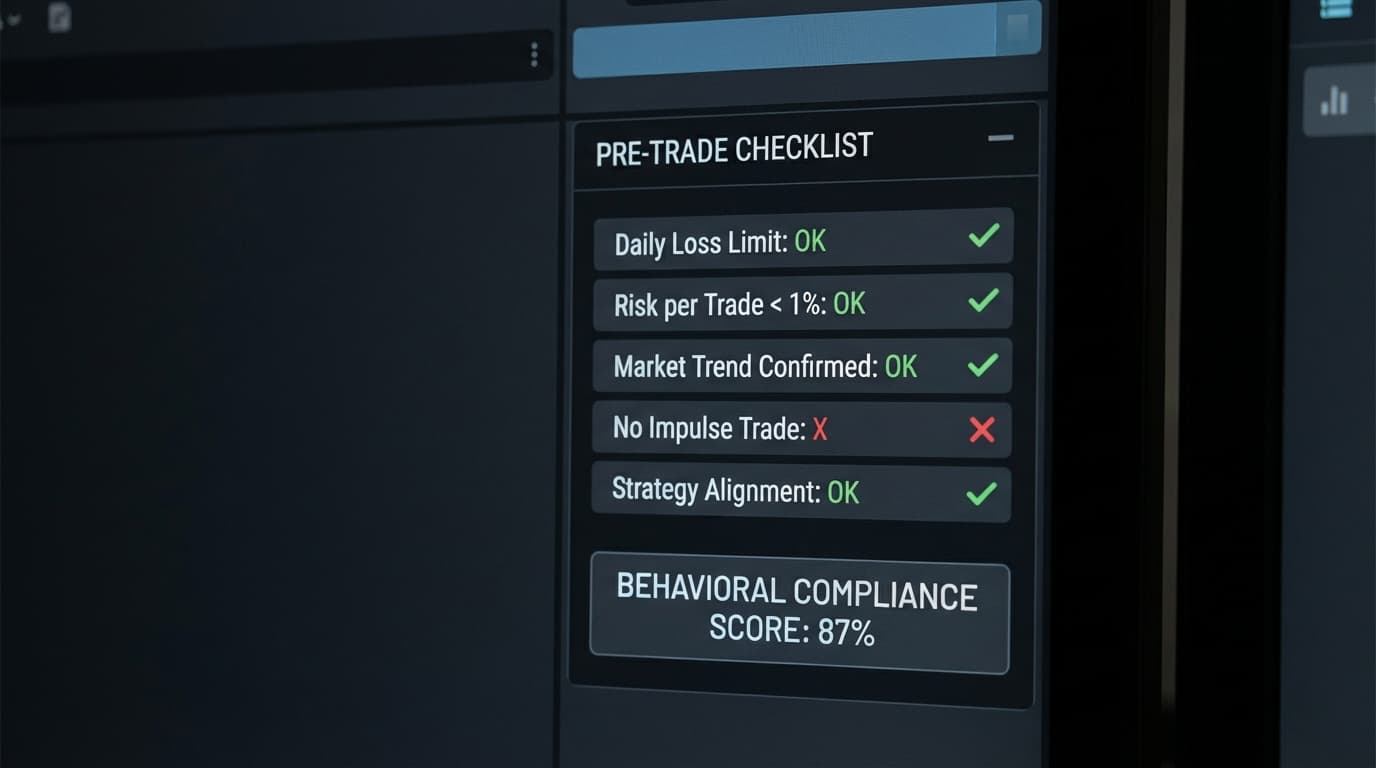
Trading Checklist: How to Build One That Actually Improves Your Results

Why Checklists Work in Trading (and Why Most Traders Don't Use Them)

A checklist works for one fundamental reason: it transfers the compliance decision from in-the-moment judgment to a pre-committed standard. You don't decide whether to check the landing gear based on how busy you are. You check it because the checklist says to check it.

In trading, the equivalent is this: you don't decide whether to verify your stop placement based on how excited you are about the setup. You verify it because the checklist says to verify it.

The behavioral value of a trading checklist is twofold:

**Prevention:** Catches the mechanical errors (no stop set, position sized incorrectly, trading outside your defined session) before they become losses.

**Data generation:** Every checklist completion creates a behavioral data point. When you skip a box and the trade loses, that's a data point. When you skip a box and the trade wins, that's also a data point — and a more dangerous one, because it reinforces the wrong behavior.

Why don't most traders use checklists? Because they feel slow, because overconfidence makes rules feel unnecessary, and because most traders don't have a mechanism to measure whether their checklist compliance affects their results. Without the feedback loop, the checklist becomes a formality rather than a performance tool.

The 5-Item Pre-Trade Checklist

A pre-trade checklist should be short enough to complete before every single trade without creating hesitation. Five items is the target. Anything longer gets skipped when markets are moving fast.

**1. Setup valid?** Does this trade meet all the criteria in your trading plan? Not most criteria — all of them. FOMO entries often fail this check: the setup was valid yesterday, not now.

**2. Stop defined?** Where exactly is my stop? Not "below the lows" — what price, exactly, am I setting my stop at? If you can't answer this in two seconds, the trade isn't ready.

**3. Position size correct?** Based on the distance to my stop, what is the correct position size for my risk parameters? Is that the size I'm about to trade? This check catches oversizing after losses.

**4. Session valid?** Am I trading within my defined trading hours? Is this a day when I committed to not trading (post-max-loss day, scheduled break, major news event)? This is the check that prevents revenge trading outside normal session hours.

**5. Recent loss count?** How many consecutive losses have I taken today? If I'm at my personal circuit breaker number (typically 2-3), is taking this trade consistent with my rules?

All five checks can be completed in under 30 seconds. Any trade that fails a check either gets modified (fix the stop, fix the size) or skipped.

  • Setup meets all criteria — not 'mostly' meets criteria
  • Stop price defined precisely, not approximately
  • Position size calculated based on stop distance and account risk percentage
  • Trading within defined session hours and days
  • Consecutive loss count within personal circuit breaker limit

The 3-Item Post-Trade Checklist

A post-trade checklist has a different purpose than a pre-trade checklist. It's not about prevention — it's about data collection and pattern recognition.

**1. Did I follow my plan?** Was this a planned trade or a discretionary deviation? Did I enter at the right level, with the right size, in the right session? A simple yes/no. Over time, compare your P&L on 'followed plan' trades vs. 'deviation' trades. The data is almost always clear.

**2. Did I manage the trade according to my rules?** Did I move my stop for a structural reason or an emotional one? Did I take partials at my planned level? Did I hold the position for its intended duration? Again, yes/no. Management compliance is tracked separately from entry compliance.

**3. Behavioral state note?** One sentence. Was there anything notable about your state when you took this trade? Post-loss? Pre-news? Fatigued? Distracted? This note becomes the raw material for pattern analysis — six months later, you can filter your losing trades by behavioral context and find the specific triggers that precede your worst sessions.

How to Use Checklist Compliance as Performance Data

A checklist you complete but never analyze is worth less than it seems. The real value emerges when you track compliance rates and correlate them with outcomes.

The analysis that matters most:

**Compliance rate vs. win rate:** Do trades where you completed the pre-trade checklist have a higher win rate than trades where you skipped it? This analysis is usually the most persuasive argument for consistency, because the data is your own.

**Violation frequency by behavioral state:** Which checklist items do you violate most often? When? After a loss? During high-volatility sessions? The pattern in your violations tells you which specific situations compromise your discipline.

**P&L by compliance level:** Calculate your P&L on fully compliant trades (all 5 boxes checked) vs. partial compliance vs. no checklist. For most active traders, the difference is substantial.

Tiltless automatically tracks behavioral compliance across sessions. The behavioral scoring system functions as an automated checklist audit — computing tilt, FOMO, and revenge scores from your actual trade behavior and surfacing the sessions where checklist compliance was likely compromised.

Related Resources

FAQ

?How long should a trading checklist be?

5 items maximum for a pre-trade checklist. 3 items for a post-trade checklist. Longer checklists get skipped in real market conditions, which defeats the purpose. If you have more than 5 things you want to verify before every trade, prioritize the 5 that most often lead to losses when skipped.

?Should I use a digital or physical trading checklist?

Either works — consistency matters more than format. Digital checklists have the advantage of creating data that can be analyzed (compliance rates, violation patterns over time). Physical checklists may feel more deliberate. The key requirement: it must be accessible before every trade and completed before you enter.

?What's the most important item on a trading checklist?

Stop price definition. Entering a trade without a precisely defined stop price is the single most common mechanical error in active trading. A stop that's 'somewhere below the lows' becomes a stop that gets moved, widened, or removed during the trade. An exact price set on the order level cannot be rationalized away.

?How do I measure whether my checklist is working?

Compare P&L on trades where you followed your full checklist vs. trades where you skipped it or deviated. This requires logging compliance alongside your trade data. Over 50+ trades, you'll have a clear answer. Most traders who run this analysis find that checklist-compliant trades outperform non-compliant trades significantly.

Track your checklist compliance automatically

Tiltless behavioral scoring works like an automated checklist audit — it tells you exactly which sessions and trades deviated from your rules, and what they cost you.

Trading Checklist | Pre-Trade and Post-Trade Checklists That Work