
Updated: 2026-03-06

How to Develop Trading Discipline: The System-Based Approach That Works

Trading discipline is not a personality trait. It is not something some traders have and others do not. It is a system design problem — and like any system design problem, it has an engineering solution. This guide explains why willpower-based discipline fails, what actually works, and how to build the specific systems that create consistent, rule-based trading behavior.
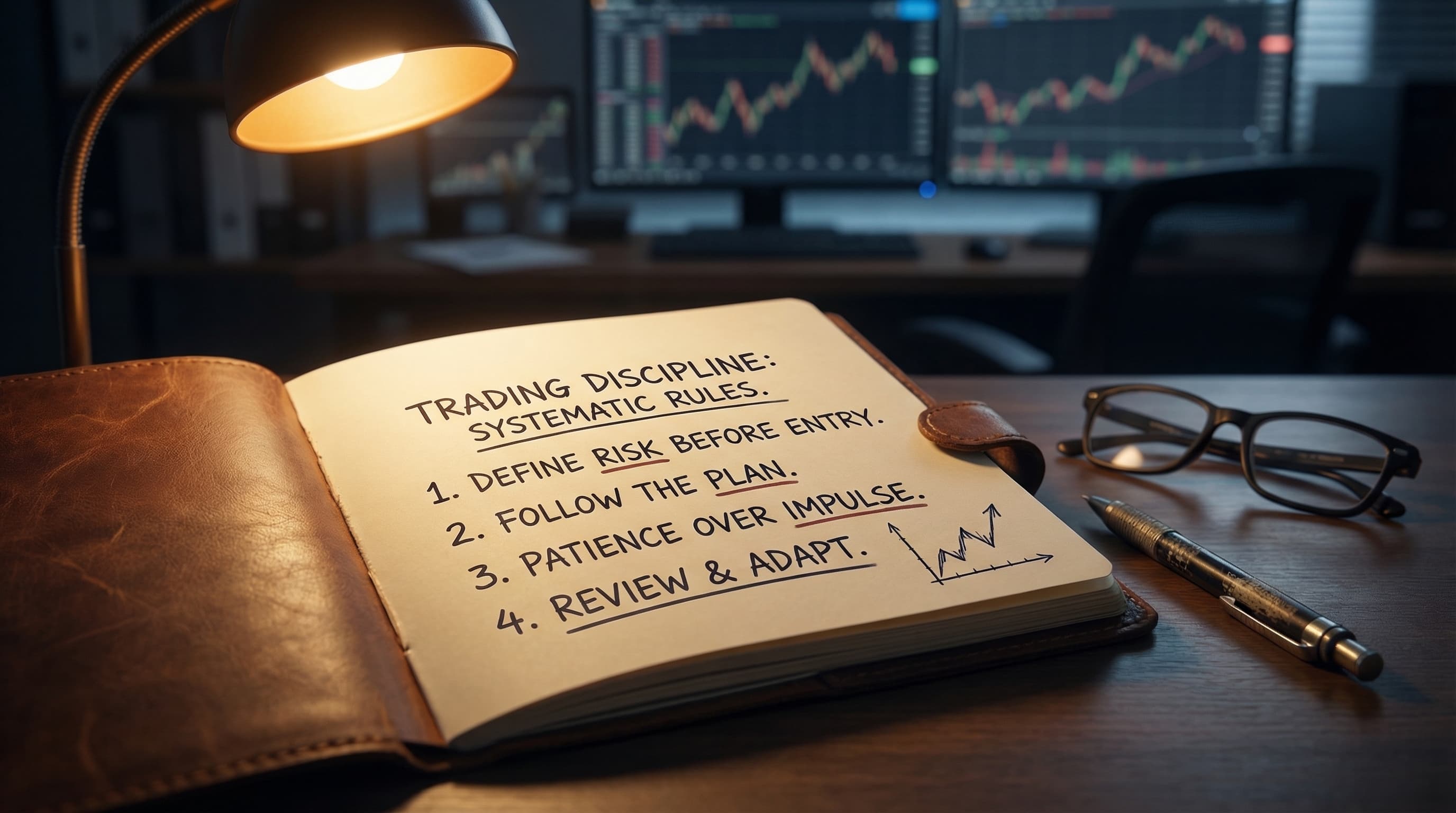
How to Develop Trading Discipline: The System-Based Approach That Works

Why Willpower-Based Trading Discipline Always Fails

Trading discipline built on willpower has a predictable failure mode: it works until you lose money, then it collapses at exactly the moment you need it most.

This is not a character flaw. It is neuroscience. The prefrontal cortex — responsible for rational decision-making and impulse control — is directly impaired by cortisol, the stress hormone released during financial loss. A losing trade literally degrades the cognitive function required to 'be disciplined.'

The research confirms this:

  • Baumeister et al. (1998): willpower is a depletable resource — the more decisions you make, the less self-control capacity you have. Most traders are decision-fatigued by the time their worst trades happen
  • Shiv & Fedorikhin (1999): cognitive load reduces self-control. The mental effort of active trading directly undermines discipline
  • Lo & Repin (2002): experienced traders show significant physiological stress responses during volatile markets — these responses impair decision quality even in professionals
  • The implication: you cannot rely on willpower when markets are stressful, when you are losing, or when you are fatigued — which is precisely when discipline matters most

System-Based Discipline: The Engineering Alternative

System-based discipline removes the in-the-moment decision from the trader. Instead of 'will I break my rules right now?', the question becomes 'have I designed a system that makes breaking my rules impossible or very difficult?'

The key shift: discipline is built in advance, not enforced in the moment. Here are the five systems that work:

  • Pre-committed rules: written, specific trading rules created when you are calm, rational, and not in a position. 'Breakout above 15-minute resistance, minimum 1:2 R, stop below the range low' is a rule. 'Wait for a good setup' is not. Pre-commitment works because you are binding your future emotional self to your current rational self.
  • Hard circuit breakers: automated or pre-scheduled session stops that trigger regardless of emotional state. A daily loss limit that you tell your broker to enforce. A timer that locks your trading platform after 3 losses. These are not suggestions — they are structural stops.
  • Behavioral data tracking: measuring your rule compliance rate turns discipline into a metric you can improve. 'I broke my rules 4 times this week' is information. 'I need to be more disciplined' is not. What gets measured gets managed.
  • Environmental design: remove friction from good behavior, add friction to bad behavior. Close Twitter during trading hours. Pre-calculate your position size before the market opens. Disable one-click trading. Make the undisciplined action require effort.
  • Accountability structures: a trading partner, a public commitment, or a mandatory session review. Social accountability is one of the most powerful behavioral tools available — it activates loss aversion (fear of being seen to fail) to reinforce compliance.

What Your Trading Rules Need to Specify

Vague rules are not rules. A vague rule gives your emotional brain a loophole. Every trading rule needs to specify exactly:

  • Entry condition: what specific, observable price action triggers entry? Not 'looks bullish' — what price level, what pattern, what confirmation?
  • Stop loss: where is the stop, in price terms, before entry? Not 'I'll use a tight stop' — what is the exact price?
  • Target: what is the minimum reward target? What is the R multiple required for this setup to be valid?
  • Position size: what is the maximum risk in dollar terms or percentage of account for this setup? Write the formula, not a range.
  • Invalidation conditions: what would cause you to not take this setup even if all other criteria are met? (e.g. 'do not trade in first 15 minutes after major news')
  • Session limits: maximum number of trades per session, maximum loss per session at which trading stops
  • Rule of thumb: if two different traders with your rules would make the same entry decision on the same chart, the rule is specific enough. If they might disagree, it is still too vague.

How to Measure Your Trading Discipline (With a Number)

You cannot improve what you do not measure. Trading discipline needs a metric — a number you track weekly that tells you whether your systems are working. Here is the discipline score framework:

  • Rule compliance rate: for each trade, was every entry criterion met before entry? Yes/No. Your weekly rule compliance rate is the percentage of trades that were 'yes' entries. A 90%+ compliance rate is the target.
  • Emotional override count: how many times did you override a stop, add to a losing position, or stay in a trade past your exit target? Count these weekly. Zero is the goal.
  • Session abort rate: when your circuit breakers triggered (daily loss limit, trade count limit), did you stop trading? Yes/No. Track this weekly.
  • Rule break cost: calculate the P&L difference between your rule-compliant trades and your rule-violation trades. This number — the weekly cost of indiscipline — is the most motivating metric you can track.
  • Most traders who track their rule compliance rate for 30 days discover that their compliant trades are profitable and their non-compliant trades are what creates losses. This discovery is more motivating than any discipline advice.

Trading Discipline at Each Phase of a Session

Discipline requirements are not uniform throughout a trading session. Different phases create different behavioral risks:

  • Pre-market (before open): this is the highest-leverage discipline moment. Review your rules, set your position size calculator, identify the 1-2 setups you are looking for. Traders who complete a pre-market routine show 30-40% better rule compliance than those who open charts cold.
  • First 30 minutes (market open): highest volatility, highest emotional activation, most common overtrading window. Many systematic traders do not trade the first 30 minutes at all. If you do, use smaller size.
  • Mid-session (after first trade): if your first trade was a loss, this is the highest-risk discipline window. The revenge trading impulse peaks here. Pre-commit to a mandatory 15-minute break after any loss.
  • Late session (last 90 minutes): the 'make it back' window. Trade count often spikes here for losing traders as they try to finish green. A hard daily loss limit and daily trade limit make this the safest period by eliminating the temptation entirely.
  • After session: the discipline work here is review, not trading. Did you follow your rules? Where did you break them? What triggered the break? Log this before you close your platform.

How to Rebuild Trading Discipline After a Blowup

A drawdown or blowup does not mean you lack discipline permanently. It means your current system failed a stress test. The rebuild process is structured, not motivational:

  • Step 1 — Take a mandatory break (3-5 trading days minimum): trying to fix discipline while in an emotional state reinforces bad patterns. Stop trading first.
  • Step 2 — Autopsy the blowup: identify every rule violation that contributed. Not 'I was emotional' — which specific rules did you break, and when? Calculate the cost of each violation.
  • Step 3 — Add one new system constraint: based on the autopsy, what single system change would have prevented or limited the blowup? Add that constraint before returning to trading.
  • Step 4 — Return at half size for two weeks: smaller size reduces emotional activation, which gives your pre-committed systems time to prove they work before full exposure
  • Step 5 — Track compliance rate daily for 30 days: the goal is not P&L — it is 90%+ rule compliance for 30 consecutive trading days. If you achieve that, increase size gradually.
  • Tiltless behavioral tracking: your tilt score, rule compliance rate, and session-level behavioral patterns are tracked automatically. You can see exactly when and why your discipline broke down — not from memory, but from data.

Related Resources

FAQ

?How long does it take to develop trading discipline?

System-based trading discipline can be established within 30 days if you track it. The process: write specific rules when calm, measure compliance rate daily, and review breakdowns weekly. Most traders see measurable improvement in rule compliance within 2-3 weeks of systematic tracking. The behavioral research suggests 60+ days of consistent tracking to establish stable new decision patterns.

?Is lack of trading discipline a sign that trading isn't for me?

No. Lack of willpower-based discipline is universal — even professional traders have discipline failures under stress. The difference between professional and retail traders is not the absence of discipline failures; it is the presence of systems that limit the damage when failures occur. Hard circuit breakers, daily loss limits, and mandatory breaks are used by professional traders precisely because they do not rely on willpower.

?What is the most important trading discipline rule to follow?

The daily loss limit — the specific dollar amount at which you stop trading for the day regardless of what the market is doing. This single rule prevents the majority of catastrophic trading losses. A trader with a $500 daily loss limit who has a bad day loses $500. Without it, a bad day can become an account-ending event. Set it as a hard rule, not a guideline.

?How do I stay disciplined when a trade is going against me?

Your stop loss must be set at entry, in advance. If you are asking 'how do I stay disciplined when a trade moves against me?' after entry, the system failure already occurred before entry — you entered without a committed stop. The discipline fix is pre-entry: calculate your stop level, enter it in your broker platform, and confirm the maximum loss before clicking execute. Post-entry discipline is too late.

See Your Rule Compliance Rate — In Your Own Data

Tiltless tracks your behavioral patterns across every session. Tilt score, post-loss trade count, session-hour P&L breakdown — your discipline metrics, automatically calculated.

How to Develop Trading Discipline | Stop Relying on Willpower