
Updated: 2026-03-08

How to Backtest a Trading Strategy: A Complete, Honest Guide

Backtesting is the most misused tool in retail trading. A 2020 paper by Harvey, Liu, and Zhu in the Review of Financial Studies documented what they called the 'multiple testing problem' in strategy development: because thousands of parameter combinations can be tested on the same historical data, finding a backtest that looks profitable is trivially easy — finding one that reflects genuine forward-looking edge is hard. The majority of traders who run backtests are confirming patterns they want to find rather than genuinely testing hypotheses. Done correctly, backtesting is the most powerful tool available for strategy development. Done incorrectly, it produces false confidence in strategies that will fail the moment live trading begins. This guide covers the complete backtesting process — how to run one correctly, what the results actually mean, and how to avoid the statistical traps that invalidate most retail backtests.
Track your patterns free →No credit card · Free forever
How to Backtest a Trading Strategy: A Complete, Honest Guide

What You Need Before You Begin Backtesting

The most common backtesting mistake is starting the process without defined rules. If you write rules based on charts and then test those rules on the same charts, you are confirming a story you already told yourself — not testing a hypothesis.

**Proper sequence:** 1. Hypothesis: articulate why the edge should exist (market structure reason, behavioral explanation, or documented phenomenon) 2. Rules: write precise entry and exit rules BEFORE looking at the sample data 3. Sample selection: choose a historical period that was NOT used to generate the hypothesis 4. Blind test: apply the rules to the sample without modifying them during the process

**Data quality requirements:** For stocks and futures: tick data or at minimum 1-minute bars are necessary for strategies with tight stops. 5-minute bars are insufficient for strategies that execute near session opens when candle ranges are large. For forex: account for spread costs — raw OHLC data without spread integration produces optimistic results. For crypto: account for funding rates in perpetual futures if testing strategies held longer than 8 hours.

**Sample size minimum:** Statisticians require a minimum of 30 samples to make any inference — in trading, 100 is a more appropriate minimum given the noise-to-signal ratio. Below 100 trades, results are dominated by variance.

  • Define rules BEFORE examining the test data — never write rules based on the sample you'll test
  • Proper sequence: hypothesis → rules → sample selection → blind test
  • Minimum 100 trades for statistical relevance — 30 is too few given market noise
  • Tick or 1-min data for tight-stop strategies — 5-min bars create false precision
  • Always account for spread, slippage, and funding costs — raw OHLC overstates results

Manual vs. Automated Backtesting: Which to Use

**Manual backtesting** involves you, a chart, and a spreadsheet. You walk through historical bars one by one, applying your rules and recording outcomes. This is slow but has significant advantages:

*Qualitative insight*: Manual backtesting forces you to encounter every trade your strategy would have taken. You see the losing clusters, the conditions when the strategy struggles, and the setups that consistently work. This context is absent in automated results.

*Rule refinement*: When a manual test reveals that a rule produces consistently poor results in specific conditions (e.g., strong trend, pre-market gap days), you can refine the rule and retest. Automated systems catch this only in aggregate statistics.

*Best for*: Discretionary strategies, strategies with qualitative confirmation signals, early-stage strategy development.

**Automated backtesting** involves programming your rules into a platform (TradingView Pine Script, NinjaTrader, Python with backtrader, MT4/5 Strategy Tester) and running a systematic test across a date range.

*Advantages*: Speed (thousands of trades in seconds), consistency (no human error in rule application), the ability to test multiple parameter combinations.

*Key risks*: Lookahead bias (the most common automated backtesting error — the system sees data during a bar that would only be available after the bar closes), overfitting (testing hundreds of parameter combinations on the same data), and unrealistic fill assumptions.

*Best for*: Rules-based systematic strategies where every condition can be precisely coded.

  • Manual backtesting: slower but provides qualitative insight automated tests miss
  • Manual test reveals trade context — why strategies fail in specific conditions
  • Automated backtesting: faster, consistent, testable at scale — but lookahead bias is common
  • Lookahead bias: the system sees data during a bar that would only be known after close
  • Hybrid approach: manual backtest first (100 trades), automate to validate at scale

Backtest Metrics That Actually Predict Live Performance

Most traders evaluate backtests by looking at total profit — the least predictive metric for live performance. The metrics that actually matter:

**Expectancy (most important)**: Average profit per trade as a multiple of initial risk. Formula: (Win Rate × Average Win R) − (Loss Rate × Average Loss R). A strategy with 40% win rate and 2.0R average win has expectancy of 0.60 − 0.60 = 0.0R (breakeven, before costs). A strategy with 45% win rate and 2.0R average win has expectancy = 0.90 − 0.55 = 0.35R per trade — that's a viable strategy.

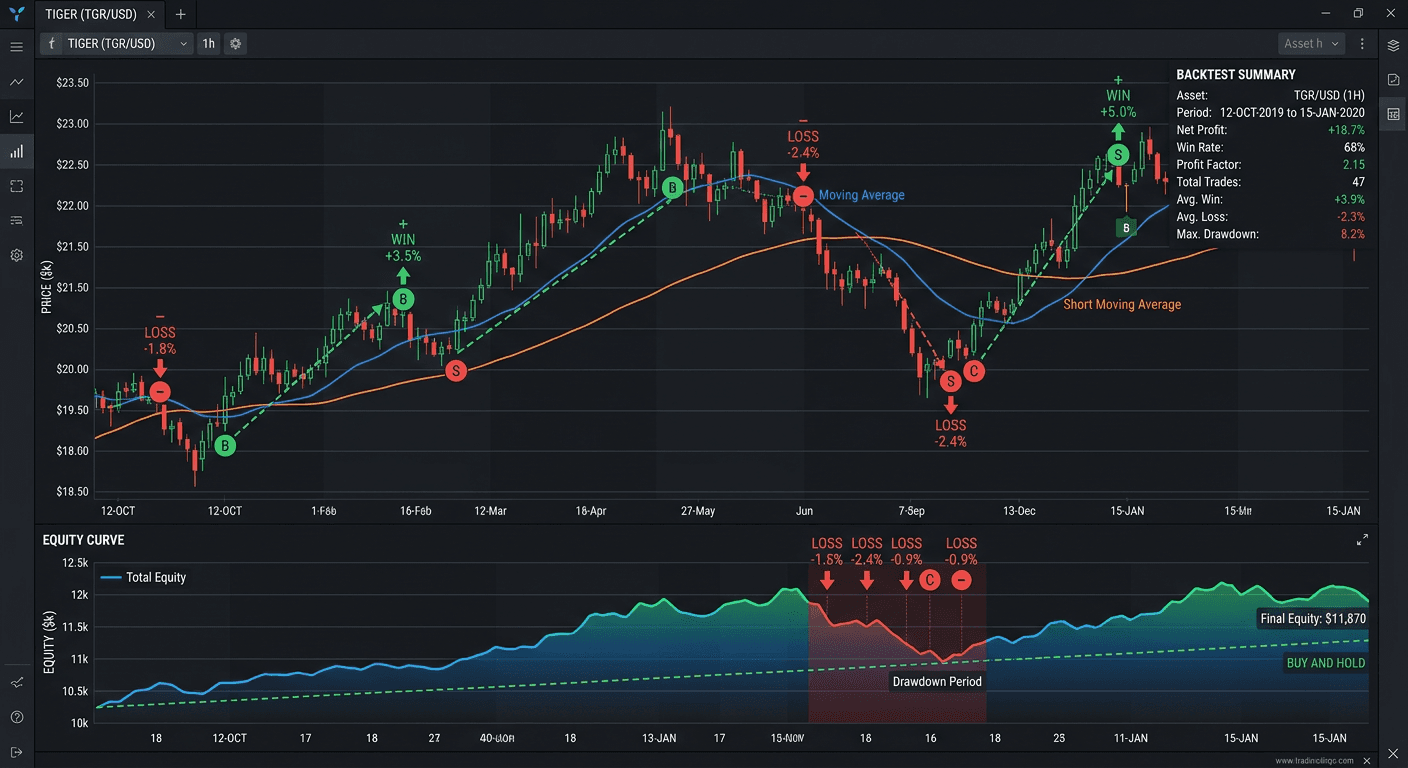
**Maximum drawdown**: The largest equity decline from peak to trough during the test period. Critical: add 50% to the historical maximum drawdown for planning purposes. Historical drawdowns systematically underestimate future drawdowns because the tested period may not include all market regimes.

**Consecutive losing streaks**: The longest sequence of consecutive losses in the historical sample. This number determines whether your risk parameters produce psychological sustainability. Six consecutive losses at 2% per trade is a 12% drawdown — most traders can survive this mentally. Six consecutive losses at 5% per trade is a 30% drawdown — most cannot.

**Profit factor**: Total gross profit divided by total gross loss. Must be above 1.0 to be profitable. Above 1.5 is generally considered robust. Above 2.0 may indicate overfitting to the sample.

  • Expectancy is the most predictive metric — not total profit, not win rate alone
  • Expectancy formula: (Win Rate × Avg Win R) − (Loss Rate × Avg Loss R)
  • Max drawdown: add 50% to historical figure for live planning — historical underpredicts
  • Consecutive losses determine psychological sustainability — calculate before going live
  • Profit factor: 1.5+ is robust, 2.0+ may indicate curve-fitting

How to Avoid Curve-Fitting and False Validation

Curve-fitting — optimizing a strategy's rules or parameters to fit the historical test data — is the primary reason retail backtests fail to predict live performance. A strategy optimized to the past is modeling historical noise, not genuine edge.

**Walk-forward validation**: After completing your in-sample backtest, test the exact same rules (without modification) on a future period of data not used in development. If performance drops significantly out-of-sample, the rules were overfitted. Acceptable degradation: up to 30–40% reduction in expectancy. If expectancy drops by 70%+ or flips negative, the strategy has no forward-looking edge.

**Parameter sensitivity testing**: Run your strategy with slightly different parameters (e.g., ±1 bar on a moving average, ±0.5 ATR on a stop). If performance is highly sensitive to exact parameter values — if changing the RSI period from 14 to 13 significantly changes results — the system is fragile. Robust strategies perform similarly across a range of parameter values.

**Regime testing**: Test separately on trending markets and ranging markets, on high-volatility periods and low-volatility periods. A strategy that only works in one market regime has limited forward applicability because regimes change unpredictably.

**The minimum backtest portfolio**: Test on at least 3 instruments in the same asset class, on at least 2 different time periods. If the strategy works on all 6 combinations, you have strong evidence. If it only works on one instrument in one period, you have a data artifact.

  • Curve-fitting: optimizing to historical data is modeling noise, not edge
  • Walk-forward validation: test on out-of-sample data — up to 30-40% degradation is acceptable
  • Parameter sensitivity: robust strategies perform similarly with slightly different parameters
  • Regime testing: verify the strategy works across trending AND ranging markets
  • Minimum portfolio: test on 3+ instruments across 2+ distinct time periods

Related Resources

FAQ

?How far back should I backtest a trading strategy?

At minimum, test across 2–3 years of data that includes different market regimes (bull, bear, sideways, high volatility, low volatility). More is better for robustness, but very long lookbacks may include market structure that no longer applies. For most retail strategies, 3–5 years of recent data with regime diversity is appropriate. Also test separately across the 2020 COVID volatility spike, as this period tests robustness to extreme conditions.

?Can I backtest without coding?

Yes — manual backtesting requires no coding. You replay charts manually, apply your written rules, and track results in a spreadsheet. This is actually preferable for discretionary strategies where the entry signal includes qualitative judgment. For purely systematic strategies with objectively definable rules, automated backtesting (TradingView Pine Script, Python) produces faster and more consistent results.

?If my backtest shows positive results, does that mean my strategy works?

A positive in-sample backtest is necessary but not sufficient. You also need: positive walk-forward (out-of-sample) results, parameter insensitivity across similar settings, regime robustness across different market conditions, and 100+ trade sample size. A positive backtest that fails any of these tests is likely curve-fitted. When all these conditions are met, you have reasonable evidence — not certainty — that the strategy has forward-looking edge.

Track Your Live Strategy Performance Against Your Backtest

Tiltless calculates your win rate, expectancy, and max drawdown in real time — so you know whether your live edge is matching what your backtest predicted.

How to Backtest a Trading Strategy: Complete Guide for Active Traders