
Updated: 2026-03-07

Forex Trading Psychology: Session-Specific Behavioral Failures and How to Fix Them

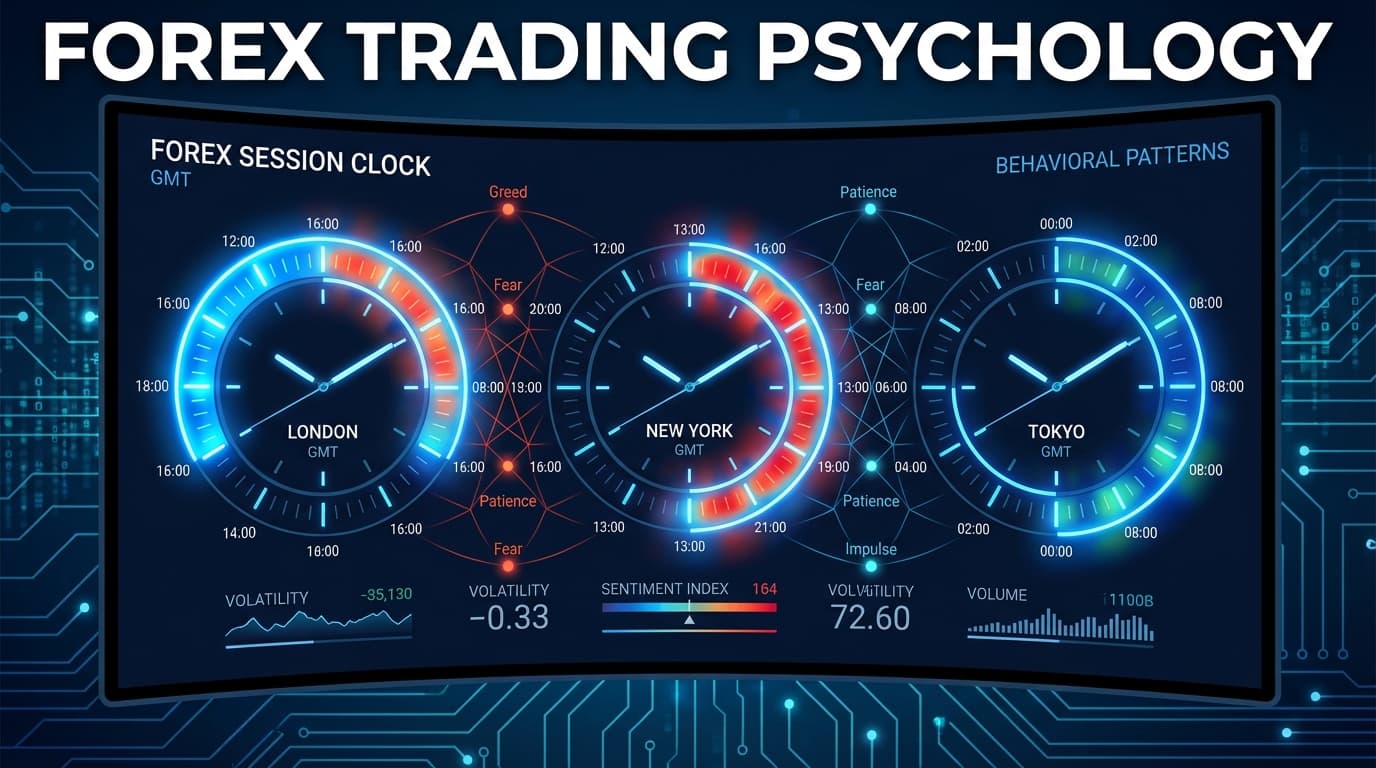
Forex is the only major financial market open 24 hours a day, 5.5 days a week, across four major geographic sessions. That structure creates a unique set of psychological failure modes that don't exist in time-bounded markets. A stock trader works within defined hours. A forex trader chooses which hours to work — and that choice, driven by FOMO, routine, or habit rather than statistical analysis of their own performance, is often the largest source of behavioral leakage in their trading. Research by Chaboud, Chiquoine, Hjalmarsson, and Vega (Federal Reserve, 2009) documented that retail forex trader performance varies significantly by session — with systematic underperformance patterns that cluster by time of day and session overlap. The specific patterns are trader-dependent: your session data will not perfectly match any generic benchmark. But the categories of failure are consistent.
Forex Trading Psychology: Session-Specific Behavioral Failures and How to Fix Them

London Open FOMO: Why the Biggest Session Causes the Most Behavioral Errors

The London session (8am-4pm GMT) is the most liquid forex session, with approximately 35% of all daily forex volume. For traders outside Europe, it represents a highly anticipated window that creates a specific emotional trap: the urgency to participate in the most active session regardless of whether their setups materialize. London open FOMO manifests as entering trades in the first 15-30 minutes of the session based on the momentum of the open rather than a well-structured setup. The problem is that London opens are notoriously volatile — the initial direction often reverses within 30-60 minutes as institutional players complete their order flow and the market finds its actual direction for the session. Retail traders who enter on the first directional push are frequently caught in the reversal. Data from retail forex broker analysis consistently shows that trades taken in the first 20 minutes of the London session have a lower win rate than trades taken after the initial volatility settles (typically 30-45 minutes into the session). Your data will show this too — if you segment your trades by session phase in Tiltless.

  • London open: 35% of daily forex volume, highest volatility, lowest setup quality in opening 20 min
  • Initial London direction reverses 40-60% of the time within the first hour
  • FOMO: entering on opening momentum rather than waiting for confirmed structure
  • Fix: mandatory 20-30 min observation period before first London trade
  • Measure it: your win rate in London's first 20 min vs after — likely a large gap

NY-London Overlap: Overtrading the Highest-Volume Window

The NY-London overlap (1-5pm GMT / 8am-12pm EST) is the single highest-volume period in forex trading — a confluence of two major sessions producing the tightest spreads and most defined directional moves. It's also where overtrading is most dangerous, precisely because it feels so justified. 'The market is moving' is the rationalization for taking 8 trades in a 4-hour window when your edge only requires 2-3. High volume and tight spreads reduce the visible cost of each individual trade. What they don't reduce is the cognitive load, decision fatigue, and behavioral drift that accumulate with trade count. Research by Lo, Repin, and Steenbarger (Journal of Cognitive Neuroscience, 2005) found that emotional arousal in financial traders is significantly correlated with trade frequency — higher trade counts produce physiological stress markers that impair decision quality, even when individual trade sizes are small. The data fix: measure your P&L by trade number within a session. Most traders find that trades 4+ in the NY-London window have significantly lower win rates than trades 1-3.

  • NY-London overlap: highest volume, tightest spreads, most justified overtrading
  • Decision fatigue accumulates with trade count regardless of position size
  • Emotional arousal increases with trade frequency — Lo, Repin, Steenbarger (2005)
  • Measure it: your win rate on trade 1-2 vs trade 4+ in the overlap session
  • Fix: maximum 3 trades per session in the overlap — quality over quantity

Asian Session Revenge Trading: Low Liquidity, High Emotional Risk

The Asian session (11pm-8am GMT) has the lowest volume of the three major sessions. Spreads are wider, range is typically narrower, and many major pairs consolidate rather than trend. For traders in time zones where the Asian session is their primary window (Australia, Japan, Southeast Asia), this is simply their market — they learn to trade in these conditions and adapt. For Western traders who access the Asian session after a losing European or American session, it's a behavioral trap. Lower liquidity means stops are hit more easily on the same position size. Wider spreads mean the threshold for profitable entries is higher. And the emotional state of a trader who lost money earlier in the day and is now 'making it back' in the Asian session is precisely the state in which sound judgment is most impaired. If your journal data shows that your Asian session trades taken on days when you had prior session losses have a win rate 20-30% below your Asian session baseline, revenge motivation is the cause.

  • Asian session: lowest volume, wider spreads, smaller ranges than EU/NY
  • Western traders in Asian session after losses = emotional revenge context
  • Wider spreads increase break-even requirements — bad time to take marginal setups
  • Measure it: Asian session win rate on losing-prior-session days vs neutral days
  • Fix: no Asian session trading on days with >1% prior session losses

Building Session-Based Rules From Your Own Data

Generic forex trading psychology advice says 'trade during your best session.' Your specific data says which session that is. The process: segment your forex trade history by session (Asian, London, NY, overlap). Calculate win rate, average R, and trade count for each. Look for two signals: where your win rate is significantly above your baseline (session strength), and where your worst trades cluster (session weakness). Add a second segmentation: for each session, separate trades taken on days when you were already net positive vs days when you were net negative. The revenge trading signal will appear here — a session that shows neutral win rate in aggregate will often show dramatically worse win rate on negative prior-day trades. These two data points — session strength and revenge-session interaction — are the inputs to meaningful session rules. 'I only trade the NY-London overlap, and I stop trading that session if I've already lost 0.75%' is a rule derived from data. 'Trade your best session' is generic.

  • Segment trades by session: Asian, London, NY, overlap
  • Identify your session strength: where win rate is consistently above baseline
  • Identify revenge-session interaction: where losses precede your worst session trades
  • Build rules: session + prior-loss condition + position count limit
  • Tiltless session-level analysis surfaces all this in your trade history automatically

Related Resources

FAQ

?What is the best forex trading session for retail traders?

The NY-London overlap (8am-12pm EST) offers the tightest spreads and most defined directional moves. However, the 'best session' for you specifically depends on your data. Many traders have edge in one session but not others — and the session where you feel the most active pressure to trade (London open for most) is often not where your statistical edge is strongest. Analyze your trade history segmented by session before choosing.

?Why do I keep losing money in forex despite knowing the basics?

Behavioral patterns account for the majority of retail forex losses among traders who understand technical analysis. The most common: London open FOMO (entering in the first 20 minutes before the true direction is established), overtrading the NY-London overlap (taking 6-8 trades when edge only requires 2-3), and Asian session revenge trading after prior session losses. All three are identifiable in your trade journal data before they become obvious in your P&L.

?Does Tiltless support forex trading journals?

Yes. Tiltless supports forex trade import from MT4, MT5, OANDA, Interactive Brokers, and most major forex brokers. Session-level analysis shows your performance by time of day and session phase. Behavioral scoring per trade flags FOMO, tilt, and revenge probability. Edge Lab tests whether your session-level performance differences are statistically significant.

Find Your Worst Forex Session in Your Own Data

Tiltless imports forex trades and segments performance by session, time of day, and behavioral state. See where your edge is real and where behavioral drift is costing you money.

Forex Trading Psychology: Session Failures and Fixes | Tiltless