Updated: 2026-03-07

Funded Trader Journal: What to Track Once You Have a Prop Account

Getting a funded account is hard. Keeping it is harder. The traders who pass their evaluation and then blow their funded account have one thing in common: they stopped reviewing their behavior. The evaluation phase forces discipline through rules and stakes. Once you are funded, that external pressure eases — and for many traders, so does the rigor. This guide covers exactly what to journal as a funded trader, which metrics matter most to your account survival, and the behavioral risks that kill funded accounts that nobody talks about.

Funded Trader Journal: What to Track Once You Have a Prop Account

Why Your Journaling Requirements Change Once You Are Funded

During an evaluation, your primary concern is passing: hit the profit target, stay within drawdown rules, do not violate the daily loss limit. The rules are clear and the stakes are the evaluation fee.

Once funded, the equation flips. Now you have three simultaneous objectives: grow the account, survive the drawdown rules, and hit the consistency requirements for a payout. These objectives can conflict. Growing the account might push you toward larger sizing exactly when proximity to your trailing drawdown limit demands smaller sizing. Chasing a payout might push you to take a marginal trade on Friday afternoon that violates your own rules.

According to data published by FTMO, approximately 90% of traders who attempt funded evaluations do not pass on their first try. Of those who do get funded, a significant portion blow their funded account within the first 90 days. The most common cause: behavioral patterns that were suppressed during the evaluation but re-emerge once the initial pressure is off.

According to Barber and Odean's research on individual investor behavior, published in the Journal of Finance, overconfidence increases significantly following a string of wins — and funded traders who just passed an evaluation often experience exactly that sequence. The evaluation win is real. The overconfidence it triggers is dangerous.

A funded trader journal must track three layers that a standard trading journal does not: account constraint proximity (how close are you to your limits?), consistency metrics (are you eligible for a payout?), and behavioral risk signals (are you trading differently now than you did during the evaluation?).

The Metrics Every Funded Trader Must Monitor Daily

These are the numbers your journal needs to capture every single day — not weekly, daily. The difference between staying funded and getting reset is often one bad session that you would have avoided if you had checked these numbers before opening the platform.

Daily Max Loss Remaining: Your firm's daily loss limit (typically 4-5% of starting balance for most prop firms) minus your current day's P&L. If you are down 3% and your limit is 4%, you have 1% remaining. This number should be the first thing you check at session open and the number that determines your maximum position size for the session.

Trailing Drawdown Proximity: The single most dangerous metric in funded trading. A trailing drawdown limit follows your high-water mark up, not down. If you started with a $100k account, hit $107k, and your trailing drawdown is 5%, your new floor is $101,650 — not the original $95,000. Many funded traders do not realize how quickly a profitable run can tighten their actual risk. FTMO's standard trailing drawdown is 10% of starting balance; Apex Trader Funding uses similar parameters across their evaluation tiers. Calculate your exact trailing floor every morning.

Consistency Score: Most prop firms require that no single trading day account for more than 30-50% of your total profits for a payout period. A trader who makes $4,000 on Monday and then loses $500 each remaining day of the week may have a net profit of $1,500 — but fail the consistency requirement because Monday represented 267% of their net result. Track your daily P&L distribution, not just your cumulative P&L.

Payout Eligibility Days: Most funded accounts require a minimum number of active trading days (typically 10-30) before a payout request. Track where you are in this cycle and factor it into your daily planning.

R-Multiple Distribution: Even funded traders need to track whether their wins and losses are coming from their A-setups or from deviations. A funded account with a positive balance built on low-quality, high-frequency trades is fragile — one bad streak will breach a limit.

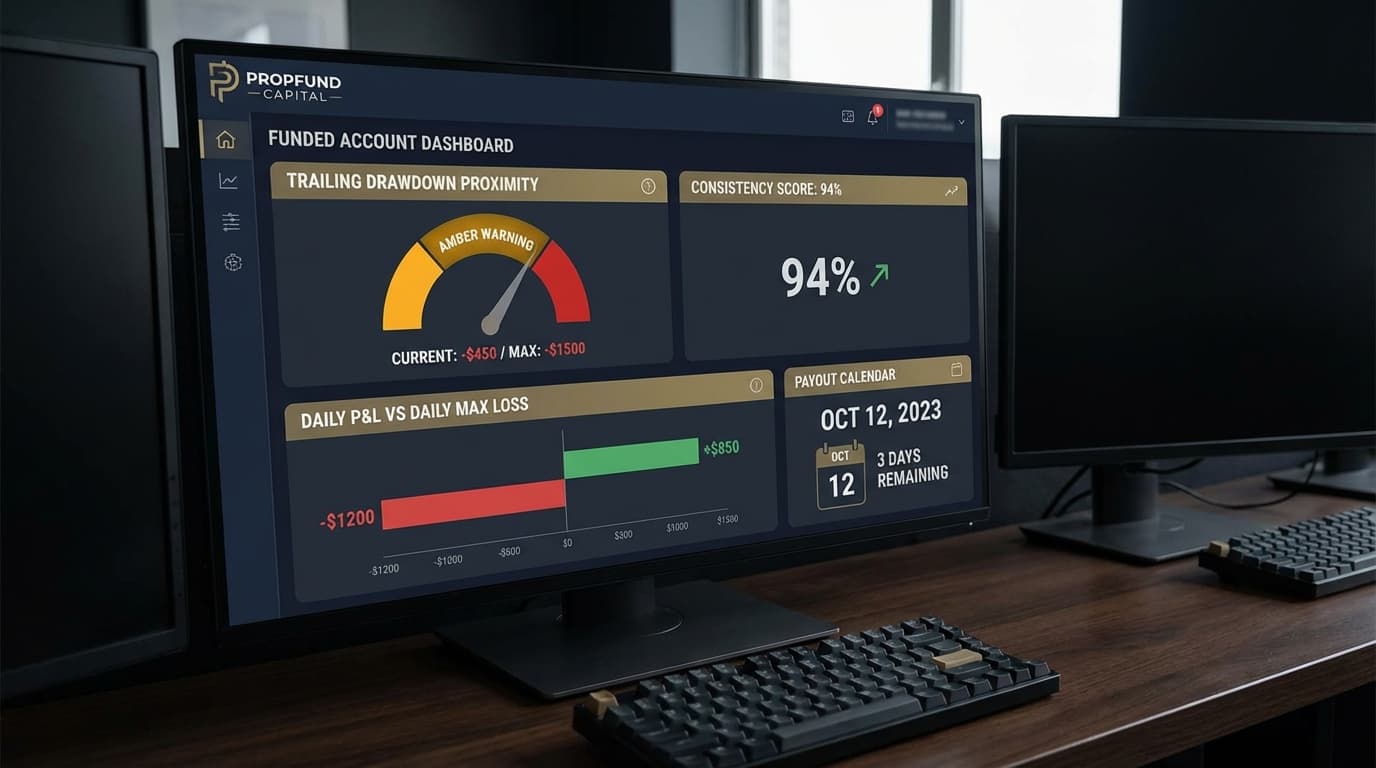
  • Daily max loss remaining — calculate before session open, determines your max position size
  • Trailing drawdown proximity — your actual floor moves up as you profit; recalculate daily
  • Consistency score — no single day should dominate your payout period P&L
  • Payout eligibility days — know exactly where you are in the minimum-day cycle
  • R-multiple by setup — confirm your balance is coming from high-quality trades, not luck

The Behavioral Risks That Kill Funded Accounts

The technical rules are the easy part. The behavioral patterns are what end funded accounts. These three are the most dangerous.

Overtrading After a Good Day: You hit your daily target by noon. You are up 2% and feeling sharp. So you take one more trade — after all, you have buffer. Then another. By end of day you have given back 60% of your gains and you are now closer to your trailing drawdown floor than you were at open. This pattern is so common that some funded traders create a hard rule: platform closed once daily target is hit. No exceptions.

According to Barber and Odean's 'Trading Is Hazardous to Your Wealth' (Journal of Finance, 2000), traders who experience a positive return period significantly increase their trading frequency in the following period — and this increased activity reliably degrades subsequent performance. The win creates overconfidence; the overconfidence creates overtrading; the overtrading creates losses.

FOMO When Already at Daily Target: A related but distinct pattern. You are up 1.8% and your daily target is 2%. A strong momentum move appears. You know you should not trade — you are near your target, it is not your setup — but the fear of missing a move is overwhelming. You enter late, at a bad price, into a trade you would not take if you were flat on the day. This trade has poor expected value and risks a limit breach.

Revenge Trading After Hitting Daily Loss: The most account-ending pattern. You are down 3% against a 4% daily limit. You have 1% of risk remaining. Instead of closing the platform, you take a large trade to make it back and breach the daily loss limit. Account reset. The psychological driver is loss aversion — the same force Kahneman identified as making losses hurt 2-2.5 times more than equivalent gains feel good. That pain drives irrational risk-taking.

A funded trader journal that tracks emotional state at entry, session trade count, and daily P&L proximity to limits will surface all three of these patterns within 2-3 weeks.

  • Overtrading after a good day: Set a platform-closed rule once daily target is hit
  • FOMO when near daily target: Near-target sessions require higher setup quality standards, not lower
  • Revenge trading after daily loss: Track trades taken while down more than 2% as a separate behavioral metric

How to Structure Your Funded Trader Review Routine

A funded trader needs three review cadences, not one.

Daily Review (5 minutes): This is a constraint check and behavioral acknowledgment, not a full analysis. Answer four questions: (1) Did I trade within my daily loss limit buffer? (2) Did I stay at or above my trailing drawdown floor? (3) Did I follow my trading plan for every trade? (4) Flag any behavioral signal — overtrading, FOMO entry, revenge attempt. Log the answers. On days where all four are clean, move on. On days where one is flagged, add a note about what triggered it — not a moral judgment, just a factual observation.

Weekly Review (30 minutes): Now you are looking at patterns. Did the behavioral flags cluster around specific market conditions, times of day, or account P&L states? Is your win rate on A-setups holding steady, or has it declined since you got funded (a common overconfidence signal)? Calculate your consistency score for the week and project whether you are on track for payout eligibility.

Pre-Payout Review (60 minutes): Before requesting any payout, do a full review of your payout period. Check your consistency score against firm requirements. Review every losing trade for execution quality. Confirm you have not had any rule violations that might affect payout approval. This review also serves as a psychological reset — it reminds you what disciplined trading looks like and sets the tone for the next payout period.

Tiltless automates the quantitative layer of all three reviews. Your daily constraint metrics, weekly consistency scores, and behavioral pattern flags are generated automatically from your broker data. You provide the qualitative layer — the why behind each flag — and Tiltless provides the data that makes that reflection accurate.

  • Daily review: 5 minutes, 4 questions, constraint check and behavioral flag
  • Weekly review: 30 minutes, pattern analysis, consistency score, payout trajectory
  • Pre-payout review: 60 minutes, full period audit, consistency verification, psychological reset

Setting Up Your Funded Trader Journal in Tiltless

A funded trader journal needs to be configured differently from a standard trading journal. The key additions:

Account constraints as hard inputs: Enter your firm's daily loss limit, trailing drawdown limit, and consistency requirement. Tiltless will display your proximity to each constraint at session open and flag you if your current session is moving you toward a breach.

Behavioral triggers specific to funded trading: Tag entries with near-daily-target (trades taken within 0.5% of your daily profit target), drawdown-proximity (trades taken within 1% of your trailing floor), and post-loss-entry (any trade taken within 30 minutes of a stop-out). These tags are invisible without a system — and they are where most funded account damage occurs.

Payout period tracking: Log your trading day count and cumulative payout-period P&L so you always know your payout eligibility status without logging into your firm's dashboard.

The goal is to make your funded account constraints as visible as your P&L — because for a funded trader, breaching a constraint is more expensive than a losing trade. A $200 losing trade is a cost. A daily limit breach can reset a $50,000 account.

Related Resources

FAQ

?Do funded traders need a different journal than regular traders?

Yes. A funded trader journal needs to track account constraints (daily loss limit proximity, trailing drawdown floor) and consistency metrics (payout eligibility) that a standard journal does not address. The behavioral layer is the same, but the quantitative framework must reflect the specific rules of your prop firm.

?What is a trailing drawdown and why does it matter for journaling?

A trailing drawdown limit follows your high-water mark upward. If you start at $100k with a 5% trailing drawdown, your floor starts at $95k. But if you grow to $110k, your floor rises to $104,500. The danger: a profitable run can dramatically reduce your actual risk buffer without you noticing. A funded trader journal must calculate and display the trailing floor every day.

?What is a consistency requirement in prop firms?

Most prop firms require that no single trading day account for more than 30-50% of your total payout-period profits. This prevents traders from taking one enormous risk to hit their target. Track your daily P&L distribution every week, not just at payout time, to avoid a nasty surprise when you request withdrawal.

?How do I avoid getting reset on a funded account?

The three behaviors that most commonly cause funded account resets are: overtrading after winning days, revenge trading after hitting daily loss limits, and scaling up too aggressively when the account is growing. A funded trader journal that tracks session trade count, emotional state at entry, and drawdown proximity will surface these patterns before they breach a limit.

?Can Tiltless connect to prop firm accounts like FTMO or Apex?

Tiltless connects to the brokers and platforms that prop firms use for funded accounts — including MetaTrader 4/5, TradeStation, and others. Once connected, it auto-imports every trade and applies the funded trader metrics framework automatically. You set up your firm's specific constraints once, and Tiltless monitors them on every session.

Journal built for funded traders

Tiltless tracks your trailing drawdown proximity, consistency score, and behavioral risk signals automatically — so you can focus on trading, not spreadsheet math. Connect your funded account free.

Funded Trader Journal: How to Track Your Prop Account Performance