
Updated: 2026-03-07

Futures Trading Psychology: The Mental Edge That Separates Survivors from Quitters

Futures trading amplifies everything. The leverage that makes a 2% move on ES worth $5,000 also makes a 2% adverse move feel catastrophic. The same account that can compound at 40% annually when trading correctly can be wiped out in a single day when trading incorrectly. Margin calls don't give you time to think — they happen in real time. The psychological demands of futures trading are qualitatively different from stocks or even options. And most traders who fail at futures don't fail because of bad strategy. They fail because their behavioral patterns — already present in their trading before they touched futures — get amplified by the leverage, the speed, and the 23-hour market until those patterns produce outcomes that aren't survivable.
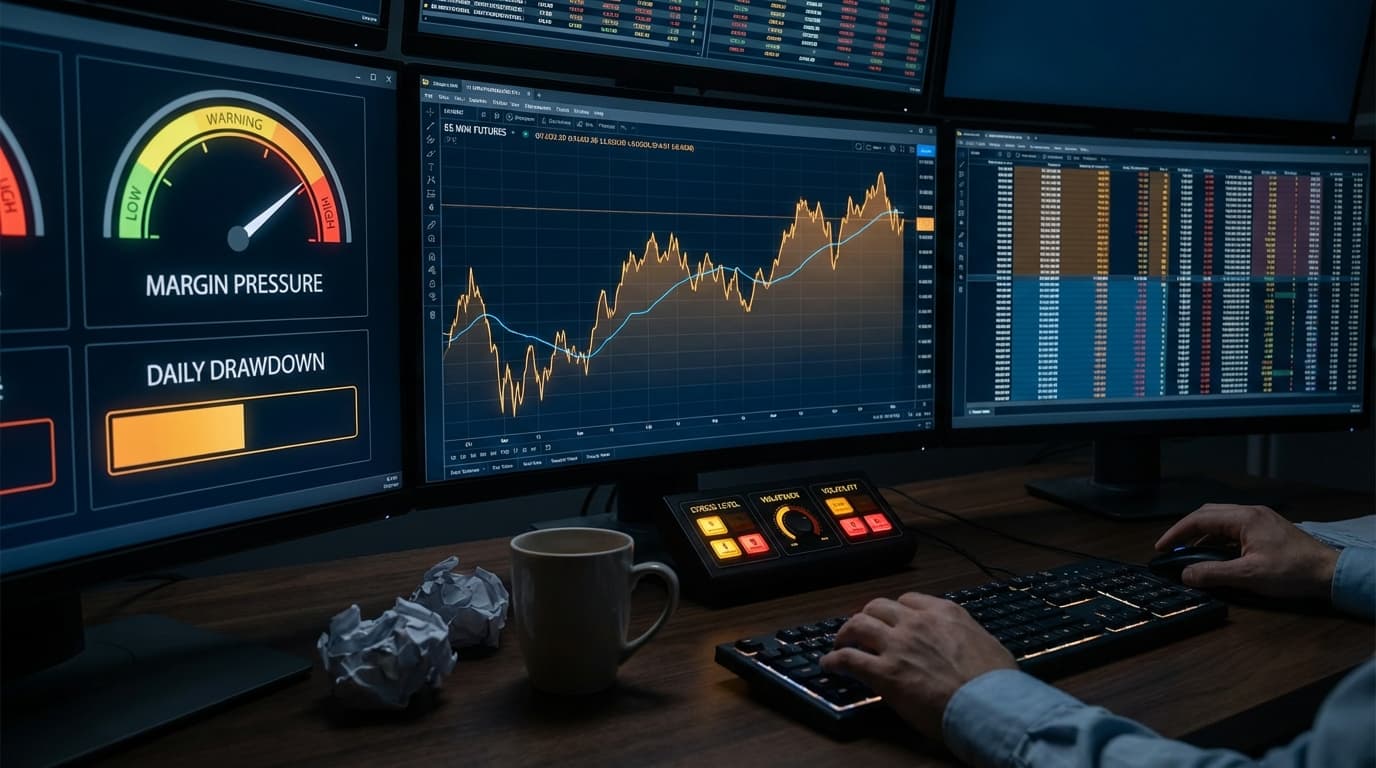
Futures Trading Psychology: The Mental Edge That Separates Survivors from Quitters

How Leverage Amplifies Every Behavioral Pattern You Have

A trader who revenge trades after losses in stocks is annoying to their P&L. The same trader revenge trading after losses in ES futures can blow through a $50,000 funded account in an afternoon.

Leverage doesn't create behavioral problems. It reveals the ones that were already there and multiplies their consequences.

According to ESMA/FCA mandatory risk disclosures, 74-78% of retail CFD and derivative traders lose money in any given quarter. Futures traders face similar statistics — not because futures are inherently unprofitable, but because the leverage and speed of futures markets punish behavioral errors at a rate that more forgiving markets don't.

The three behavioral patterns that kill futures traders most often:

**Revenge trading after margin pressure:** Taking bigger positions after a margin-threatening drawdown to recover quickly. The urgency is real, but the response is exactly backward.

**Stop-moving during overnight holds:** The position that seemed fine at 4pm looks dangerous at 11pm when Asia opens down. Moving stops during overnight holds based on emotion rather than technical levels destroys defined-risk frameworks.

**Overtrading during news events:** FOMC, CPI, NFP — high-volatility news events trigger FOMO entries at the worst possible time. Most futures traders have significantly lower win rates during news-driven sessions.

  • Leverage multiplies both gains and behavioral error consequences
  • 74-78% of retail derivative traders lose money quarterly (ESMA/FCA disclosure data)
  • Revenge trading + futures leverage = account destruction, not gradual erosion
  • Behavioral patterns invisible in stocks become critical in futures

Funded Account Psychology: Why Prop Firm Challenges Create Unique Mental Stress

Trading a funded account — whether through Apex Trader Funding, Topstep, FTMO, or similar — creates psychological constraints that discretionary retail accounts don't have.

The daily drawdown limit is the primary mental constraint. A $150K Apex account with a $2,500 daily drawdown limit means that a single bad morning — four or five revenge trades, each losing $500-600 — ends the trading day. For many traders, this creates a loss-aversion spiral: the fear of hitting the daily drawdown makes them take trades more defensively, which creates hesitation, which creates FOMO when they miss moves, which creates the exact revenge trading that triggers the drawdown.

**The data on funded account failures:** Most traders who fail prop firm challenges don't fail because their strategy is wrong. They fail because their behavioral patterns produce a single catastrophic session — usually triggered by a loss sequence in the first few days of the challenge. The strategy would have recovered. The daily drawdown rule didn't allow for it.

The behavioral antidote isn't more discipline — it's pre-commitment rules: maximum trades per day, mandatory break after two consecutive losses, hard stop at 50% of daily drawdown limit. Rules made before the session starts override emotional decisions made during the session.

  • Daily drawdown limits create unique psychological pressure not present in retail accounts
  • Most funded account failures trace to a single catastrophic session, not gradual erosion
  • Pre-commitment rules outperform in-session willpower for behavioral control
  • Track daily drawdown consumption as a behavior metric, not just a risk metric

The Psychology of Overnight Risk in Futures

Futures traders who hold positions overnight face a psychological challenge that equity traders rarely experience at the same intensity: gap risk.

A position that shows $800 unrealized profit at 5pm can open at a $1,200 unrealized loss at 9pm when a geopolitical event moves the market overnight. This uncertainty — knowing your risk is not fully defined while you sleep — creates chronic low-level anxiety that compounds over time.

The behavioral responses to overnight anxiety:

**Premature close:** Closing profitable positions before their targets to remove overnight exposure. This systematically shrinks average wins while leaving losses intact (traders rarely close losing positions for the same reason — the loss isn't "locked in" yet).

**Stop-moving:** Moving protective stops wider than the technical level justifies to avoid being stopped out by overnight volatility. This transforms a defined-risk trade into an undefined-risk trade.

**Position sizing down:** Taking smaller size on valid setups because "anything can happen overnight." While position sizing is often appropriate, fear-driven size reduction prevents the compounding necessary for account growth.

The solution is clarity before the trade: a defined overnight plan (hold/close/reduce at X level) decided before the position is entered, not after the emotions of an open P&L are present.

How to Measure Your Futures Trading Psychology

Futures traders need behavioral tracking that accounts for the unique patterns their market creates.

Key behavioral metrics to track:

**Post-margin-touch win rate:** What happens to your win rate after your account approaches its daily drawdown limit? If it drops significantly, you have a tilt pattern triggered by drawdown pressure.

**News session win rate:** Compare your win rate during FOMC/CPI/NFP weeks vs. normal weeks. High FOMO scores during news sessions are the most common futures-specific behavioral pattern.

**Consecutive loss recovery rate:** After 2-3 consecutive losses, what percentage of your next trades win? This directly measures your revenge trading susceptibility in a futures context.

**Overnight hold performance:** Do positions held overnight perform better or worse than your intraday positions? The performance gap tells you whether overnight anxiety is affecting your hold quality.

Tiltless imports futures trade history from all major platforms via CSV (NinjaTrader, TradeStation, Tradovate, Sierra Chart, Rithmic). The behavioral scoring engine then runs these specific pattern analyses automatically.

Related Resources

FAQ

?What is the biggest psychological mistake futures traders make?

Revenge trading after a daily drawdown hit — specifically in funded accounts with strict loss limits. When a trader approaches their daily drawdown limit and takes aggressive positions to recover, they often breach the limit and lose the account. The emotional urgency created by drawdown pressure is the number one killer of funded futures accounts.

?How does futures trading psychology differ from stock trading psychology?

Three key differences: (1) Leverage magnifies behavioral errors from annoying to catastrophic. (2) 23-hour markets with overnight gaps create chronic anxiety that stock traders at regular session hours don't experience. (3) Funded account constraints (daily drawdown limits, profit targets) create unique psychological pressure that changes how emotional triggers fire.

?Can I trade ES or NQ futures and import my data to Tiltless?

Yes. Tiltless supports CSV import from NinjaTrader, TradeStation, Tradovate, Sierra Chart, Rithmic, and any platform that exports trade history in a standard format. Once imported, the same behavioral scoring (tilt, FOMO, revenge, fatigue) and Edge Lab analysis applies to your futures data.

?How do I handle the psychology of funded account trading?

Pre-commitment rules made before the session starts are more reliable than in-session willpower. Before each trading day: set a maximum trade count, define a mandatory break trigger (e.g., two consecutive losses), and commit to a hard stop at 50% of your daily drawdown limit. Track whether you followed these rules — that compliance rate is a leading indicator of long-term funded account survival.

Track your futures behavioral patterns

Import from NinjaTrader, TradeStation, Tradovate, or any CSV export. Tiltless shows you exactly which behavioral patterns are hitting your funded account.

Futures Trading Psychology | Mental Edge for ES, NQ, CL, and Futures Traders