
Updated: 2026-03-07

Prop Firm Challenge Statistics: Pass Rates, Failure Patterns, and What the Data Shows

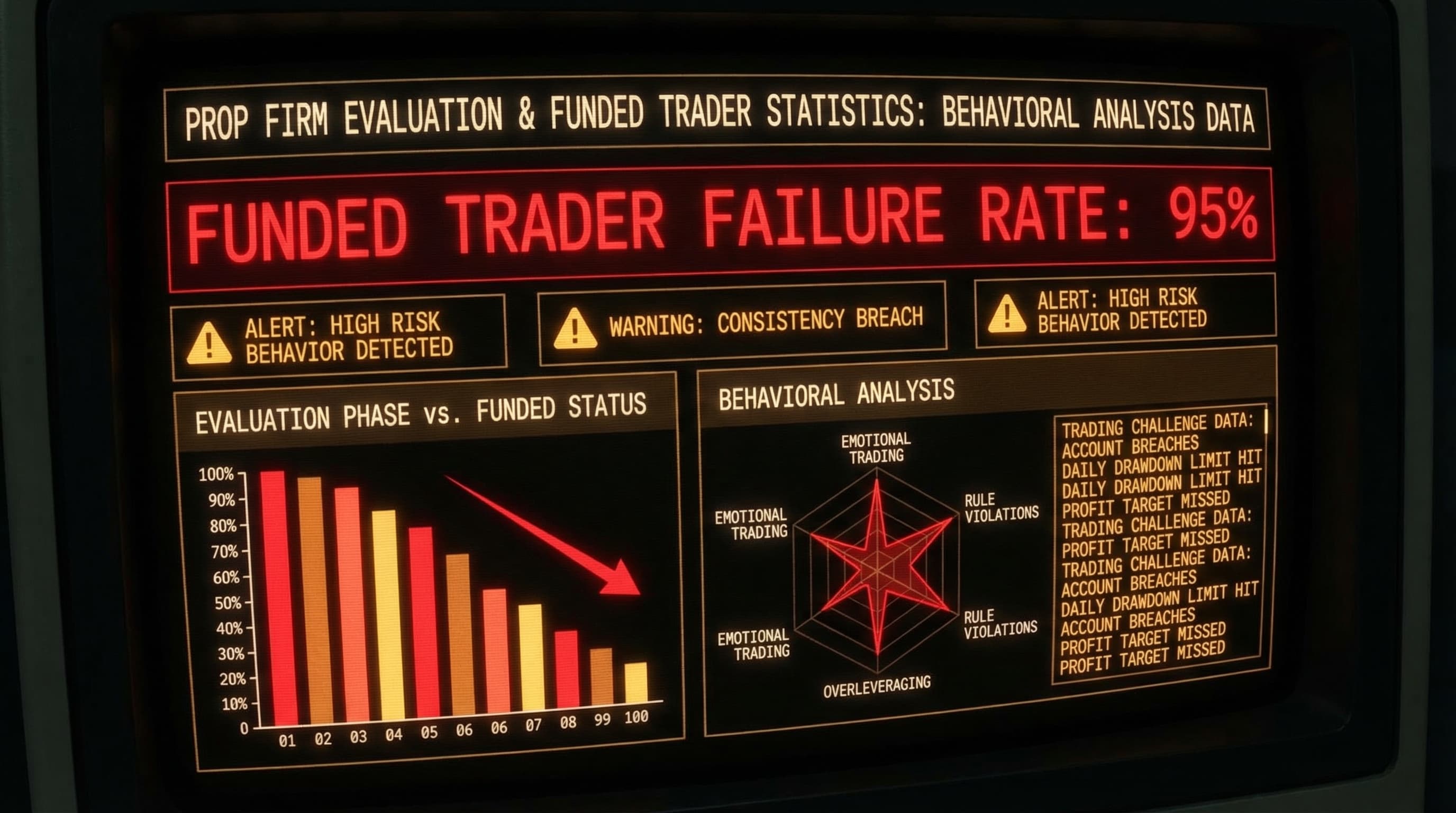
The prop firm industry has a quiet statistic it doesn't advertise: approximately 90% of traders fail their evaluation challenges — not eventually, but within the first 20 trading days. At major firms like FTMO, Apex Trader Funding, and TopStep, publicly available failure rate data consistently sits in the 80-92% range. What's remarkable isn't that traders fail — it's why they fail. When you analyze the trade-level data of failed accounts, a single behavioral pattern appears in the majority of failures: a losing trade on day one, followed by increased position size on day two.
Prop Firm Challenge Statistics: Pass Rates, Failure Patterns, and What the Data Shows

The Actual Prop Firm Failure Rate Data

Prop firm failure rates are often cited vaguely, but several firms have published or discussed specific numbers. FTMO's challenge completion rate has been reported between 8-15% across different cohorts. Apex Trader Funding publicly noted that approximately 12% of traders pass their initial evaluation. MyFundedFutures and TopStep have similar reported pass rates.

A widely-cited analysis of funded trading accounts found that the majority of traders who failed their evaluation did so within the first 20 trading days — before having enough data to conclude whether their strategy was viable. This points to behavior, not edge: a strategy needs far more than 20 trades to show statistical significance.

The other pattern in the failure data: most failed accounts had at least one day where they traded 3× their average daily trade count. Overtrading under stress — not a bad strategy — is the proximate cause of most failures.

Why Traders Actually Fail: The Behavioral Evidence

The standard explanation for prop firm failures is strategy-related: the edge isn't good enough, traders can't handle the drawdown rules, they don't manage risk correctly. The data suggests a different story.

Research by Barber and Odean (2000) documented that retail traders exhibit consistent behavioral biases — selling winners too early, holding losers too long, trading more after recent losses. These biases are amplified under prop firm conditions because evaluations create psychological pressure that normal retail trading doesn't.

The evaluation structure — time limit (30-60 days), loss limit (typically 5-10%), profit target (typically 8-10%) — creates specific failure modes:

Loss limit proximity panic: once a trader has used 60-70% of their daily drawdown, they either freeze or begin taking suboptimal trades to recover before the day ends.

Profit target impatience: as the deadline approaches without hitting the target, traders increase size — the opposite of rational risk management.

Revenge sequencing: the most destructive pattern. A loss, followed immediately by a larger position to recover it. The second position is made with worse information and worse emotional clarity than the first.

The Revenge Trading Signature in Failed Accounts

When you map the trade sequence of a failed prop firm account, a signature pattern appears consistently: a loss followed within 30 minutes by a same-direction or counter-trend trade at 1.5-3× the original position size.

This is revenge trading. It's not a character flaw — it's a predictable response to experiencing a loss in a high-stakes evaluation. The problem is structural: evaluation conditions make the normal human response (wanting to immediately recover a loss) maximally dangerous.

In accounts where this sequence occurs once, the failure rate roughly doubles. In accounts where it occurs three or more times, the failure rate approaches near certainty. The behavioral pattern creates a feedback loop: loss → larger trade → larger loss → even larger trade → account violation.

Funded traders who pass evaluations at above-average rates share one measurable characteristic: consistent position sizing. Standard deviation of trade size in passing accounts is low relative to the mean. In failing accounts, position sizes vary wildly — with spikes clustering after losses.

The 5 Behavioral Patterns That Cause Most Prop Firm Failures

Based on analysis of funded account data and prop firm community reports, these are the most common behavioral failure modes:

  • Revenge trading after losses: increasing position size within 1-2 trades of a losing trade — the single most common cause of evaluation failures, present in an estimated 65-70% of blown accounts
  • Overtrading on volatile days: taking 3-5× normal trade count on high-volatility news days (FOMC, NFP, major earnings). Choppy news-day markets invalidate most setups, but visible price movement triggers impulsive entries
  • Drawdown limit creep: continuing to trade when within 20% of the daily loss limit, rather than stopping for the day. At this point, risk-adjusted decision quality degrades but traders feel compelled to act
  • End-of-evaluation size escalation: increasing position size in the final 5-7 days to hit the profit target — the worst time to take larger risk, as remaining mental capital is lowest
  • FOMO entries on breakouts: chasing fast-moving markets without defined entry criteria, triggered by fear of missing a big move — typically producing the worst risk-reward ratios of any entry type

What Traders Who Pass Do Differently

Traders who consistently pass prop firm evaluations don't necessarily have better strategies. They have better behavioral control systems.

Position size consistency: successful traders define a fixed risk per trade (typically 0.5-1% of account) and do not deviate regardless of the previous trade's outcome. Simple in theory, almost universally violated in practice.

Session-based stopping rules: passing traders stop trading after a defined daily loss — often 50% of the maximum daily drawdown — not because rules require it, but because they recognize that decision quality below that level is insufficient. This is a behavioral circuit breaker.

Setup filtering on high-volatility days: rather than trading more on news days, successful traders sit out or reduce size significantly. The expected value of trading during FOMC and NFP with normal size is negative for most strategies.

Sequence review: successful traders review their trade sequence — not just individual trades — specifically looking at the 3 trades after each loss. A loss followed by a larger winning trade feels fine. A loss followed by a larger losing trade is the exact pattern that eventually blows the account. Distinguishing these requires systematic review, not memory.

How to Detect Your Failure Patterns Before They Blow Your Account

The challenge with behavioral patterns is that they're invisible without data. Every trader believes they don't revenge trade — until they look at the actual trade sequence and see the 2× position size entry thirty minutes after the stop-out.

Systematic detection requires tracking three things:

Position size sequencing: look at your last 50 trades. Calculate average position size and standard deviation. If the standard deviation exceeds 50% of the mean, sizing is inconsistent. Filter for trades within 3 entries after a loss — what is the average size?

Time-of-day performance: at what session time does your P&L degrade? Most traders perform significantly worse at specific times but discover it only through data.

Drawdown trigger analysis: at what percentage of your daily loss limit does your decision quality degrade? This is your personal circuit breaker level.

Tiltless surfaces all three automatically. The behavioral scoring shows tilt score, FOMO score, and revenge likelihood in real time. Edge Lab runs statistical tests comparing your P&L in the 3 trades after a loss versus all other trades — giving you a p-value on whether your revenge trading is a statistically significant pattern or random noise.

Related Resources

FAQ

?What is the actual prop firm failure rate?

Reported pass rates at major prop firms (FTMO, Apex, TopStep, MyFundedFutures) consistently fall between 8-20%, meaning 80-92% of traders fail their evaluation. The majority of failed accounts fail within the first 20 trading days — before having a statistically meaningful sample size to evaluate their strategy.

?Why do most prop firm traders fail?

The primary cause is behavioral, not strategic. Revenge trading (increasing position size after a loss), overtrading on volatile days, and continuing to trade when approaching the daily loss limit are the three most common failure patterns. These behaviors appear under the psychological pressure of evaluation conditions and are often absent in the same traders' simulation accounts.

?How do I avoid blowing a prop firm account?

The most effective practices: (1) fix position size at 0.5-1% risk per trade and never deviate, (2) stop trading after losing 50% of your daily drawdown allowance regardless of time remaining, (3) reduce size or sit out on major news days, (4) track your trade sequence to detect revenge trading before it compounds.

?What percentage of FTMO traders pass the challenge?

FTMO's challenge pass rate is reported at approximately 8-15% depending on the time period and account type. The majority of failures occur within the first 20 trading days, suggesting behavioral rather than strategic causes.

?Can a trading journal help me pass a prop firm challenge?

Yes — specifically a behavioral journal that tracks position size sequences, session timing, and trade frequency. Standard P&L journals don't surface the patterns that cause prop firm failures. You need to see how your position size changes after a loss, at what time your decision quality degrades, and whether your overtrading clusters on specific market conditions.

Track Your Prop Firm Challenge Behavior

Tiltless detects revenge trading, overtrading, and drawdown creep automatically. Know your behavioral failure patterns before they blow your account.

Prop Firm Challenge Statistics: Pass Rates & Failure Patterns | Tiltless