Updated: 2026-03-07

How to Analyze Losing Trades (Without the Emotional Spiral)

Most traders look at a losing trade and feel bad. Elite traders look at the same trade and find the pattern. The difference is not discipline — it is a system for analysis. Emotional loss review is not just ineffective; it is actively counterproductive. When you review losses in a triggered emotional state, your brain is optimized for threat detection, not pattern recognition. You will find a scapegoat (bad fill, slippage, news) rather than a signal. The 5-step framework below is designed to bypass that emotional interference and extract the actual lesson.

How to Analyze Losing Trades (Without the Emotional Spiral)

Why Emotional Loss Review Is Counterproductive

When you take a loss, your brain activates the same threat-response circuits as a physical danger. Cortisol and adrenaline flood the system. Working memory narrows. Pattern recognition — a prefrontal cortex function — degrades significantly.

In this state, reviewing a trade is neurologically similar to trying to read while someone shouts at you. You process surface-level details (the candle that stopped you out, the news headline you missed) and miss the structural pattern (you have been trading overleveraged on Fridays for six weeks).

According to Daniel Kahneman's research on loss aversion, which earned the 2002 Nobel Prize in Economics, losses hurt psychologically approximately 2 to 2.5 times more than equivalent gains feel good. This asymmetry means a $500 loss generates roughly the same psychological distress as a $1,000 to $1,250 gain would rationally justify. Your emotional review of a loss is operating on a distorted scale from the start.

According to Brett Steenbarger's research on trader performance, traders who conducted structured, delayed reviews of losing trades improved their behavioral metrics significantly faster than those who reviewed losses immediately and emotionally. The structure is what makes the difference — not the act of reviewing.

The fix is a two-phase approach: a brief immediate acknowledgment (to prevent rumination), followed by a structured analytical review at least 30-60 minutes after the loss, or at end of session.

The 5-Step Loss Analysis Framework

This framework is designed to be completed at end of session or end of day — never in the heat of the moment. Each step builds on the previous one.

Step 1 — Setup Failure or Execution Failure? This is the most important distinction in loss analysis. A setup failure means the thesis was wrong: price action did not unfold as your edge predicted, but you followed your plan. An execution failure means you deviated from your plan — entered early, moved your stop, sized up impulsively, or exited prematurely. These two loss types require completely different responses. A setup failure teaches you about market conditions. An execution failure teaches you about your behavior.

Step 2 — Did I Follow My Rules? Review your written trading plan against what you actually did. Score each element: entry trigger (followed or deviated), stop placement (followed or deviated), position size (followed or deviated), target management (followed or deviated). A trade that loses while following all rules is a high-quality loss. A trade that wins while breaking rules is a dangerous illusion of competence.

Step 3 — What Was My Emotional State at Entry? This requires honest pre-trade introspection, which is why you should log emotional state at the time of entry — not reconstruct it afterward. Were you calm and patient, or was there urgency, anxiety, FOMO, or frustration present? Research on cognitive performance shows that mild anxiety narrows attention to threat cues; in trading, this manifests as seeing only the bullish signals when you are afraid of missing a move.

Step 4 — What Would I Do Differently? Not what should I have done in hindsight — that is outcome bias. Instead: given only the information available at the time of entry, what process change would have led to a better decision? This might be: I would have waited for the second confirmation signal, or I would have checked the daily trend before taking a counter-trend setup. The answer must be an implementable rule, not a vague intention.

Step 5 — Is This Part of a Pattern? A single loss is noise. The same loss appearing repeatedly across different sessions and setups is signal. After completing steps 1-4, tag the trade with relevant behavioral tags (FOMO, revenge, oversize, no-confirmation, late-entry, etc.) and check: how many of your last 20 losses share this tag? If the answer is 5 or more, you have a pattern to address.

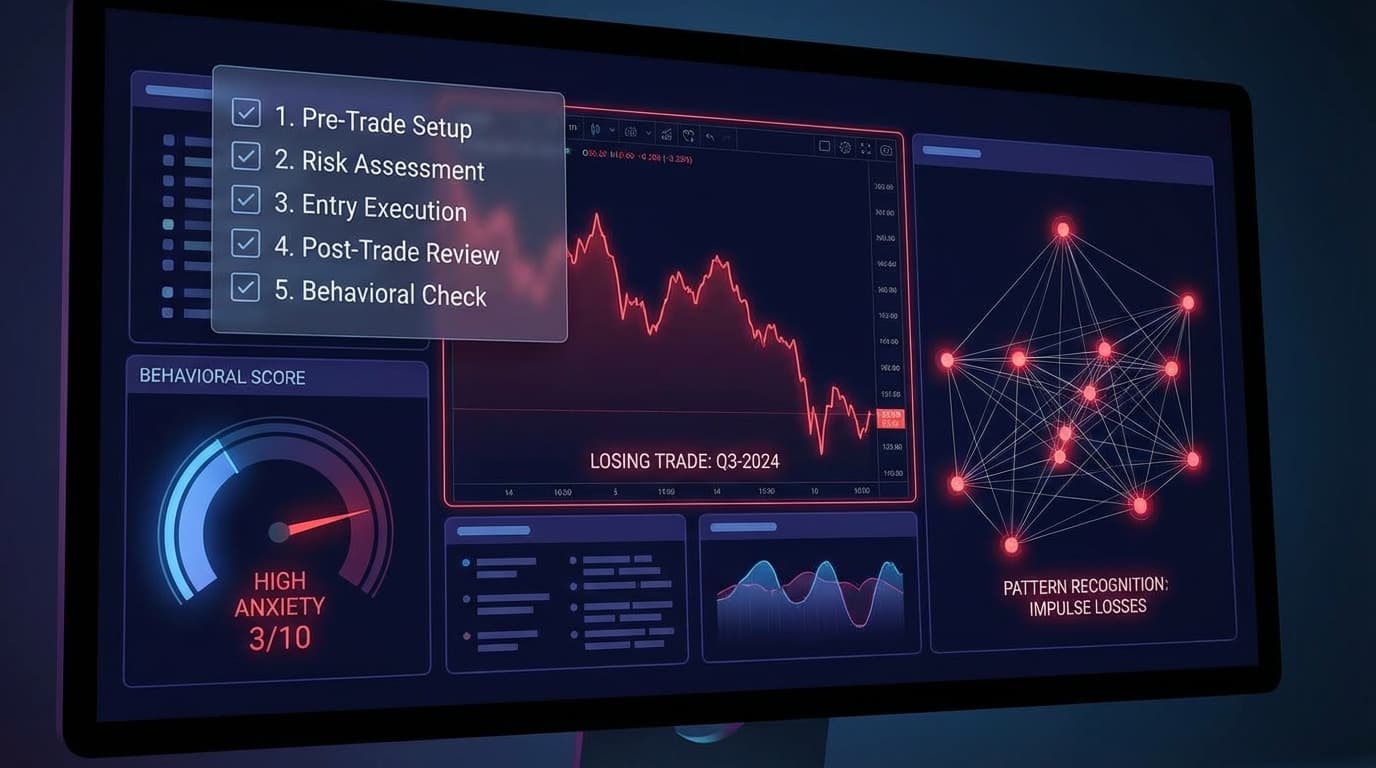
  • Step 1: Setup failure (market was wrong) vs. execution failure (you were wrong) — different lessons
  • Step 2: Score each plan element against what you actually did
  • Step 3: Emotional state at entry is forward-looking insight, not backward-looking blame
  • Step 4: Process change, not outcome change — what rule would improve the decision?
  • Step 5: Tag and filter — one loss is noise, five losses with the same tag is a pattern

How to Spot Patterns in Your Losses

Individual loss analysis is useful. Loss pattern analysis is transformative. Patterns in losses almost always fall into one of four categories: time-based, condition-based, emotional-trigger-based, and setup-specific.

Time-based patterns: You lose disproportionately in the first 30 minutes of the New York open, or after 2 PM EST, or on Fridays. This is not bad luck — it is a behavioral or market-structure mismatch that repeats. The fix is simple once identified: do not trade those sessions, or trade smaller.

Condition-based patterns: Your edge evaporates in ranging markets but is strong in trending ones. You consistently lose when VIX is above 30. Counter-trend trades during momentum days are your biggest losers. These patterns tell you where your edge lives and, crucially, where it does not.

Emotional-trigger patterns: Losses that follow a winning streak (overconfidence), losses that cluster after a previous stop-out (revenge trading), losses on days when you traded more contracts than usual (size anxiety). According to Barber and Odean's landmark 2000 paper 'Trading Is Hazardous to Your Wealth,' published in the Journal of Finance, individual investors who traded most frequently earned an annual return 6.5 percentage points below average — driven largely by behavioral patterns that compounded over time.

Setup-specific patterns: Your breakout entries have a 62% win rate, but your fade setups have a 31% win rate. You have been treating them as equivalent and wondering why your overall numbers look flat. The journal is the only tool that surfaces this.

According to the UK Financial Conduct Authority's 2020 review of retail CFD traders, 76% of accounts lost money over the studied period. The most consistent predictor of losses was not the strategy — it was the frequency of overtrading and deviation from plan. Both are detectable only through systematic loss pattern analysis.

  • Time-based patterns: Losses cluster at specific sessions or days of week
  • Condition-based patterns: Edge disappears in specific market regimes
  • Emotional-trigger patterns: Losses follow wins (overconfidence) or losses follow losses (revenge)
  • Setup-specific patterns: Two setups with vastly different win rates being treated as one

How Tiltless Automates Loss Pattern Detection

The manual version of this framework works — but it requires discipline to apply consistently across hundreds of trades. Tiltless automates the quantitative layer so you can focus on the qualitative one.

For every session, Tiltless calculates your win rate, average R, and execution quality score automatically from broker data. It flags behavioral anomalies: sessions where you took more trades than your 30-day average (overtrading signal), sessions where your average position size was more than 1.5x your norm (size escalation), and sequences where losses followed losses within the same session (revenge trading pattern).

Weekly, Tiltless generates a pattern report: your best and worst setup by R, the sessions where your edge is strongest, and any behavioral tags that appear more than 3 times in the last 20 trades. This is the equivalent of a professional trading desk's risk review — built for individual traders.

You add the qualitative layer: emotional state check-ins, notes on what you were thinking at entry, and the what-would-I-do-differently reflection. Tiltless provides the data substrate that makes those reflections accurate rather than distorted by memory bias.

The result: you spend 10 minutes on meaningful analysis, not 45 minutes manually pulling trade data from your broker statement.

Related Resources

FAQ

?How soon after a loss should I analyze the trade?

Not immediately. Wait at least 30-60 minutes, or better yet, do your loss review at end of session when you are no longer in a reactive state. The exception is a brief immediate note — just 1-2 sentences logging your emotional state and the raw facts while they are fresh. Save the analysis for later.

?What is the difference between a bad loss and a good loss?

A good loss follows your plan — entry, stop, size, and exit all matched your rules, but the setup failed. This is a cost of doing business and tells you about market conditions. A bad loss involves a plan deviation — you sized up impulsively, moved your stop, or entered on FOMO. Bad losses are the ones that require behavioral correction, not market analysis.

?How many losses do I need to identify a pattern?

As a rule of thumb, look for patterns that appear in at least 20% of your losses and in at least 5 trades. One or two instances is noise; five or more with the same tag is signal. The more specific the tag (for example, revenge-trade after same-session loss vs. just bad trade), the fewer instances you need to act on it.

?Should I delete or ignore my worst losing trades to avoid skewing stats?

Never. Your worst losing trades are your most important data points. They show you the tail risk of your behavioral patterns — what happens when overtrading, revenge trading, or overleveraging compound. Removing them from your journal gives you a false sense of your actual risk profile.

?How do I stop an emotional spiral after a big loss?

Two steps: First, close the platform immediately after the loss and take a physical break — even 10 minutes of walking resets cortisol levels. Second, write one factual sentence about the loss (setup, entry, outcome) before you close your journal for the session. This prevents rumination by giving your brain a closed loop and defers analysis to a time when you can actually learn from it.

Let Tiltless find your loss patterns automatically

Stop manually hunting for patterns in your losing trades. Tiltless auto-imports every trade from your broker, calculates behavioral scores, and surfaces the patterns your gut misses. Free to start.

How to Analyze Losing Trades: A 5-Step Framework