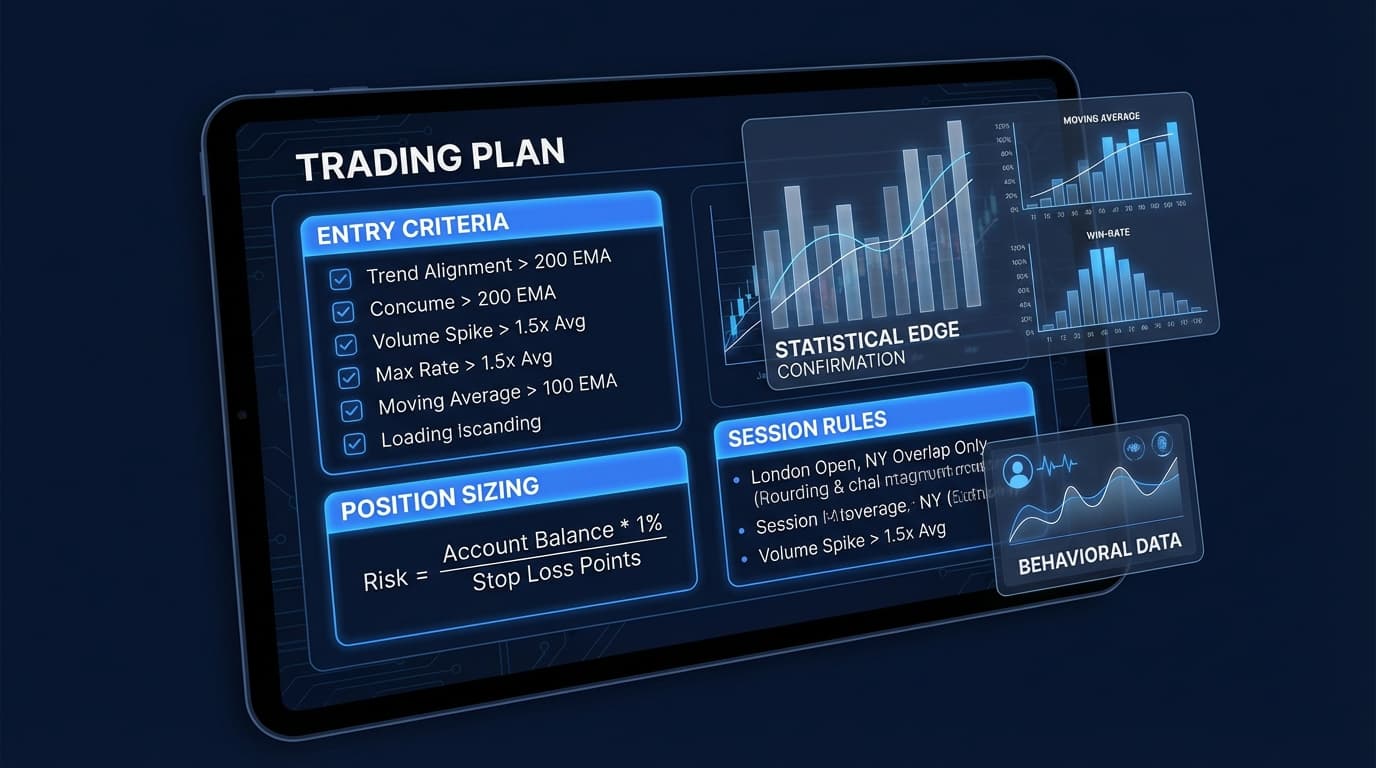
Every component of a data-driven trading plan requires statistical analysis of your trade history. Tiltless provides that analysis automatically.
Edge Lab gives you the statistical foundation for your entry criteria. It tests your setups for win rate, expectancy, and statistical significance — telling you which conditions produce genuine edge and which are noise. When you write entry rules, you can validate them against your actual historical data rather than guessing.
Time-of-day performance curves let you set session start and end times based on where your edge actually exists, not based on convention. If your data shows your edge is concentrated between 9:45 and 11:30 AM, your session parameters should reflect that.
Post-loss win rate analysis gives you the quantitative case for your hard daily stop rule. Seeing that your win rate drops to 38% in the 45 minutes after a loss (versus 54% baseline) makes the session-end rule feel like an opportunity cost savings rather than a restriction.
Behavioral pattern detection — revenge sequence identification, position sizing drift after losses, session fatigue scoring — shows you specifically which behaviors your plan needs to address. Your plan's rules should be calibrated to your actual behavioral failure modes, not generic ones.
MAE and MFE analysis provides the data for your stop and target levels, replacing guesswork with historical evidence of how your specific setups move.
For context on how a trading journal provides the raw material for all of this analysis, the [Trading Journal Template](/blog/trading-journal-template) explains what to capture and how to structure it. For a deeper understanding of edge identification, see [How to Find Your Statistical Trading Edge](/blog/statistical-trading-edge).