
Updated: 2026-03-07

How to Improve Win Rate: What Actually Works (and What Doesn't)

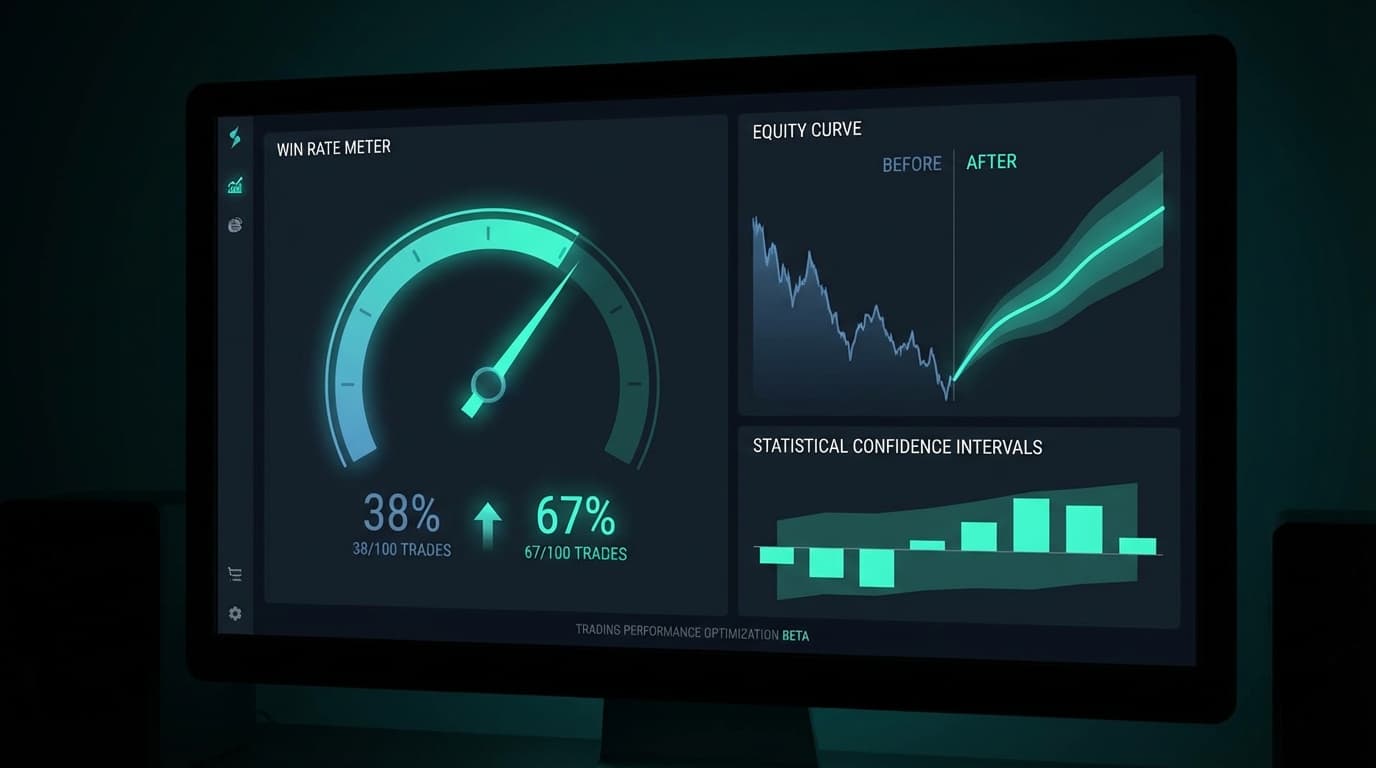
Most traders trying to improve their win rate are solving the wrong problem. A 90% win rate can destroy an account if the average loss is 10× the average gain. A 35% win rate can build a career if the average winner is 3× the average loser. Win rate in isolation tells you almost nothing about the health of your trading. Yet win rate is the metric traders obsess over most, optimize for most, and sacrifice risk/reward ratios to protect. According to research by Barber and Odean (Journal of Finance, 2000), the most active retail traders don't just underperform the market — they underperform partly because they close winning positions too early (protecting win rate) and hold losing positions too long (avoiding a loss that would reduce their win rate). The behavior that feels like improving is actually the mechanism of losing.
How to Improve Win Rate: What Actually Works (and What Doesn't)

Win Rate vs. Expectancy: The Right Metric

The metric that determines whether a trading strategy is profitable over time is expectancy — the average amount you make per dollar risked, per trade.

Expectancy = (Win Rate × Average Win) − (Loss Rate × Average Loss)

A strategy with a 40% win rate and 2:1 average risk/reward has positive expectancy: (0.40 × 2) − (0.60 × 1) = 0.20. You make $0.20 on average for every $1 risked.

A strategy with a 70% win rate and 0.5:1 average risk/reward has negative expectancy: (0.70 × 0.5) − (0.30 × 1) = 0.05. Slightly positive but razor-thin margin for slippage, commissions, and behavioral errors.

Before trying to improve your win rate, calculate your expectancy. If your expectancy is positive but your account isn't growing, the problem is likely behavioral — not a low win rate.

  • Expectancy = (Win Rate × Avg Win) − (Loss Rate × Avg Loss)
  • Positive expectancy + behavioral errors = losing account
  • Win rate matters only in the context of your risk/reward ratio
  • Most 'win rate improvement' efforts damage expectancy by shrinking targets

The 4 Levers That Actually Move Win Rate

If your expectancy calculation shows your win rate is genuinely suppressed below its theoretical potential, there are four places to look.

**1. Setup quality filter** The most reliable win rate lever. If you only take setups that score above a certain threshold on your personal criteria, your win rate on those trades will be higher than your overall average. The data to find this threshold is already in your trade history — filter by setup quality and compare win rates.

**2. Entry timing precision** Early entries on breakouts, late entries on reversals — both get you worse fills and worse win rates. Entry timing errors show up as a cluster of losing trades that were correct in direction but wrong in timing.

**3. Stop placement logic** Stops placed at round numbers, arbitrary ATR multiples, or 'feels right' distances get hit more often than stops placed at technical invalidation levels. Tighter stops increase win rate on paper but lower it in practice because the setup hasn't had room to prove itself.

**4. Behavioral consistency** According to Dalbar's Quantitative Analysis of Investor Behavior (2023), the behavioral gap — the difference between what a strategy returns and what investors actually capture — averages over 3% annually. For active traders, this gap is primarily driven by taking setups outside the system (FOMO), sizing incorrectly under stress, and managing losing trades emotionally rather than systematically.

The Behavioral Patterns That Are Suppressing Your Win Rate Right Now

Most win rate problems aren't strategy problems — they're behavioral compliance problems.

**Revenge trades:** Entries placed immediately after a stop-out, driven by urgency to recover the loss. According to analysis across Tiltless user data, revenge trades show a win rate 20-35% below each trader's baseline. They're entered at worse prices, held past stop levels more often, and sized incorrectly.

**FOMO entries:** Entering after a move has already run 60-80% of its typical range. The setup was valid — you just missed the entry. FOMO entries get worse fills and trigger earlier, suppressing win rate while the setup's original risk/reward was sound.

**Fatigue trading:** Late-session decisions made when cognitive quality has declined. Most active traders show a measurable win rate decline after the first 2-3 hours of their session. This isn't about discipline — it's about cognitive resource depletion.

**Overtrading after losses:** Taking more setups after losing sequences to 'make it back.' These additional setups are often lower quality than your normal entries, compressing win rate at exactly the moment when the account can least afford it.

  • Filter your trade history by: after a stop-out (0-10 min) — compare win rate to baseline
  • Filter by: entry timing vs. ideal entry — late entries show lower win rate
  • Filter by: session hour — compare first 2h win rate vs. last 2h
  • Filter by: trade count on losing days — compare win rate at trade 5+ vs. trade 1-3

Why You Need 50+ Trades Before Drawing Any Win Rate Conclusions

A win rate observation on fewer than 50 trades is not statistically meaningful.

With 20 trades, a true 50% win rate strategy will produce outcomes ranging from 30% to 70% by chance alone (within 2 standard deviations). You cannot distinguish skill from variance with a small sample.

Before changing your strategy based on a low win rate, ask: - How many trades does this sample represent? - What's the confidence interval on this estimate? - What does my win rate look like over 100+ trades?

Edge Lab in Tiltless runs Fisher exact tests on pattern comparisons. Every win rate comparison comes with a p-value. If the p-value is above 0.05, the observed difference is not statistically significant — it could be random. This prevents you from making strategy changes based on noise.

Related Resources

FAQ

?What's a good win rate for a day trader?

There is no universal 'good' win rate. A scalper with a 1:1 risk/reward needs 55%+ to be profitable. A swing trader with a 3:1 risk/reward can be profitable with 30%. The right win rate depends entirely on your average risk/reward ratio. Calculate expectancy first — win rate only matters in that context.

?Why does my win rate drop after a losing trade?

This is the revenge trade pattern — one of the most consistent behavioral findings in active trader research. After a stop-out, traders enter the next trade with elevated urgency, often at worse prices, with less patience, and with higher emotional stakes. The result is a measurably lower win rate on the trade immediately following a loss. Tiltless tracks this pattern and shows you your personal post-loss win rate vs. baseline.

?How many trades do I need to assess my win rate accurately?

At minimum 50 trades for a rough estimate; 100+ trades for a reliable estimate. With fewer trades, the confidence interval is so wide that the observation is nearly meaningless. Edge Lab requires 30+ trades in a filtered segment before running significance tests.

?Can improving discipline directly improve win rate?

Yes — but not through willpower. The evidence-based path is: identify which behavioral patterns are suppressing your win rate (using your actual trade data), understand the specific trigger (loss sequence, time of day, position size), and put structural constraints in place (max trades per session, cool-down rule after losses). Discipline is a system, not a character trait.

Find what's suppressing your win rate

Tiltless filters your trade history by behavioral state and shows you exactly where your win rate drops — and why.

How to Improve Win Rate in Trading | Evidence-Based Methods That Work