
Updated: 2026-03-07

Momentum Trading Strategy: The Evidence-Based Approach (and Why Most Retail Traders Execute It Wrong)

Momentum is one of the most replicated anomalies in financial markets — the tendency for assets that have recently performed well to continue outperforming, and for underperformers to continue underperforming. The academic evidence is overwhelming. The retail execution is almost universally terrible. Most traders who call themselves momentum traders are actually chasing price after the momentum has already played out, entering at exactly the wrong moment, and getting stopped out when the inevitable pullback arrives. Here is the evidence-based framework that actually works.
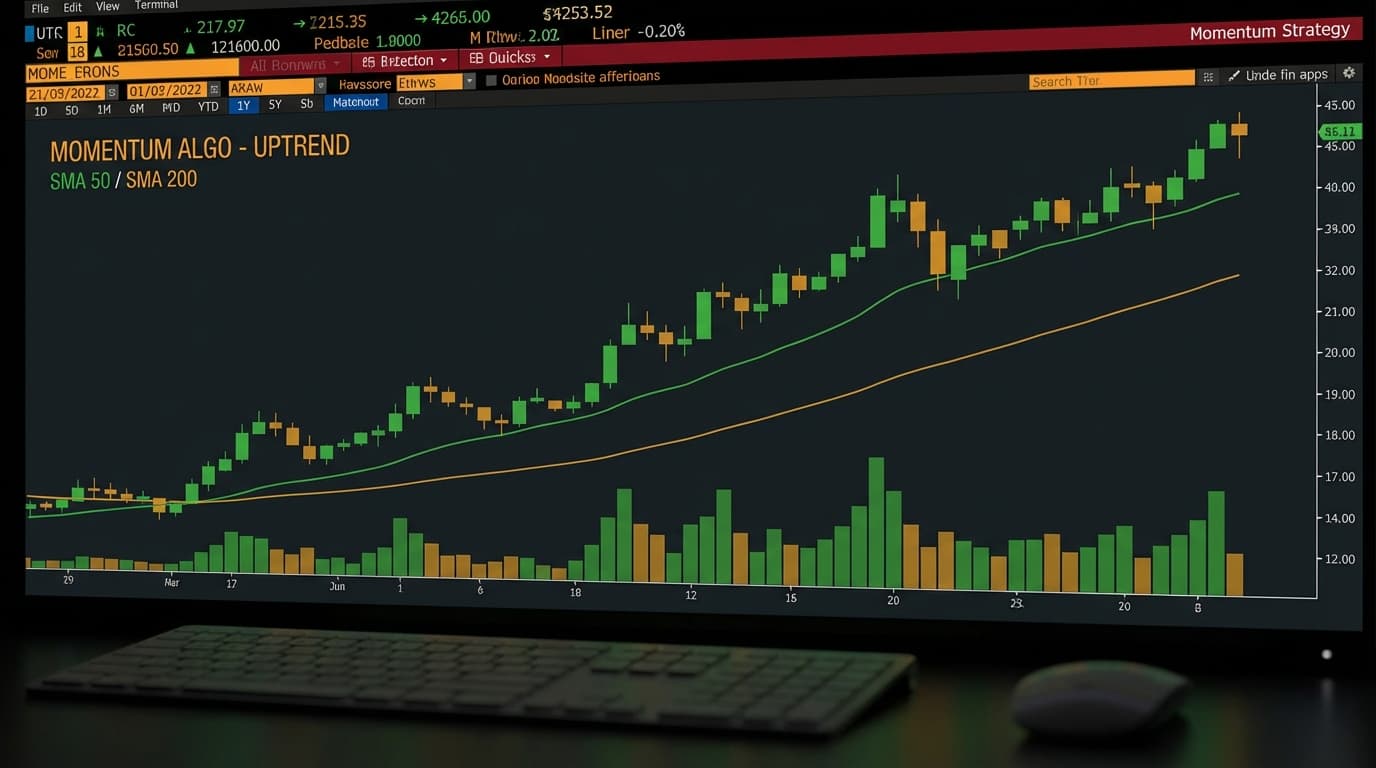
Momentum Trading Strategy: The Evidence-Based Approach (and Why Most Retail Traders Execute It Wrong)

The Academic Foundation of Momentum Trading

According to Jegadeesh and Titman (Journal of Finance, 1993) — the foundational momentum paper — stocks that outperformed their peers over the prior 3 to 12 months continued to outperform over the following 3 to 12 months. The strategy of buying recent winners and shorting recent losers generated abnormal returns of approximately 1% per month in their US equity dataset. This finding has been replicated across equity markets globally, across asset classes, and across time periods spanning over 200 years of data.

A follow-up study by Asness, Moskowitz, and Pedersen (Journal of Finance, 2013) demonstrated that momentum works in 8 different asset classes simultaneously: US equities, UK equities, continental European equities, Japanese equities, government bonds, currencies, commodities, and credit markets. The universality of the anomaly is its strongest argument for persistence.

The critical detail that most retail traders miss: the Jegadeesh-Titman momentum signal uses a 12-month lookback period with a 1-month skip (to avoid short-term mean reversion). Retail traders typically use 5-day or 20-day lookbacks — far too short to capture the underlying signal the academic evidence identifies. They are optimizing a completely different phenomenon and calling it 'momentum trading.'

  • Jegadeesh & Titman (1993): buying 12-month winners, shorting losers earned ~1%/month — replicated across 200+ years of data
  • Asness et al. (2013): momentum works across 8 asset classes simultaneously — universality argues for persistence
  • Critical detail: academic momentum uses 12-month lookback with 1-month skip — not the 5-20 day windows retail traders use
  • Most retail 'momentum' traders are capturing a different (weaker) signal than the one with academic backing

The Two Main Momentum Approaches

Momentum trading divides into two structurally different approaches. Understanding which one you are using is prerequisite to executing it correctly.

Cross-sectional momentum (relative momentum): Rank a universe of assets by their trailing returns over a defined lookback period. Buy the top decile (or quintile). Short the bottom decile. Hold for a defined period and rebalance. This is the approach from the academic literature. It is systematic, requires a universe of comparable assets, and is essentially a relative ranking exercise — you own what is strongest relative to its peers.

Time-series momentum (trend following): For each asset independently, determine whether it is trending up or down relative to its own historical performance. Hold long positions in assets above their trailing moving average (or with positive trailing returns). Exit or go short when the asset falls below the signal threshold. This approach is used by most systematic trend-following funds. It does not require ranking across a universe — it evaluates each asset on its own terms.

The distinction matters for journaling. Cross-sectional momentum requires tracking your ranking criteria and relative performance of the universe. Time-series momentum requires tracking your trend signal and whether your exit criteria triggered correctly. Mixing the frameworks — applying cross-sectional thinking to individual stock selection, or time-series thinking to sector rotation — is a common source of systematic errors.

  • Cross-sectional momentum: rank universe by trailing returns, buy top decile, short bottom — requires comparable asset universe
  • Time-series momentum: evaluate each asset vs. its own history — used by trend-following funds, no ranking required
  • Cross-sectional journaling: track ranking criteria + relative performance; time-series: track trend signal + exit triggers
  • Mixing frameworks is a systematic error source — determine which approach you use and apply its rules consistently

Why Retail Momentum Traders Fail at Execution

The academic evidence for momentum is strong. The behavioral evidence for retail failure at momentum is equally strong. According to research by Barber and Odean (Journal of Finance, 2000), retail traders who attempt momentum strategies — buying recent winners — actually underperform buy-and-hold investors, despite the strategy having positive expected value. The gap is entirely behavioral.

Failure mode 1: Chasing price instead of ranking. A stock that has risen 40% in the last week feels like momentum. But if it has fallen 20% over the prior 12 months, it is not a positive-momentum stock by any evidence-based definition — it is a beaten-down stock having a relief rally. Retail traders chase recent visual movement, not the medium-term signal that has academic backing.

Failure mode 2: Holding through momentum crashes. Momentum strategies have well-documented 'crash risk' — periods of rapid, severe drawdown when momentum reverses sharply. These crashes are predictable in the sense that they cluster around market stress periods: sharp overall market drawdowns, extreme valuations, and compression of the spread between winners and losers. Most retail momentum traders have no crash risk protocol — they hold full positions through reversals that the most sophisticated momentum funds hedge against.

Failure mode 3: Transaction costs eroding the edge. The 1%/month momentum premium calculated in the academic literature assumes monthly rebalancing at institutional-level transaction costs. Retail traders who 'momentum trade' daily or weekly with high-frequency rebalancing give most of the premium to spreads and commissions before it reaches their account.

  • Barber & Odean (2000): retail momentum traders underperform buy-and-hold despite positive-EV strategy — behavioral gap
  • Price chasing vs. momentum: 40% 1-week rally after -20% 12-month trend is not momentum — it is a relief rally
  • Momentum crash risk: clusters around market stress — hold through without a hedge and drawdowns exceed the annual premium
  • Transaction costs: monthly rebalancing preserves the edge; daily 'momentum' trading gives it all to spreads

How to Journal Momentum Trades for Systematic Improvement

Momentum trading is systematic by nature — the edge is in the ranking or trend signal, not in discretionary chart reading. A momentum trading journal should reflect this by tracking the quality of signal adherence, not just the P&L outcome.

Key journal fields for momentum trading:

Ranking/signal at entry: For cross-sectional: record the asset's trailing return percentile rank within your universe at the time of entry. For time-series: record the specific trend indicator value and whether it met your entry threshold exactly. This documents whether you entered correctly or bent your signal criteria.

Holding period adherence: Momentum strategies have defined holding periods. Did you hold for the full intended period, or did you exit early due to intraday noise? Early exits are the most common execution failure in momentum trading — and the most expensive.

Rebalancing discipline: Did you rebalance at the defined interval regardless of emotional state? Skipping rebalances because 'the market feels risky' is the behavioral error that most undermines systematic momentum strategies.

Market regime flag: Momentum performs differently in trending vs. mean-reverting markets. Tag each trade with the overall market regime at entry — this allows you to analyze whether your signal works consistently across regimes or concentrates in trending environments.

  • Log ranking/signal at entry: percentile rank (cross-sectional) or indicator value vs. threshold (time-series)
  • Holding period adherence: early exits from noise are the most expensive and most common momentum execution failure
  • Rebalancing discipline: skipping rebalances due to emotional market reads is the behavioral error that destroys systematic edge
  • Market regime flag: momentum edge concentrates in trending markets — tag entries to analyze regime-specific performance

Related Resources

FAQ

?What is a momentum trading strategy?

A momentum trading strategy buys assets that have recently outperformed and sells (or shorts) assets that have recently underperformed, based on the empirically documented tendency for trends to persist over intermediate time horizons. The two main forms are cross-sectional momentum (ranking assets within a universe by trailing returns) and time-series momentum (evaluating each asset's trend relative to its own history). The academic backing for momentum is among the strongest of any market anomaly, with evidence dating back 200+ years across asset classes globally.

?How long should I hold a momentum trade?

The evidence-based holding period for momentum is 1 to 12 months, with the strongest signal in the 3-12 month range. Jegadeesh and Titman's original 1993 research found that the momentum premium is strongest when measured over 12-month lookback windows, with a 1-month skip at the end to avoid short-term mean reversion. Retail traders who hold 'momentum' positions for days or weeks are operating in a different regime where the academic backing is weaker and transaction costs more likely to erase any edge.

?Why does momentum work as a trading strategy?

Two main explanations have been proposed. The behavioral explanation: investor underreaction to news causes gradual price adjustment — momentum profits come from the slow incorporation of information into prices. The risk-based explanation: momentum stocks carry a specific type of crash risk that the premium compensates. Neither explanation is definitively proven. What is proven is that momentum works empirically across 200+ years of data and 8 asset classes simultaneously — the strategy has edge regardless of why.

?What is momentum crash risk in trading?

Momentum crash risk refers to periods of sudden, sharp reversal in momentum strategies — when recent winners rapidly underperform recent losers. These crashes cluster around market stress events (sharp overall market drawdowns, high volatility regimes) and can erase 12 months of momentum premium in a few weeks. Sophisticated momentum strategies hedge crash risk by reducing exposure during high-volatility regimes or when the spread between winners and losers compresses below historical norms. Retail traders who hold full momentum positions through stress periods bear this crash risk without compensation.

Track your momentum signal adherence, not just P&L

Tiltless categorizes your trades by setup type and calculates profit factor per category — so you can see whether your momentum signal actually has edge or whether execution is eroding it.

Momentum Trading Strategy: The Evidence-Based Guide for Active Traders | Tiltless