
Updated: 2026-03-07

How to Stop Overtrading: The Circuit Breaker System That Actually Works

Overtrading doesn't feel like overtrading when you're doing it. It feels like opportunity. Every new setup looks reasonable. Every re-entry after a loss feels like a recovery play. Every slow afternoon feels like a perfect moment to force a trade. That internal justification is precisely what makes overtrading so expensive — and why willpower alone has never stopped it for any trader. The academic evidence is damning. According to Barber and Odean (2000), traders who trade the most underperform those who trade the least by 6.5% annually on a net basis — not because their per-trade win rate is lower, but because their transaction costs compound against them and their decision quality degrades under the cognitive load of managing too many positions. Overtrading is not an execution problem. It is a behavioral problem with a structural solution.
How to Stop Overtrading: The Circuit Breaker System That Actually Works

What Overtrading Actually Means (Most Traders Only Know Half the Definition)

The common definition of overtrading is trading too frequently — taking more positions per session than your edge statistically supports. That is accurate but incomplete. Overtrading also includes size-based overtrading: holding positions so large that a single move forces an emotional response. A trader who takes three trades per day but sizes each at 5% of account when their risk-adjusted edge only supports 1% is overtrading in the dimension that matters most.

Defined precisely: overtrading occurs when the frequency or size of your positions exceeds what your documented edge justifies given current market conditions. Both dimensions matter. A trader can be frequency-appropriate but size-overloaded, or size-appropriate but entering setups that fall outside their tested strategy parameters. Tiltless scores overtrading on both dimensions per session — frequency deviation from your own baseline and size deviation from your historical norms.

The 3 Root Causes of Overtrading (And Why Identifying Yours Changes Everything)

Overtrading is not one behavior. It is three distinct behaviors that look identical on a trade log but require completely different interventions.

FOMO-driven overtrading occurs after a missed trade. You watched a setup develop, hesitated, it moved without you, and now you are forcing an entry on the tail of the move or hunting for something that feels similar. The emotional driver is the pain of inaction — which behavioral economists call omission bias working in reverse.

Revenge overtrading occurs after a loss. The cortisol spike from a losing trade — documented by Lo and Repin (2002) through physiological stress measurements on active traders — impairs prefrontal cortex function and activates the brain's pattern for recovering losses immediately. The brain interprets the market as something it can fight back against. It cannot.

Boredom overtrading occurs on slow days. When a session produces no setups within your criteria for the first two hours, the urge to manufacture a trade becomes overwhelming. The psychological driver is action bias — the well-documented human tendency to prefer action over inaction even when inaction produces better outcomes.

Knowing which type you are most prone to determines which circuit breaker you need. Your journal data — specifically time-of-day entry patterns, performance after losses, and entry quality on low-volatility days — reveals your dominant pattern.

Why Willpower Fails Every Time

Willpower is a finite cognitive resource that depletes throughout a trading session. By the time a trader faces the emotional pressure of a missed move or a losing trade, willpower reserves are already drawn down from hours of attention and decision-making. This is precisely when the temptation to overtrade is highest — and when willpower is least available.

The deeper problem is the loss aversion feedback loop. According to the FCA's disclosure data on retail CFD accounts, approximately 77% of retail CFD accounts lose money. A significant portion of those losses are not caused by a bad edge — they are caused by behavior that undermines a workable edge. Loss aversion — the psychological principle established by Kahneman (Nobel Prize, 2002) showing that losses feel roughly twice as painful as equivalent gains feel pleasant — drives traders to overtrade specifically in recovery mode. The very emotion that should make traders cautious after a loss makes them more aggressive.

No amount of conviction that you will be disciplined tomorrow survives this feedback loop in real time. The solution is structural, not motivational.

The Circuit Breaker System: Three Rules That Replace Willpower

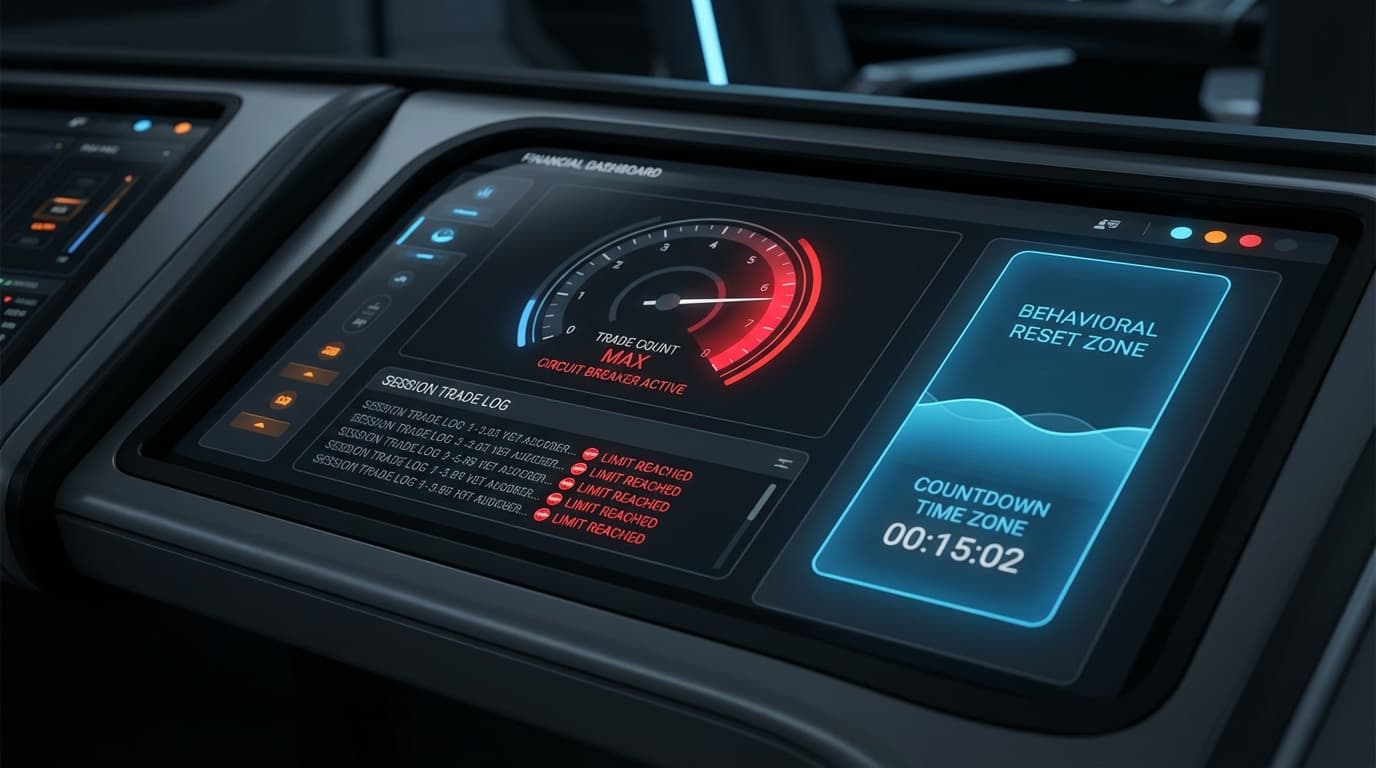
A circuit breaker is a pre-committed rule that triggers automatically, before the emotional state that would cause you to override it. Three rules work together as a system.

Rule 1: Max trades per session — set before market open, not during it. Choose a number based on your historical average winning session trade count, not your maximum. If your best sessions average 4 trades, your cap is 5. Write it down before you open your platform. Once you hit the cap, you are done for the session — not because you are in a drawdown, but because the rule exists independent of outcome.

Rule 2: Mandatory 15-minute cool-down after any loss. Set a physical timer. Step away from the screen. The neurological case is direct: Lo and Repin's (2002) research shows that cortisol levels elevated by a losing trade take between 10 and 20 minutes to return to baseline. Returning to a screen before that window closes means your next decision is being made under measurable physiological impairment.

Rule 3: Daily max-loss as a hard stop — not a guideline. Calculate 1.5x your average losing session P&L. When you hit that number, your trading day ends. Not pauses. Ends. The only exception is a documented, pre-existing reason for a larger risk budget that day — such as a scheduled news play sized for in advance.

  • Set max-trades-per-session BEFORE market open — not during it
  • 15-minute timer after every loss, no exceptions — set a physical timer
  • Daily max-loss = 1.5x average losing session — hard stop, not a guideline
  • Write all three rules down and keep them visible during the session

How to Detect Your Overtrading Pattern Using Journal Data

Willpower-based approaches fail because they respond to feelings. Journal-based detection responds to data — and data is what allows you to replace the feeling of 'I think I overtraded today' with 'I took 8 trades when my edge supports 4; here is what triggered entries 5 through 8.'

Four journal analyses reveal your specific overtrading pattern.

Time-of-day heatmap: Chart your trades by hour. If your win rate drops significantly in the first 30 minutes (market open noise) or after 2pm (boredom zone), you have session-timing overtrading that a simple time restriction eliminates entirely.

After-loss behavior: Filter your log to show only trades taken within 60 minutes of a losing trade. Compare that subset's win rate and average P&L to your baseline. If performance degrades, you have revenge overtrading — and a mandatory cool-down period becomes a mathematical expectancy improvement, not a soft guideline.

After-big-win behavior: The same analysis after your largest winning sessions. Some traders overtrade after wins due to overconfidence — a phenomenon Barber and Odean (2000) identify as particularly damaging because it inflates position sizes during periods of perceived momentum.

Setup quality scoring: Rate each entry on a 1-3 scale (1 = A-grade setup meeting all criteria, 3 = forced or marginal). If your 3-rated trades have dramatically worse outcomes, you are overtrading on setup quality even when frequency looks controlled.

Tiltless auto-scores overtrading per session by comparing your trade count, size distribution, and setup timing against your own historical baseline — no manual log analysis required.

How Tiltless Detects and Flags Overtrading Automatically

Manual journal analysis surfaces overtrading patterns in retrospect. Tiltless surfaces them in the session replay and in your post-session behavioral score, so patterns compound into insight rather than into continued losses.

For each session, Tiltless calculates an overtrading score based on three signals: frequency deviation from your personal baseline, size deviation from your historical norms, and entry timing relative to your documented session windows. If you normally take 3.2 trades per session and took 9 today, the score flags it with a severity level — not as a judgment, but as a data point that explains your P&L variance.

The session replay feature shows each trade in sequence with your emotional annotations, letting you see visually whether trades 6 through 9 came after a loss streak, a flat period, or a large winning trade. The pattern becomes undeniable when it is rendered as a timeline rather than a feeling.

Over time, Tiltless builds a behavioral profile that distinguishes which type of overtrader you are — FOMO-driven, revenge-driven, or boredom-driven — and surfaces the specific triggers most predictive of your worst overtrading sessions.

Related Resources

FAQ

?How many trades per day is considered overtrading?

There is no universal number — overtrading is defined relative to your own edge, not an absolute count. A scalper with a statistically validated strategy may take 30 trades per day without overtrading. A swing trader who normally takes 2 setups per week is overtrading if they take 5 in one day chasing a volatile market. The correct benchmark is your own historical average on winning sessions, not an industry standard.

?Does overtrading only mean trading too frequently?

No. Overtrading has two dimensions: frequency and size. You can overtrade by taking too many positions, but also by sizing individual positions larger than your edge justifies — particularly after a loss or a missed trade. Size-based overtrading is often more damaging than frequency-based overtrading because a single oversized position can produce a drawdown that takes weeks to recover from.

?Why do I keep overtrading even when I know I'm doing it?

Because knowing and deciding are handled by different brain systems. Lo and Repin's (2002) research demonstrates that physiological stress — elevated cortisol after a loss — measurably impairs prefrontal cortex function, which is where rule-following lives. Your emotional brain has already decided to re-enter before your rational brain finishes its objection. Circuit breakers work precisely because they are pre-committed before the impairment occurs.

?Can a trading journal actually stop overtrading?

A journal cannot stop overtrading in real time — but it provides the evidence base that makes structural rules possible. Once your journal data shows that your after-loss trades have a 23% win rate versus your baseline 52%, the case for a mandatory cool-down period becomes mathematical rather than motivational. Data converts a vague resolution into a specific, justified rule.

?What should I track in my journal to monitor overtrading?

Track trade count per session, time of each entry, whether each entry followed a loss, setup quality score on a 1-3 scale, and position size as a percentage of account. These five fields reviewed weekly will reveal your overtrading pattern within 2 to 3 weeks of consistent logging.

See your overtrading pattern in your own data

Tiltless scores overtrading per session — frequency deviation, size deviation, and behavioral triggers — so you can build circuit breakers based on your actual patterns, not guesswork.

How to Stop Overtrading: Circuit Breakers, Root Causes, and Journal-Based Detection | Tiltless