
Updated: 2026-03-07

Trade Review Process: The 3-Layer System That Actually Improves Performance

Reviewing trades without a process is just reliving losses. Most traders look at their P&L, feel bad about the red trades, feel good about the green ones, and close the tab. That's not review — that's emotional recapitulation. A structured trade review system turns raw data into actionable improvements, and that's what separates traders who genuinely improve from traders who repeat the same mistakes for years. The research on deliberate practice is unambiguous: exposure alone doesn't create expertise. Feedback, analysis, and intentional adjustment do. Trading is no different. You can take 10,000 trades and get worse if you're reinforcing bad habits. The traders who improve are doing something specific after every session, every week, and every month — and it's not just staring at their P&L.
Trade Review Process: The 3-Layer System That Actually Improves Performance

Emotional Review vs. Systematic Review: Why Most Traders Get It Wrong

There are two ways to review a trade. The first is emotional: you look at a loss, reconstruct a narrative around why it was bad luck or bad market conditions, feel the sting, and move on. The second is systematic: you compare the trade against pre-defined rules, tag the behavioral state at entry, and log a specific observation about what to do differently.

Emotional review is the default because it's easier. It requires no framework, no discipline, and no willingness to confront uncomfortable patterns. It also produces no lasting improvement.

Research by Anders Ericsson on deliberate practice — the same body of work that underpins the '10,000 hours' concept — found that what distinguishes expert performers from experienced non-experts is not the volume of practice but the quality of feedback loops. Experts receive structured feedback, identify specific errors, and make targeted adjustments. They don't just repeat the activity and hope for improvement.

Brett Steenbarger, who has coached professional traders at major hedge funds for decades, has documented the same pattern in trading specifically. In his research and consulting work, traders who conduct structured post-session reviews with defined metrics show measurably faster performance improvement than those who review P&L without behavioral context. The structure is not optional — it's the mechanism of improvement.

According to Barber and Odean's foundational research on retail investor behavior (2000, 2001), traders who rely on heuristic decision-making — gut feel, narrative reasoning, recency bias — consistently underperform traders who apply systematic rules. Systematic review builds the habit of systematic decision-making. They reinforce each other.

The 3-Layer Trade Review System

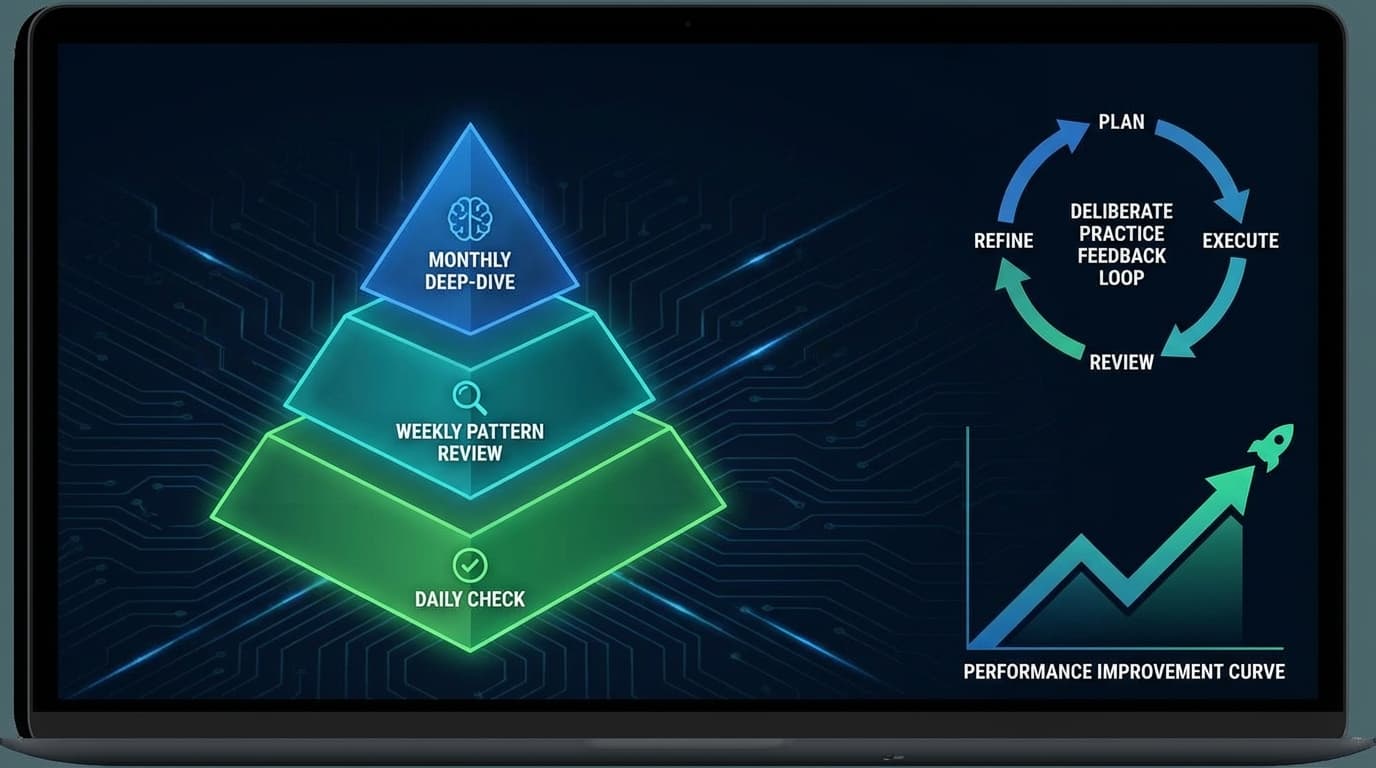
Effective trade review happens at three timescales, each with a different purpose and time commitment. Trying to do everything in one long weekly session is less effective than distributing the review across daily, weekly, and monthly layers — each layer asks different questions.

  • Layer 1 — Daily (5 minutes, post-session): The purpose of the daily review is behavioral awareness and rule compliance tracking — not deep analysis. Answer three questions: Did I follow my entry and exit rules on every trade? What was my emotional state during the worst trade of the session? What is one specific thing I want to do differently tomorrow? Log the answers. Don't analyze yet — just capture. The daily review is a data collection habit, not an analysis session.
  • Layer 2 — Weekly (30 minutes, end of week): The purpose of the weekly review is pattern detection across 50–150 trades. Look for: which setups generated the most losing trades this week, whether there's a time-of-day pattern in your underperformance, how your rule compliance score correlates with P&L, and whether any behavioral tags (FOMO, revenge, boredom) appear disproportionately in losing trades. The weekly review turns daily observations into testable hypotheses about your behavior.
  • Layer 3 — Monthly (60 minutes, end of month): The purpose of the monthly review is strategic evolution. Ask: which setups should I retire because they've been net negative for 60+ days, what rule adjustments do my behavioral patterns suggest, is my edge degrading or improving, and what is my one highest-leverage improvement target for next month? The monthly review drives structural changes to your trading plan — not just tactical tweaks.

Layer 1 in Depth: The 5-Minute Daily Post-Session Review

The daily review works only if it's fast enough to do consistently. Five minutes, every session, no exceptions. The moment it takes 20 minutes, compliance drops and the habit breaks.

The five-minute format:

First, scan your session P&L curve — not the total, but the shape. Did you give back gains in the afternoon? Did you dig a hole in the first hour and spend the rest of the session recovering? The curve shape is a behavioral fingerprint.

Second, identify the single worst trade of the session. Not the biggest loser by P&L — the worst decision quality. Was it a rule violation? A FOMO entry? A revenge trade after a prior loss? Log it with one sentence: 'Trade 7: chased breakout 10 minutes after the move started, was not a planned setup.'

Third, score your rule adherence for the session: what percentage of your trades followed your entry and exit rules exactly? Even a rough score (70%? 90%? 50%?) is more valuable than no score.

Fourth, write one sentence about tomorrow: 'Tomorrow I will not enter any trade that isn't on my watchlist.' That's it. Specific, behavioral, forward-looking.

Tiltless automates the data layer of the daily review — session P&L curve, trade-by-trade behavioral scores, rule compliance tracking — so your five minutes goes toward interpretation and decision-making, not data assembly.

Layer 2 in Depth: The 30-Minute Weekly Pattern Review

The weekly review is where you shift from observation to pattern recognition. You now have 50–200 trades with behavioral tags. The questions change.

Start with behavioral tags vs. P&L. For every emotional state tag you logged this week (FOMO, revenge, calm, disciplined, bored), calculate the average P&L for trades in that state. You will almost certainly find that your worst emotional states correlate with your worst trade outcomes. That correlation is the most actionable insight in trading.

Next, review setup performance. For each setup type you traded this week, calculate: total P&L, hit rate, average win, average loss, and expectancy. Any setup with negative expectancy over 20+ trades is a candidate for retirement.

Then review time-of-day performance. Break your trades into time buckets: first 30 minutes of session, mid-session, last hour. Day traders almost universally have time-of-day patterns. Some traders are sharp in the first hour and drift in the afternoon. Others need 30 minutes to warm up. Knowing your pattern lets you size differently or stop trading outside your high-performance windows.

Finally, set one specific hypothesis for next week: 'I will test whether reducing position size after 2 consecutive losses improves my afternoon P&L.' Hypotheses make the review experimental, not just reflective.

Layer 3 in Depth: The Monthly Strategic Deep-Dive

The monthly review is the hardest and most valuable. It requires you to confront whether your edge is real, whether your rules are serving you, and whether the patterns from your weekly reviews have produced any lasting change.

Start with your 30-day P&L curve. Smooth out single-session volatility by looking at the rolling 5-day average. Is the trend up, flat, or down? What are the inflection points — what changed around your biggest losing streaks?

Next, audit your setups with 30-day expectancy. The minimum sample size for a meaningful expectancy estimate is 30 trades per setup. Any setup with negative expectancy over 30+ trades should be placed on a 30-day probation: trade it at half size while you investigate whether the problem is the setup or your execution.

Then review behavioral trend. Compare your weekly rule compliance scores across the month. Are you improving, declining, or flat? If you're flat after four weeks of weekly reviews, something structural needs to change — your rules might be too vague, your review process might not be surfacing the right patterns, or you might need external accountability.

Finally, set your one monthly improvement target. Not five targets. One. According to Ericsson's research, expert performance improvement comes from focused, specific practice on a single weakness at a time — not broad, diffuse effort across multiple areas simultaneously. Pick the highest-leverage behavioral change and commit the entire next month to it.

  • 30-day P&L curve analysis: identify inflection points and behavioral drivers
  • Setup expectancy audit: retire or put on probation any setup with negative expectancy over 30+ trades
  • Rule compliance trend: weekly scores compared across the month to detect drift
  • One monthly improvement target: specific, behavioral, measurable

The 4 Most Common Trade Review Mistakes (and How to Fix Them)

Most traders who review their trades at all still fall into predictable traps that undermine the value of the process.

  • Only reviewing big losses: Reviewing only your worst trades creates survivorship bias in reverse — you optimize for avoiding catastrophes instead of improving average performance. Your small, consistent losing trades (the ones that bleed P&L across 50 trades per week) often carry more information than your rare large losses. Review every trade, not just the memorable ones.
  • Not tracking rule compliance: P&L alone can't tell you whether a winning trade was a good decision or a lucky bad decision. A trade that violated your rules and happened to work is evidence of bad process, not good process. Without rule compliance tracking, you're measuring outcomes instead of decisions — and outcomes have far too much noise at the trade level to be reliable signals.
  • No action items: Review without commitment to change is journaling as therapy, not journaling as professional development. Every review session — daily, weekly, monthly — should end with at least one specific behavioral commitment for the next period. 'I will not trade the first 15 minutes' is an action item. 'I need to be more disciplined' is not.
  • Reviewing when emotional: Don't review the session within 30 minutes of closing the last trade. Let the emotional residue clear. Reviewing while still activated by losses leads to motivated reasoning — you construct explanations that protect your ego instead of revealing patterns. Wait, then review with data as your primary input.

Related Resources

FAQ

?How long should a trade review take?

It depends on the layer. The daily post-session review should take 5 minutes — any longer and compliance will drop. The weekly pattern review should take 30 minutes. The monthly strategic deep-dive should take 60 minutes. Total time commitment across a full month is under 3 hours, but the compounding effect on performance is significant if done consistently over 6–12 months.

?What should I look for when reviewing my trades?

At the daily level: rule compliance and worst-decision identification. At the weekly level: behavioral tag vs. P&L correlations, setup expectancy, and time-of-day performance patterns. At the monthly level: P&L trend inflection points, setup expectancy over 30+ trade samples, rule compliance drift, and one structural improvement target. The goal is to surface specific, actionable patterns — not to generate a narrative about why you won or lost.

?How is a trade review process different from just looking at my P&L?

P&L tells you what happened. A structured trade review tells you why it happened and what to do differently. P&L is an outcome with enormous short-term noise — a winning week can be the result of terrible decisions and lucky execution, and a losing week can reflect excellent process undermined by bad variance. A proper review process evaluates decision quality (rule compliance, behavioral state, setup selection) independent of P&L, which is the only way to improve the process rather than just reacting to outcomes.

?How often should I review my trades?

Three cadences: daily (5 minutes, every session), weekly (30 minutes, end of week), monthly (60 minutes, end of month). The daily review is a data collection and behavioral awareness habit. The weekly review is for pattern detection. The monthly review drives strategic changes. Missing daily reviews is most costly — behavioral patterns compound within sessions and across weeks, and without daily capture, you lose the granular data that weekly reviews depend on.

?Can a trading journal automate the review process?

Partially. A good trading journal automates the data layer: importing trades, calculating session metrics, scoring behavioral patterns, and surfacing time-of-day and setup performance data. That eliminates the manual data assembly that makes most traders skip the review. What can't be automated is the interpretive layer: setting hypotheses, making commitments, and deciding which patterns to act on. Tiltless automates the briefing so your review time goes toward decisions, not data work.

Automate the data layer of your trade review

Tiltless imports your trades automatically, scores each session for behavioral patterns, and generates a daily briefing so your review starts with insights — not spreadsheet work. Start your 7-day free trial today.

Trade Review Process: A Systematic Approach to Improving Your Trading