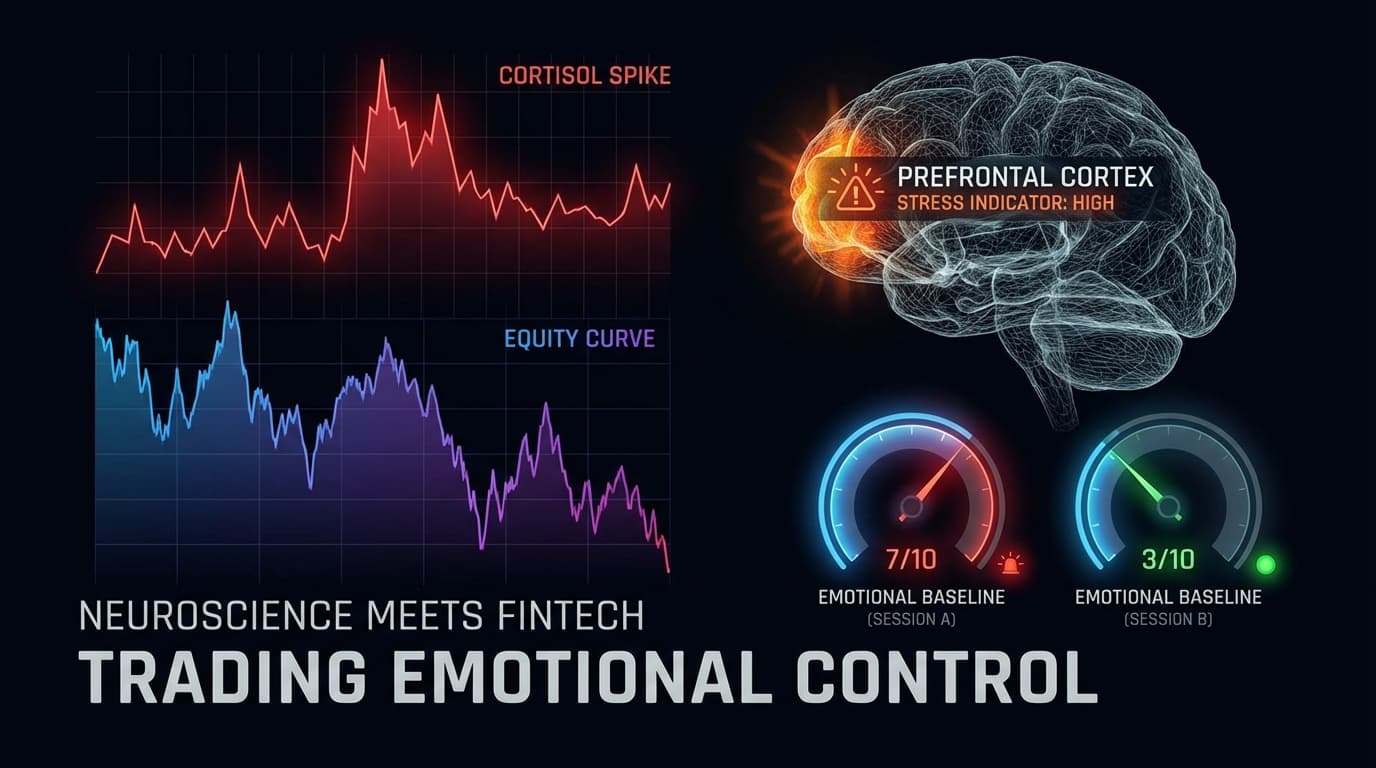
These five techniques are ordered by when they apply in the trading process. They work as a system, not as isolated tactics.
Technique 1 — Pre-session emotional baseline check. Before opening your platform, rate your emotional state on a scale of 1 to 10: 1 is highly distressed or anxious, 10 is calm and focused. Commit in advance: if your score is below 6, you do not trade today. Steenbarger's research on structured self-monitoring in active traders shows that pre-session mood assessment predicts intraday decision quality better than most technical indicators. A 10-second check before market open is a legitimate edge.
Technique 2 — Position sizing that doesn't spike cortisol. If you are lying awake thinking about a trade, the position is too large. Size down until the position no longer occupies mental bandwidth outside market hours. Cortisol is triggered by threat perception proportional to perceived stake. Smaller positions during periods of elevated baseline stress preserve your decision-making architecture for the moments it matters most.
Technique 3 — Mandatory post-loss pause of at least 15 minutes. Set a timer. Leave the screen. The physiological case: Lo and Repin's (2002) measurements show cortisol levels take between 10 and 20 minutes to return toward baseline after a loss event. Every trade placed in that window is a trade placed under measurable neurological impairment.
Technique 4 — Real-time emotional state annotation per trade. Log your emotional state as the trade happens — not in the end-of-day review. 'Felt rushed,' 'FOMO from missing the move,' 'calm, setup met all criteria,' 'anxious, sized down.' Retrospective journaling is subject to hindsight bias. Real-time annotation captures the actual state that produced the decision, making pattern analysis meaningful.
Technique 5 — Pre-built if-then decision rules that remove emotional input. 'If I have two consecutive losses, I reduce size by 50% for the rest of the session.' 'If the session P&L hits my daily max-loss, I close all positions and stop.' These rules are System 2 decisions made in advance while your prefrontal cortex is fully functional, designed to govern System 1 behavior during the moments when it is impaired.