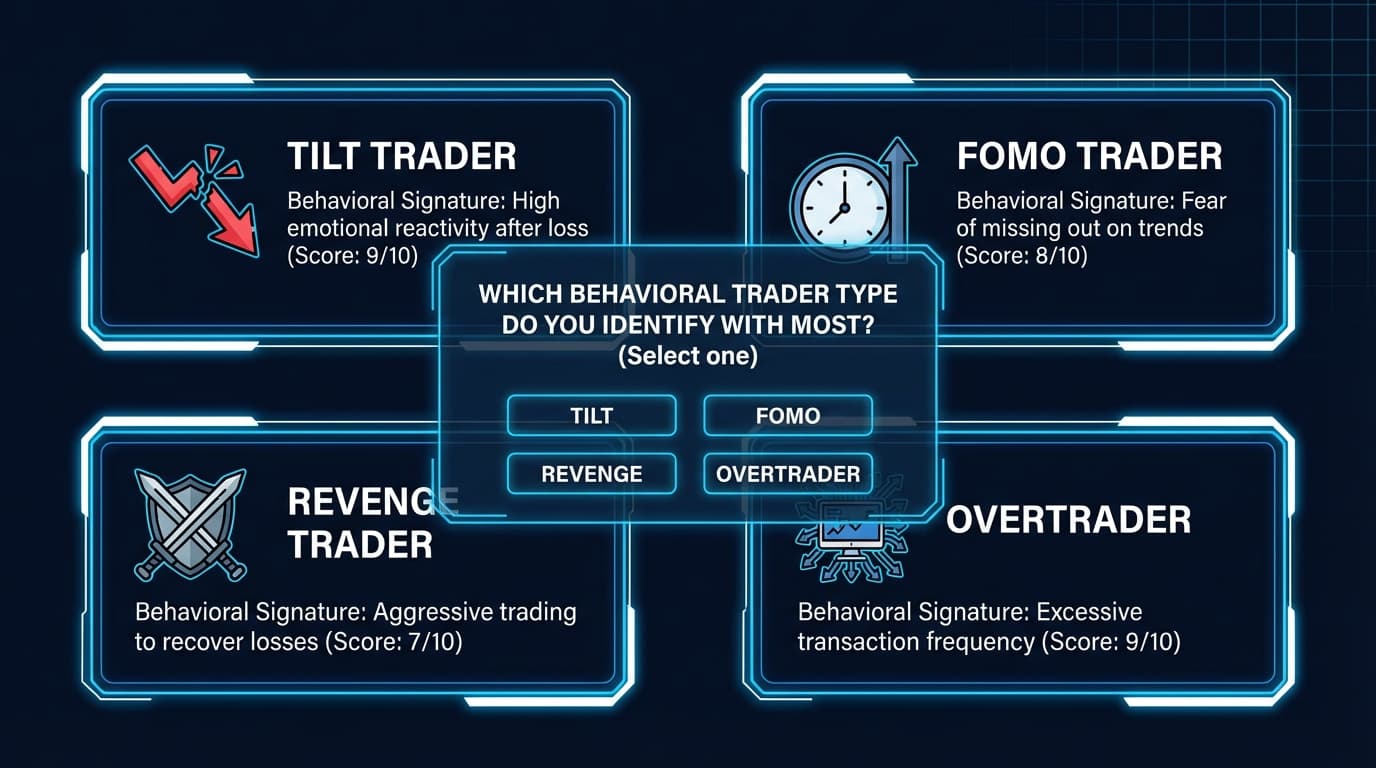
Answer each question based on what you actually do — not what you intend to do or what you know you should do. Honest answers produce a useful result. Keep a tally: note the letter (A, B, C, or D) you choose for each question.
Question 1: You have just been stopped out for -$400 — your second loss in 45 minutes. What do you do?
A) Take a 20-minute break, then look for the next valid setup.
B) Look for a new entry immediately to recover the loss.
C) Increase your position size on the next trade to get back faster.
D) Watch the charts anxiously and enter on the next move you see.
Question 2: You are watching a market move 2% without you. It started before you identified a setup. Do you:
A) Wait for a pullback that confirms a valid entry on your terms.
B) Enter immediately so you do not miss more of the move.
C) Feel frustrated but stick to your rules and pass on it.
D) Enter a small position 'just in case' it continues.
Question 3: By 11am you are up $600, which is above your daily target. You:
A) Close your session — you have hit your target for the day.
B) Keep trading — the morning momentum feels productive.
C) Look for one more setup to push to $800.
D) Double size to hit $1,200 while the market is moving.
Question 4: You had a plan to enter a trade if price hit $X. It hit $X while you were on a call. You:
A) Skip it — you missed the planned entry and the moment has passed.
B) Chase entry at the current price, which is already above $X.
C) Enter at market, reasoning it was close enough to your level.
D) Get frustrated and take a different trade to compensate for missing it.
Question 5: Your strategy typically produces 2 to 3 valid setups per day. By 1pm you have taken 8 trades. You:
A) Recognize the overtrading and log off to protect the rest of the day.
B) Tell yourself today's market action justifies the higher frequency.
C) Do not notice until you review the session later that evening.
D) Are mostly focused on recovering from losses from the morning.
Question 6: You are down $900 and close to your daily loss limit. You:
A) Stop trading — you have reached your limit.
B) Take one more trade to get back to -$400 before closing out.
C) Reduce size and try to slowly claw back some of the loss.
D) Ignore the limit because 'this next setup is different.'
Question 7: How often do you review your trade data for behavioral patterns?
A) Weekly, with statistical analysis of win rate, sizing, and sequence effects.
B) When I have a bad day and want to understand what went wrong.
C) I look at charts and P&L, but not behavioral patterns specifically.
D) I do not — I rely on feel and general memory of how sessions went.
Question 8: When you look at your last 30 losing trades, what is the most common theme?
A) Legitimate setups that did not work out — I can live with those losses.
B) Entries that came too soon after a previous loss that session.
C) Trades taken because I did not want to miss a move I was watching.
D) Trades taken because I was bored, restless, or mildly anxious.