
Updated: 2026-03-07

Trading Session Analysis: The Hidden Layer of Edge Most Traders Never Mine

Most traders know their overall win rate. Almost none know their win rate in the first hour versus the last hour. They know their average R:R, but not whether that average is carried by morning sessions or dragged down by afternoon boredom trades. That gap — between aggregate statistics and session-level data — is precisely where your edge is hiding. Trading session analysis is the practice of evaluating each trading session as a distinct unit of performance, not merely as a container of individual trades. It treats the session itself — its arc, its emotional trajectory, its behavioral pattern from open to close — as the primary unit of analysis. The traders who do this consistently find patterns in their data that aggregate statistics completely obscure.
Trading Session Analysis: The Hidden Layer of Edge Most Traders Never Mine

What Trading Session Analysis Actually Means

Trading session analysis, defined precisely, is the systematic review of each discrete trading period as a performance unit — examining session-level metrics, behavioral patterns, and decision quality across the chronological arc of that session, not just its final P&L.

This is a fundamentally different lens than trade-by-trade analysis. When you review individual trades, you ask: was this entry correct? Was my stop placement right? Did I exit too early? Session analysis asks a different set of questions: How did my decision quality change from the first trade to the last? Did my adherence to my rules degrade as the session progressed? Was my P&L front-loaded into the first 90 minutes, with the rest of the session giving it back?

According to Lo and Repin (2002), professional traders exhibit measurable changes in physiological arousal throughout the trading day — with arousal patterns correlating with performance degradation during high-volatility periods and extended sessions. Their research on intraday stress responses found that even experienced professionals showed decision quality deterioration in the later phases of extended trading sessions. Session analysis is the tool that makes these deterioration patterns visible in your own data.

The session is also the natural unit for behavioral evaluation. A trade-level behavioral score tells you whether you followed your rules on a single entry. A session-level behavioral score tells you whether you followed your rules across the full arc of a trading day — including the trades you were tempted to take but didn't, the positions you held past your exit rules, and the revenge trades that appeared after a loss.

The 6 Session-Level Metrics That Reveal Your True Edge

These are the metrics you cannot calculate from aggregate data — they require session-level segmentation to exist at all:

  • Session P&L vs. session expectancy: Not just whether you made money, but whether the session's result was consistent with your historical edge applied to the setups you took. A losing session where you followed your rules perfectly is very different from a losing session caused by rule violations.
  • Trade count per session: How many trades did you take? Compared to your historical average for similar market conditions. Overtrading in a session is almost always a behavioral signal — boredom, frustration, FOMO, or the urge to 'make it back' after a loss.
  • Win rate by session time window: Your win rate in the first 90 minutes vs. the middle two hours vs. the final 90 minutes. Most traders have dramatically different win rates across these windows — and most have never looked at the data.
  • Behavioral score arc: A rating (1-10) of your rule adherence at the start, middle, and end of each session. This arc reveals whether your discipline deteriorates over time — a near-universal pattern among retail traders.
  • Average R:R by session quarter: Whether your risk-to-reward ratio degrades as sessions progress. Traders often widen stops, shrink targets, or take worse-quality setups as sessions drag on.
  • Trades-per-hour by session quarter: A session-level overtrading metric. If you typically take 2 trades per hour but spike to 5 in the final hour, that spike is a pattern worth understanding.

The 3 Performance Patterns Session Data Almost Always Reveals

When traders begin doing systematic session analysis, three patterns appear in the data with such regularity that they have informal names among trading coaches and performance researchers:

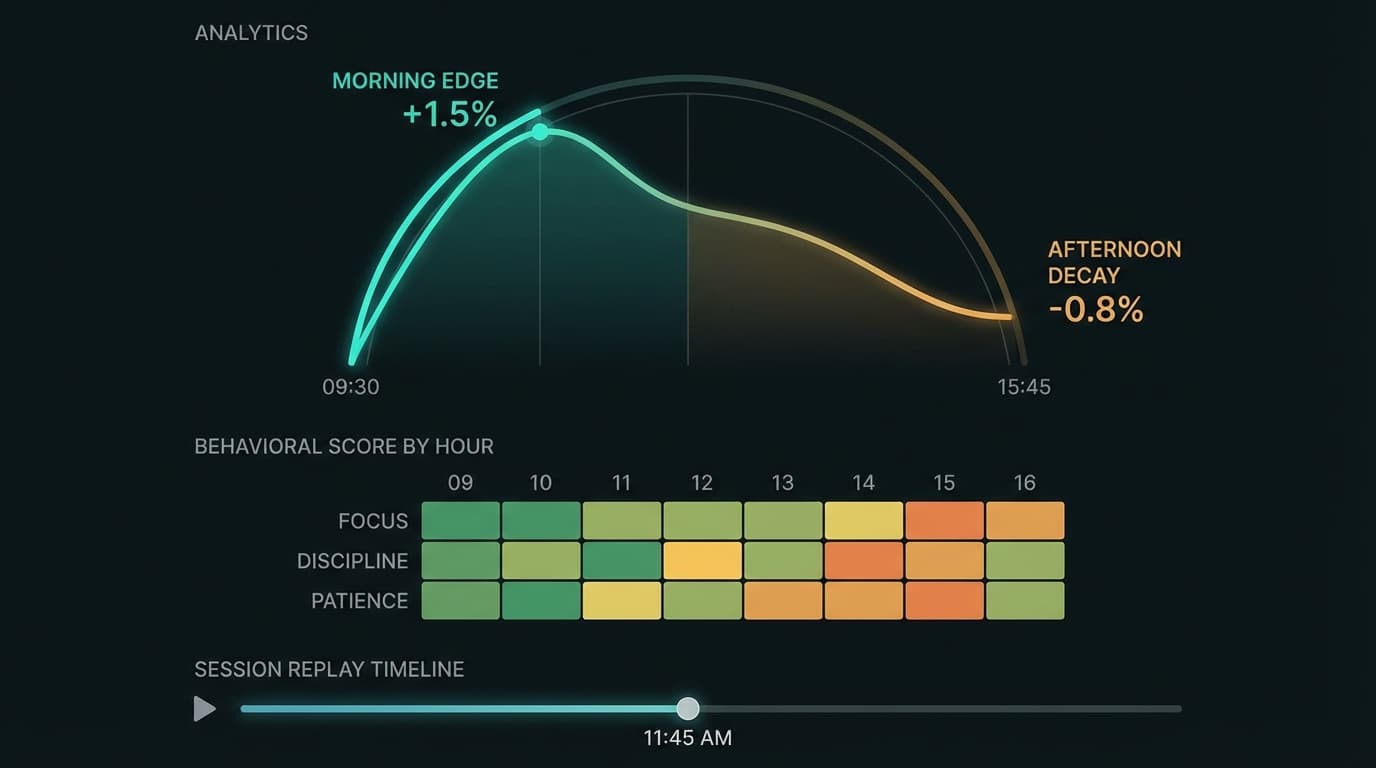
**The Morning Edge pattern** describes sessions where the majority of profitable trades cluster in the first 60-90 minutes. The trader is fresh, focused, and rule-adherent. They take only high-quality setups. Their behavioral score is at its peak. Then, as the morning session transitions to mid-day, trade quality degrades — not catastrophically, but measurably. The trader who identifies this pattern has a clear action available: a hard stop at 11 AM.

**The Afternoon Decay pattern** is more destructive. According to research by Brett Steenbarger, trading psychologist and author of *The Psychology of Trading*, performance degradation in extended trading sessions is not linear — it tends to be front-loaded, with the sharpest declines occurring after a trader has been active for more than two to three hours. Steenbarger's work on professional trader performance found that extended session duration without breaks was among the highest-correlation predictors of poor afternoon decision quality. The afternoon decay pattern shows up as a cluster of lower-quality trades, wider-than-planned stops, and behavioral score deterioration in the 1-3 PM window.

**The Friday Effect** describes a consistent pattern of impulsive, position-squaring behavior on Friday sessions. CFTC retail trader data and survey research consistently shows retail traders perform worse on Fridays — characterized by eagerness to close profitable positions before the weekend, unwillingness to hold losing positions into the close (leading to premature cuts), and impulsive trades taken to 'end the week green.' Session analysis makes this pattern visible in your own account data, not just in industry aggregates.

The Session Replay: Reviewing Your Trading Day Like Film

The session replay is the practice of reviewing each trading session chronologically — watching how your decisions unfolded in sequence, not just reviewing individual trades in isolation. The metaphor is deliberate: elite athletes watch game film to understand how their performance evolved across the game, not just to evaluate individual plays.

A proper session replay covers:

First, the pre-session state. What was your emotional and physical state at open? Were you well-rested, anxious, distracted? What was your plan for the session — which setups were you looking for, what was your maximum loss limit, what was your target?

Second, the decision sequence. Walk through each trade chronologically. For each: Was this setup in your plan? Did you execute the entry correctly? Did anything change between trades — a loss that affected the next entry, a win that increased position size, a news event that changed your thesis?

Third, the behavioral arc. At what point did your decision quality start to shift? Was there a specific trade that triggered a behavioral change — a stop-out that led to revenge trading, a quick win that led to overconfidence? The trigger is almost always a single trade, and the session replay makes it visible.

Fourth, the deviation audit. How many trades deviated from your written rules? Not whether you made money on them — whether you followed your rules. A trader who breaks rules and profits is building a dangerous habit. A trader who follows rules and loses is providing clean feedback for strategy refinement.

The 5-Minute Post-Session Analysis Routine

Comprehensive session analysis does not require an hour of post-market work. A five-minute structured routine captures 80% of the value. The routine has three components:

**P&L vs. expectancy check (90 seconds).** Write down your session P&L and your trade count. Calculate your expected session P&L based on your historical win rate, average R:R, and today's trade count. Was your result above or below expectancy? If significantly below, was it due to poor setups (strategy problem) or poor execution of good setups (behavioral problem)? These require entirely different responses.

**Behavioral score vs. average (90 seconds).** Rate your rule adherence for the session on a 1-10 scale. Compare it to your rolling 30-day behavioral score average. If today was significantly below your average, identify the session moment where adherence began to break down. Time of day? A specific trade outcome? Market condition?

**One key lesson (2 minutes).** Write one sentence that completes this prompt: 'If I traded this session again, the one thing I would do differently is...' The constraint of one sentence forces specificity. 'I would be more disciplined' is not a lesson. 'I would close my platform at 2 PM when I have hit my daily target' is a lesson. This single sentence, reviewed weekly, becomes a behavioral change log that compounds over months into measurably better trading.

How Tiltless Automates Session-Level Analysis

Manual session analysis is valuable but time-intensive. Tiltless automates the session-level layer of trading performance analysis, so the data is always available without spreadsheet work.

Tiltless automatically groups trades into sessions and calculates session-level metrics: session P&L, trade count vs. your average, win rate by time window, and behavioral score arc across each session. The time-of-day pattern mining feature shows your performance statistics broken down by intraday window — revealing whether your morning edge is real, whether your afternoon performance is a drag, and whether specific days of the week have consistent behavioral patterns.

The session behavioral scoring system assigns a score to each session based on rule adherence signals: deviation from plan, overtrading relative to your average, stop management, and exit discipline. These scores are trended over time, so you can see whether your overall behavioral quality is improving or deteriorating.

For traders who want to do session replay, Tiltless surfaces each session's trades in chronological order with the behavioral annotations needed to reconstruct the decision sequence — without requiring you to remember the details from memory.

Related Resources

FAQ

?What is trading session analysis?

Trading session analysis is the practice of evaluating each trading session as a distinct performance unit — examining session-level metrics like session P&L, trade count, win rate by time window, and behavioral score arc, rather than reviewing individual trades in isolation. It reveals patterns in decision quality, timing, and rule adherence that aggregate trade statistics completely obscure.

?How is session analysis different from trade-by-trade review?

Trade-by-trade review asks whether each individual entry and exit was correct. Session analysis asks how your decision quality changed across the arc of the session — did your behavioral score deteriorate after 2 PM, are your morning trades profitable while your afternoon trades give it back, does a single loss in the first hour affect the rest of your session? Session analysis is the layer that explains the behavioral patterns driving your trade-level results.

?How often should I do a post-session analysis?

After every session you trade. The five-minute routine described above takes less time than most traders spend refreshing their P&L after the close. The compounding value comes from consistency — a three-month streak of post-session notes creates a behavioral dataset that reveals patterns invisible in any single session.

?What time of day do most traders perform best?

Research by Brett Steenbarger and physiological studies by Lo and Repin consistently show that most traders perform best in the first 60-90 minutes of their active session, when focus is highest and decision fatigue is lowest. However, your specific pattern may differ — morning traders who are most active at open may peak then, while swing traders who review positions at end of day may have different optimal windows. Session analysis tells you your personal pattern, not the average.

?What should I write in a post-session journal entry?

Three things: (1) P&L vs. what you expected based on your setups and historical win rate — was the gap a strategy issue or execution issue? (2) A behavioral score 1-10 and the moment your adherence started to break down if it did. (3) One sentence starting with 'If I traded this session again, the one thing I would do differently is...' These three data points, tracked consistently, produce actionable improvement over time.

See your session-level patterns in seconds

Tiltless automatically groups your trades into sessions and surfaces time-of-day performance patterns, behavioral score arcs, and session replay data — without any spreadsheet work.

Trading Session Analysis: How to Evaluate Every Trading Session for Hidden Edge | Tiltless