Updated: 2026-03-07

Tradovate Trading Journal: Export Your Trades and Find Your Edge

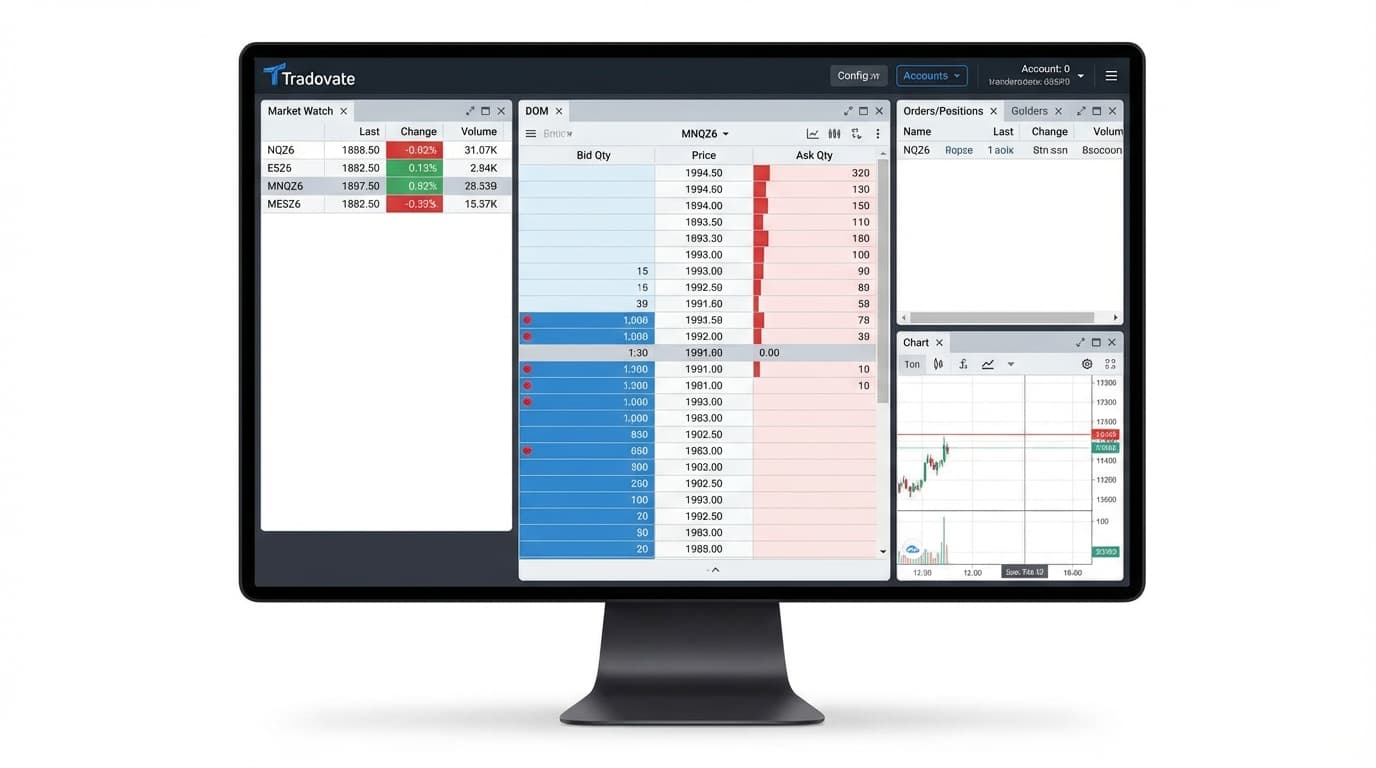
Tradovate gives you fast execution, commission-free micro futures, and a clean DOM interface. What it doesn't give you is the analytical layer that turns your trade history into a pattern — and patterns are where edges live. This guide covers how to export your Tradovate trade data, what metrics matter most for futures traders, and how to build a journaling system that finds what's actually working in your trading.

Tradovate Trading Journal: Export Your Trades and Find Your Edge

How to Export Your Trade History from Tradovate

Tradovate provides a trade history export through the platform's reporting section. The process:

1. Log in to Tradovate Web or the desktop application 2. Navigate to Reporting → Trade History 3. Set your date range (start with the last 90 days if you have sufficient trade volume) 4. Click Export and select CSV format

The exported CSV includes: fill time, symbol, quantity, side (buy/sell), fill price, order type, and account. It does not include P&L calculations in the raw export — those require combining entry and exit fills, which an automated journal handles automatically.

For Tradovate micro contracts (MNQ, MES, MCL), verify the point values before calculating P&L manually: MNQ = $2 per point, MES = $5 per point, MCL = $100 per 0.01 move. These are different from the full-size equivalents (NQ = $20/pt, ES = $50/pt) and many traders miscalculate P&L by using the wrong multiplier.

Tiltless accepts Tradovate CSV exports directly. Upload the file and the system automatically pairs fills, calculates P&L, and populates your journal with the behavioral tracking layer — no manual data entry required.

  • Export path: Reporting → Trade History → set date range → Export CSV
  • Raw export includes fills but not P&L — pairing entries and exits requires additional calculation
  • MNQ = $2/pt, MES = $5/pt, MCL = $100/0.01 — verify multipliers before manual P&L calculation
  • Tiltless auto-pairs fills and calculates P&L from the raw Tradovate CSV export

The Metrics That Matter Most for Futures Traders

Futures trading has different performance diagnostics than equities. Win rate alone is nearly meaningless in futures — a scalper winning 70% of trades may be less profitable than a trend follower winning 40%, depending on average win vs. average loss size.

The metrics that actually reveal edge in futures trading:

Profit factor by setup type: Gross profit divided by gross loss for each setup. A profit factor above 1.5 indicates a viable setup; above 2.0 is strong. Aggregate profit factor across all setups masks which approaches are working.

Average trade duration vs. outcome: Futures traders frequently discover that their best trades play out quickly (the move was right) while their worst trades are held too long (hope, not thesis). Tracking duration vs. P&L surfaces this pattern.

Time-of-day P&L distribution: Most futures markets have well-defined session structures (RTH open, London session, CME close). Traders almost universally discover that their edge concentrates in specific windows — and that they lose money in others.

Max favorable excursion vs. max adverse excursion: These measure how far a trade moved in your favor before exit (MFE) and against you before exit (MAE). High MFE vs. actual P&L indicates premature exits. High MAE vs. actual losses indicates stops too far or holding through adverse moves.

  • Win rate alone is misleading in futures — profit factor per setup type is the diagnostic metric
  • Track average trade duration vs. P&L — best trades often resolve fast; worst ones are held too long
  • Time-of-day P&L distribution reveals where edge concentrates and where to stop trading
  • MFE vs. MAE: high MFE relative to actual P&L signals premature exits; high MAE signals stop placement errors

Behavioral Patterns That Kill Futures Accounts

According to research by Lo and Repin (2002) on physiological responses during trading, cortisol levels — the stress hormone — spike significantly after losses, impairing prefrontal cortex function: exactly the brain region responsible for risk management and rule adherence. In futures, where positions can move $500 in seconds, this impairment compounds quickly.

The behavioral patterns that specifically damage futures traders:

Revenge sizing after a losing trade. The most common and most destructive pattern. A 1-contract loss triggers a 3-contract recovery attempt — with the same or worse setup quality. This is the sequence behind most large losing days.

Holding through the news. Futures markets are highly sensitive to scheduled economic releases (CPI, NFP, Fed announcements). Holding a directional position into one of these events without a defined risk plan is speculation, not trading.

Exiting winners too early, holding losers too long. According to Shefrin and Statman's research on the disposition effect (1985), traders consistently exit profitable positions 1.5 times faster than losing ones. In futures, this behavior compresses the profit factor — taking small winners off quickly while large losses are held in hope.

Fatigue trading. Session fatigue in futures is well-documented. The RTH open and first hour typically offer the highest volatility and cleanest setups for most strategies. Late-session trading, when decision quality degrades, produces disproportionate losses in most futures traders' data.

  • Cortisol spikes after losses impair prefrontal cortex function — risk management degrades exactly when needed most
  • Revenge sizing: losing 1 contract then trying 3 contracts is the sequence behind most large losing days
  • Disposition effect: futures traders hold losers 1.5× longer than winners, compressing profit factor
  • Session fatigue: late-session P&L is disproportionately negative in most traders' data — track it to confirm

Building a Futures Journal That Actually Improves Performance

A useful futures trading journal captures three categories of data that a spreadsheet struggles to maintain and an automated system handles by design:

Pre-trade context: Emotional baseline (1-10), current session P&L, consecutive losses in the session, distance to daily max loss. These variables predict trade quality better than any technical setup parameter — a trader who is at 80% of their daily loss limit and has taken 3 consecutive losses is not in a decision-making state to execute a new trade, regardless of how clean the setup looks.

Execution data: Entry and exit prices, position size, time in trade, P&L. For futures, include the contract multiplier and whether the trade was RTH or ETH (extended hours trading has different liquidity characteristics).

Post-trade reflection: Was the setup in your playbook? Did you follow your exit rules? What would you do differently? One honest sentence here — not a paragraph — is more valuable than a detailed technical post-mortem that avoids behavioral accountability.

The minimum viable futures journal review is weekly, not daily. A single futures session has too much variance to draw conclusions — a week of sessions reveals whether patterns are systematic. Look for: consistent losing time windows, setup types with negative profit factor, position sizing that deviates from your plan after losses.

  • Pre-trade context: emotional state, current session P&L, consecutive losses, daily limit proximity
  • Execution data: include contract type (RTH/ETH), position size, and duration — not just entry/exit prices
  • Post-trade reflection: one honest sentence about what you would change is more useful than technical post-mortems
  • Weekly review reveals patterns that single-session variance obscures — daily reflection, weekly analysis

Related Resources

FAQ

?Can I import Tradovate trades into Tiltless?

Yes. Tiltless accepts Tradovate CSV exports directly. Export your trade history from Reporting → Trade History, select CSV format, and upload the file to Tiltless. The system automatically pairs entry and exit fills, calculates P&L using the correct contract multipliers, and populates your journal with the behavioral tracking layer.

?What is the best way to journal futures trades?

For futures traders specifically, the most important journal fields are: pre-trade emotional state (1-10), session P&L at the time of entry, setup type, and whether you followed your exit rules. These behavioral fields — not technical setup parameters — are where the most improvement opportunities live in futures trading. At minimum, track these alongside your execution data (entry/exit prices, size, P&L). Review the data weekly, not just daily, to identify systematic patterns rather than reacting to single-session variance.

?Does Tradovate have a built-in trading journal?

Tradovate includes basic trade reporting (P&L by day, fill history, account performance) but does not offer behavioral journaling, setup tagging, emotional state tracking, or pattern analysis. For traders who want to understand why their performance varies across sessions and setups, a dedicated journal connected to the Tradovate export is necessary.

?What futures contracts are best for beginning traders?

Micro contracts (MNQ, MES, MCL, M2K) are the standard starting point for new futures traders. They offer the same market exposure as full-size contracts at one-tenth the point value — MNQ is $2 per point vs. NQ at $20 per point. This allows meaningful position sizing at smaller account sizes while maintaining full market access. The recommendation: start with micro contracts until you have 200+ trades of documented performance, then consider scaling to standard contracts only for setups with proven positive expectancy.

Import your Tradovate trades in seconds

Tiltless accepts Tradovate CSV exports directly — auto-pairs your fills, calculates P&L, and shows you the behavioral patterns your Tradovate reports can't see.

Tradovate Trading Journal: How to Export and Analyze Your Futures Trades | Tiltless