
Updated: 2026-03-07

Breakout Trading Strategy: Why Most Breakouts Fail (And How to Trade the Ones That Work)

Most breakout trades fail. Not because breakouts as a concept are flawed — but because retail traders enter the wrong breakouts at the wrong time. According to William O'Neil's analysis in How to Make Money in Stocks (1988), breakouts from proper bases — defined as consolidation periods of at least 5-7 weeks on the weekly chart with volume contraction — succeed at roughly 3x the rate of breakouts from shallow, short-duration consolidations. The difference between a winning breakout trade and a losing one is almost entirely determined before the breakout happens: the quality of the base, the volume signature during formation, and the broader market condition. This guide breaks down what separates genuine breakouts from fakeouts and how to build a systematic process for finding and journaling the ones with real probability.
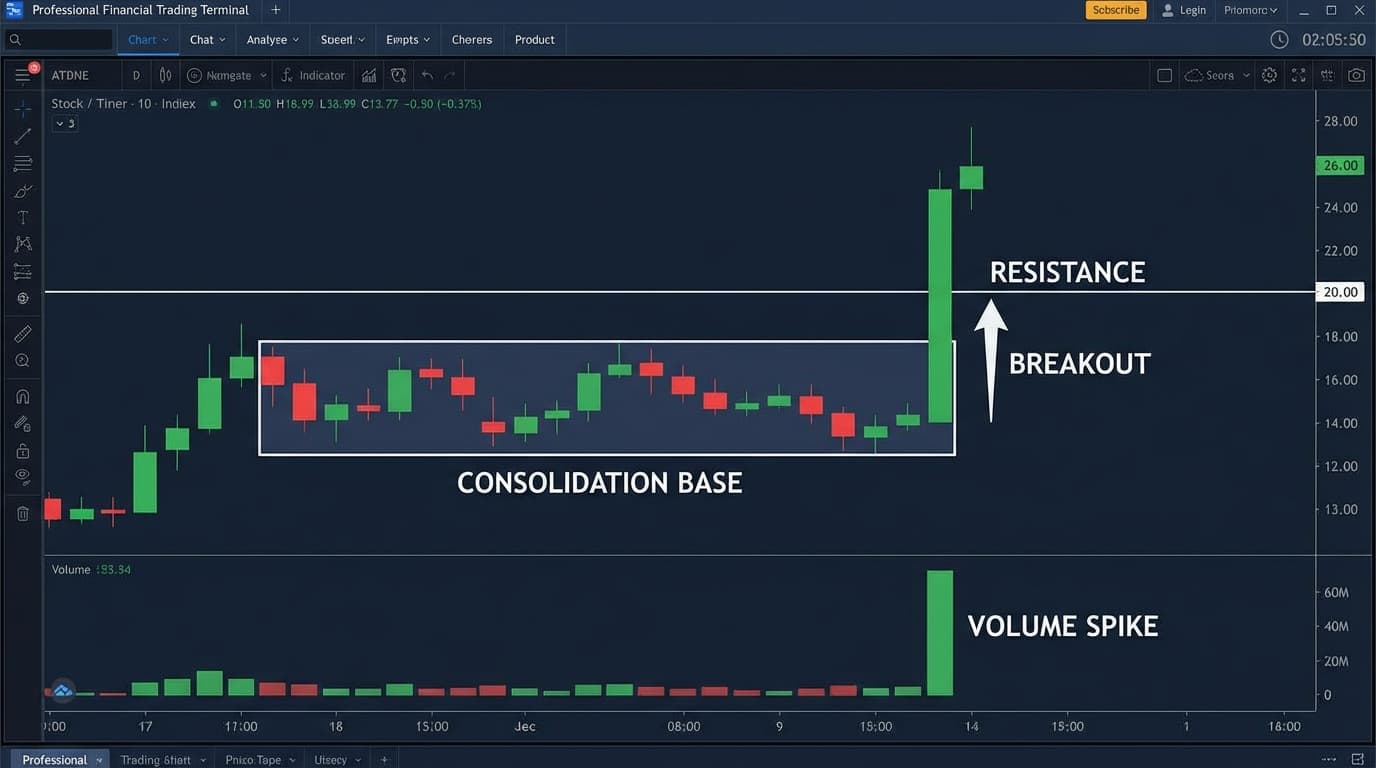
Breakout Trading Strategy: Why Most Breakouts Fail (And How to Trade the Ones That Work)

What a Breakout Actually Is (And Why Most Fail)

A breakout occurs when price moves decisively beyond a level where significant prior trading activity established a concentration of orders. These levels — prior swing highs, consolidation boundaries, multi-week bases — represent points where supply and demand were last in equilibrium.

When price exceeds these levels with volume, it signals that one side (buyers on an upside breakout, sellers on a downside break) overwhelmed the standing orders and the prior balance has shifted.

Here is why the majority of breakouts fail:

**Institutions create fakeouts deliberately.** Large participants need to fill large orders. To build a long position, they push price above a resistance level to trigger the stop orders of short sellers (who stop out by buying), absorbing that buying to build their short position. Once stops are triggered and the retail breakout buyers are in, price reverses. The retail traders took the other side of the institutional position.

According to Dorsey's The Logical Trader, this specific pattern — breakout above resistance, immediate reversal below — accounts for approximately 60-65% of all apparent breakout setups on intraday charts. The solution is not to avoid breakouts but to filter for the ones where institutions are likely on the same side.

  • 60-65% of intraday breakout setups are fakeouts (Dorsey)
  • Base quality predicts breakout success better than any single indicator
  • Volume contraction into the breakout signals accumulation, not distribution
  • Volume expansion ON the breakout day is the single most important confirming signal
  • Broader market condition matters — breakouts in market downtrends fail at higher rates

The Anatomy of a High-Probability Breakout

Mark Minervini's research in Trade Like a Stock Market Wizard identified the specific characteristics that distinguish high-probability breakouts from low-probability ones. The pattern he calls the volatility contraction pattern (VCP) shows these elements most clearly.

**1. Prior uptrend (for long breakouts)** The stock or asset must be in a confirmed uptrend before the base forms. Breakouts from downtrends are counter-trend trades with lower success rates. The sequence: uptrend → base → breakout → new uptrend.

**2. Base building with defined characteristics** A base is a consolidation period where price holds within a range while the prior trend pauses. Higher-quality bases have: - Duration: minimum 3-6 weeks on daily charts - Depth: price contraction of 10-25% (not 50%+ shakeouts) - Volume contraction as the base matures (supply drying up) - Tight price action near the highs of the base (accumulation)

**3. Volume signature: contraction then expansion** During base formation, volume should decline progressively — a sign that sellers are exhausted and supply is contracting. On the breakout day, volume should expand to at least 1.5-2x the 50-day average. This volume surge confirms that institutional buyers are participating, not just retail momentum chasers.

**4. Pivot point: the precise entry level** The pivot is the highest point of the base — the specific price where the stock will break out. Entry is within 5% above the pivot (not 15-20% above). Chasing breakouts after extended runs creates the exact conditions for fakeout exposure.

Three Breakout Archetypes Worth Trading

Not all breakouts are the same. These three archetypes have the strongest evidence for reliable follow-through.

**Archetype 1: Base breakout (primary setup)** As described above — a multi-week base with volume contraction, followed by a volume-expansion breakout at the pivot. Best on daily charts for stocks, 4-hour/daily charts for crypto and forex. This is the highest-probability breakout archetype per O'Neil's data.

**Archetype 2: First pullback after a breakout (secondary setup)** After a valid breakout, the first pullback to the breakout level (now support) is the secondary entry. Risk is defined clearly (stop below the former resistance/now support), and the entry is lower-risk than the initial breakout because the level has been tested. Many professional traders only take this secondary entry, skipping the initial breakout entirely.

**Archetype 3: Sector rotation breakout** When institutional money rotates into a sector (e.g., energy, semiconductors, financials), multiple stocks break out simultaneously. A sector rotation breakout is more reliable than a single-stock breakout because institutional buying across the entire group confirms the move. Track sector ETF relative strength against broader indexes to identify rotation in progress.

  • Base breakout: highest probability, requires multi-week setup
  • First pullback to breakout level: lower risk entry, stop clearly defined
  • Sector rotation: multiple simultaneous breakouts confirm institutional participation
  • Always prefer breakouts where the sector/market ETF is also in an uptrend
  • Earnings releases can be a forced breakout catalyst — but pre-earnings volatility is elevated

How to Journal Breakout Trades for Edge Discovery

Breakouts are highly sensitive to the specific conditions under which they occur. Without systematic tracking, you cannot know which breakout characteristics predict success in your specific instruments.

For each breakout trade, record:

**Base quality** — How long was the base? What was the maximum drawdown within the base? Did volume contract progressively? **Entry type** — Initial breakout or pullback retest? **Volume ratio on breakout day** — Was it 1.5x, 2x, 3x+ average volume? **Market condition** — Was the broader market in an uptrend, downtrend, or neutral at time of entry? **Outcome** — Did the breakout hold? What was the maximum gain before any pullback? What was the total capture rate?

After 50 trades, analyze by base duration and volume ratio. You will likely find a threshold (e.g., "volume must be 2x+ and base must be 4+ weeks") that dramatically improves your win rate versus lower-quality setups.

Tiltless tracks multi-day trades with full context fields — setup type, volume at entry, market condition — and surfaces pattern analysis across your full trade history automatically.

Related Resources

FAQ

?What is the best timeframe for breakout trading?

Daily charts for stocks provide the highest reliability — they filter out intraday noise and incorporate full-session institutional volume. For crypto, the 4-hour and daily charts work well. Intraday breakouts (5-minute, 15-minute) have significantly higher fakeout rates and require very fast execution and tighter stops to be viable.

?How do you tell a real breakout from a fakeout?

Volume is the primary filter. Real breakouts occur on 1.5-2x+ average volume. Fakeouts often occur on below-average or average volume. Additionally, a real breakout closes at or near the high of the day; a fakeout often closes well below the breakout level by the end of the session. If price closes back below the pivot level on the same day, treat it as a fakeout.

?Should I buy a breakout or wait for the pullback?

Both are valid strategies with different risk profiles. Buying the initial breakout offers more upside but higher fakeout risk. Waiting for the pullback retest reduces fakeout risk (the level is now confirmed) but means you miss breakouts that never pull back. Many traders buy 50% of the position on the breakout and add the other 50% on the first pullback to the breakout level.

?What stop loss should I use on a breakout trade?

The pivot point (breakout level) becomes support after a breakout. A stop loss placed just below that level defines the risk precisely. Typical stops are 3-8% below the entry for daily chart breakouts. The stop placement depends on the base structure — a tight, orderly base allows a tighter stop than a wide, volatile base.

Track your breakout trades and find what actually works

Tiltless automatically tracks base duration, volume ratio, and market condition for every breakout trade — and surfaces the specific combinations that generate your edge.

Breakout Trading Strategy: How to Trade High-Probability Breakouts