Updated: 2026-03-07

Candlestick Patterns: The 8 That Actually Predict Price Movement

Every candlestick is a vote. The body shows where price settled — the conviction of buyers or sellers over that period. The wicks show where the market tested and rejected. The pattern formed by a sequence of candles is the crowd's verdict on value at that price level. According to Lo, Mamaysky, and Wang (2000) in their Journal of Finance study, technical patterns including candlestick formations show statistically significant predictive power for future returns — but only when applied with strict contextual rules. The same pattern means entirely different things depending on where it appears in a trend, what the volume looks like, and whether it forms at a meaningful price level. This guide covers the 8 most reliably predictive candlestick patterns and the contextual rules that determine whether a pattern is signal or noise.

Candlestick Patterns: The 8 That Actually Predict Price Movement

What a Candlestick Actually Shows

A single candlestick represents the negotiation between buyers and sellers over one period — whether that's 1 minute, 1 hour, or 1 day. Four data points define it: open, high, low, and close.

The body (space between open and close) shows conviction. A large body means one side dominated. A small body means neither side won decisively.

The wicks (lines extending above and below the body) show rejection. A long upper wick means buyers pushed price up but sellers knocked it back. A long lower wick means sellers pushed price down but buyers defended.

According to Thomas Bulkowski's Encyclopedia of Candlestick Charts (2021), which analyzed over 4.7 million patterns across 500+ stocks, the most important variable predicting candlestick pattern reliability is not the pattern itself — it is the trend context in which the pattern appears. The same hammer candle that predicts a 62% bullish reversal in a downtrend predicts only a 41% bullish continuation in an uptrend. Context is everything.

  • Large body = strong conviction in one direction
  • Small body (doji) = balance between buyers and sellers
  • Long upper wick = buyers were rejected at higher prices
  • Long lower wick = sellers were rejected at lower prices
  • Volume confirms or disconfirms what the candle shows

The 8 Most Reliably Predictive Patterns

Most candlestick pattern lists include dozens of formations. In practice, most are too rare or too unreliable to trade systematically. These 8 have the strongest combination of frequency and directional predictability when applied with proper context.

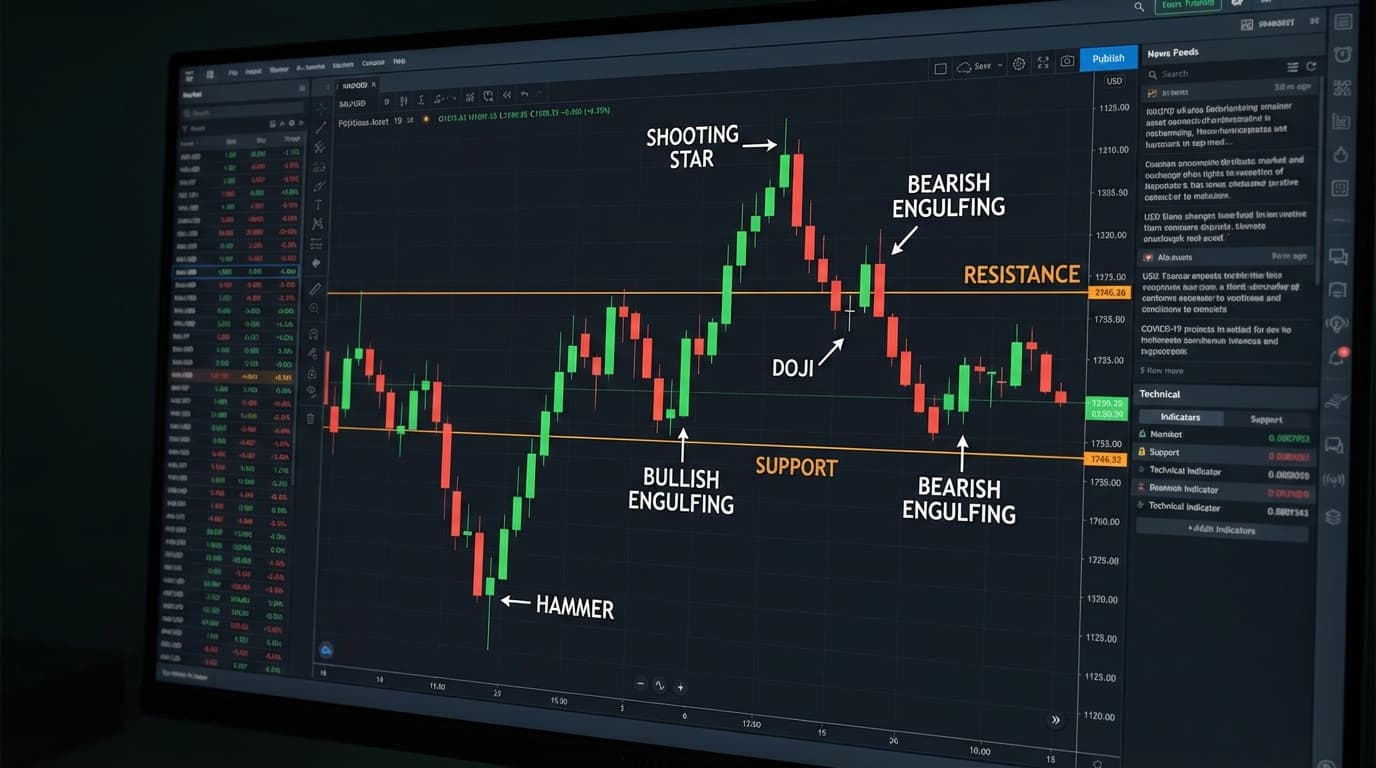
**1. Hammer (Bullish Reversal)** Small body at the top, long lower wick at least 2x the body length. Forms at support or after a downtrend. Meaning: sellers pushed price down aggressively but buyers fully absorbed the selling and drove price back near the open. Confirmation: next candle closes above the hammer's body.

**2. Shooting Star (Bearish Reversal)** Small body at the bottom, long upper wick at least 2x the body length. Forms at resistance or after an uptrend. Meaning: buyers drove price up strongly but sellers took full control and pushed price back near the open. Confirmation: next candle closes below the shooting star's body.

**3. Bullish Engulfing** Large bullish candle completely engulfs the prior bearish candle's body. At support or in a downtrend. Meaning: buyers overwhelmed the prior day's sellers entirely. Higher volume on the engulfing day is essential — without it, the pattern is suspect.

**4. Bearish Engulfing** Large bearish candle completely engulfs the prior bullish candle's body. At resistance or in an uptrend. Same logic as bullish engulfing, in reverse. Volume confirmation remains critical.

**5. Doji** Open and close are at essentially the same level, creating a cross or plus shape. Meaning: complete indecision — neither side won. A doji after a sustained trend signals exhaustion, not continuation. A doji in consolidation means nothing.

**6. Morning Star (3-Candle Bullish Reversal)** A large bearish candle, followed by a small-bodied candle (the star) that gaps down, followed by a large bullish candle closing into the body of the first. One of the highest-reliability reversal patterns per Bulkowski's data: 78% accuracy in downtrends with volume confirmation.

**7. Evening Star (3-Candle Bearish Reversal)** Mirror of the morning star: large bullish candle, small star gapping up, large bearish candle closing into the first. 72% accuracy in uptrends per Bulkowski (2021).

**8. Harami (Inside Bar)** A small candle completely contained within the prior candle's body. Meaning: volatility contraction — the market is compressing. Not a reversal signal by itself, but a precursor. A breakout from a harami, especially on volume, often initiates a strong directional move.

Why Most Traders Fail With Candlestick Patterns

Candlestick pattern books present every pattern as equally reliable, with a generic "this is bullish" or "this is bearish" verdict. This framing is the problem.

Pattern reliability varies by:

**Trend context:** A hammer in a downtrend predicts bullish reversal. A hammer in the middle of a trading range predicts nothing. A hammer in an uptrend is a continuation signal, not reversal.

**Location:** A shooting star forming exactly at a major swing high that has been respected 3 times is significantly more reliable than a shooting star forming at a random price level. Location at a meaningful level is the filter that separates signal from noise.

**Volume:** According to Morris's Candlestick Charting Explained (1992), patterns that form on below-average volume have reversal rates approximately 15% lower than the same patterns on above-average volume. A reversal pattern needs volume to confirm that real conviction drove the formation.

**Timeframe:** Patterns on weekly charts are more reliable than patterns on 5-minute charts. Higher timeframe structure filters noise from lower timeframe signals.

The most common mistake: seeing a hammer, entering immediately, and wondering why it fails. Correct process: identify the trend, check the location against marked levels, confirm volume, then determine if the pattern at this specific location is meaningful.

  • Patterns in trending markets predict continuation, not reversal
  • Patterns at key levels are 15-25% more reliable than patterns at random levels
  • Volume below average reduces pattern reliability by ~15%
  • Weekly/daily patterns filter out noise better than intraday patterns
  • No pattern should trigger an entry without a defined stop level

How to Journal Candlestick Patterns Systematically

The only way to know which patterns work for you, in which markets, on which timeframes is to track them systematically. Generic win rates from books are averages across thousands of stocks — they may not match your specific instruments and trading style.

For each trade triggered by a candlestick pattern, log:

**Pattern type** — specific name (hammer, engulfing, etc.) **Location quality** — was it at a marked key level, or random? **Trend context** — with-trend or counter-trend entry? **Volume ratio** — was the pattern candle above or below average volume? **Timeframe** — which chart generated the signal? **Outcome** — did the predicted move materialize, and how far?

After 50 trades per pattern type, calculate your personal win rate for each combination of variables. You will likely discover that 2-3 specific pattern + context combinations generate most of your edge, and 10 others are essentially coin flips.

Tiltless auto-categorizes your trades by setup type and surfaces win rate by setup — so instead of manually sorting a spreadsheet, your pattern statistics update automatically after each trade.

Related Resources

FAQ

?Which candlestick pattern is most reliable?

Per Bulkowski's research, the morning star (3-candle reversal) has the highest accuracy rate at approximately 78% when it forms in a downtrend with volume confirmation. However, reliability depends heavily on context — even the best patterns fail without proper trend alignment and location at a key level.

?Do candlestick patterns work on crypto and stocks?

Yes, but with different characteristics. Crypto markets operate 24/7 without session breaks, which affects gap patterns (morning star, evening star). On crypto, these patterns form more cleanly on higher timeframes (4-hour, daily). On stocks, candlestick patterns on the daily chart are the most reliable because they incorporate full session volume and institutional participation.

?How many candlestick patterns should I learn?

Focus on 3-5 patterns maximum. More patterns leads to seeing setups everywhere (pattern recognition bias) and overtrading. Master the hammer, engulfing patterns, and morning/evening star to start. Once you have 100+ trades for each, add more if needed.

?Can I trade candlestick patterns without indicators?

Yes — but you still need context. Indicators can be replaced by manually marked key levels (prior highs/lows, breakout zones), volume reading, and higher-timeframe trend identification. The goal is always to understand where the pattern forms and what it means in that context, not to apply it mechanically.

Track your win rate by candlestick pattern

Tiltless auto-tags your trades by setup type and calculates win rate, average R, and behavioral patterns for each — so you know which candlestick patterns actually work for you.

Candlestick Patterns: Which Ones Actually Work (Evidence-Based Guide)