Updated: 2026-03-07

How to Read Trading Charts: What the Price Is Actually Telling You

A price chart is a record of every decision every market participant made at every price level. Reading it well means understanding what those decisions reveal — where buyers overwhelmed sellers, where sellers overwhelmed buyers, and where the balance is uncertain. Most beginner traders try to memorize chart patterns. The better approach: understand what the chart is showing you and learn to ask the right questions of it.

How to Read Trading Charts: What the Price Is Actually Telling You

What a Price Chart Is Actually Showing

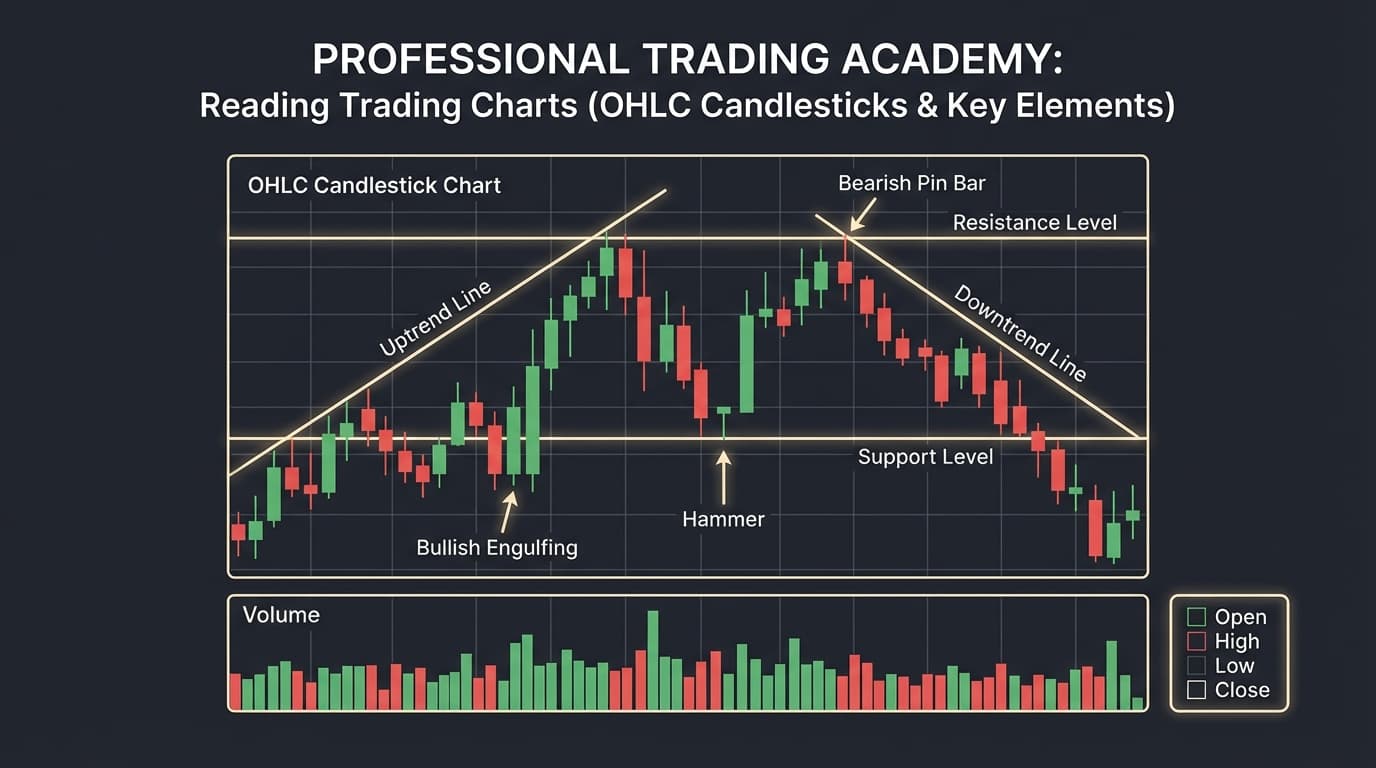
Before learning to read charts, understand what they represent. A candlestick chart does not show price moving randomly. It shows the aggregate result of every buy and sell order executed during each time period. The open is where price was when the period began. The high is the most a seller demanded (and was met) during the period. The low is the most a buyer paid at the bottom (and was met). The close is the consensus price when the period ended.

This framing changes what you are looking for. A long lower shadow on a candle (price moved far below the open and then recovered) means buyers overwhelmed sellers — buyers were willing to buy aggressively as price fell, eventually exhausting the selling pressure. A small body with long shadows on both sides means neither buyers nor sellers established control — the market is undecided at this price level.

According to Lo, Mamaysky, and Wang (Journal of Finance, 2000), who conducted one of the most rigorous academic analyses of technical chart patterns, several structural patterns including head-and-shoulders formations, double tops and bottoms, and trading channels demonstrated statistically significant predictive power. The patterns that work are structural — they represent genuine shifts in supply-demand balance that are visible in price and volume, not arbitrary visual shapes.

The foundation: read every candle as a vote. Multiple candles tell you who is winning the supply-demand battle and at what price levels the balance is shifting.

  • Candlestick components: open (start), high (maximum seller demand met), low (maximum buyer demand met), close (consensus at end)
  • Long lower shadow = buyers overwhelmed sellers as price fell — aggressive buying exhausted the selling pressure
  • Lo et al. (2000): structural patterns (H&S, double tops/bottoms, channels) show statistically significant predictive power
  • Read every candle as a vote — multiple candles show who is winning the supply-demand balance at each level

The 4 Essential Chart Reading Elements

Four elements, understood well, are sufficient to read charts effectively. Most beginners try to learn ten elements and understand none of them deeply.

1. Trend structure: The sequence of swing highs and swing lows defines the trend. An uptrend makes higher highs and higher lows. A downtrend makes lower highs and lower lows. A range makes equal highs and equal lows. When price makes a lower low in what was an uptrend, the uptrend structure has broken — this is the most reliable early signal of a trend change.

2. Support and resistance levels: Price levels where the balance between buyers and sellers previously shifted. A level where price reversed down multiple times has sellers stationed there — they are defending that price. A level where price found buyers multiple times has buyers positioned there. The strength of a level is proportional to the number of times it has held and the volume at those reversals.

3. Volume: The number of shares or contracts traded during a period. Volume confirms or questions price action. A breakout on high volume (well above the 20-day average) is more significant than the same breakout on low volume. A reversal on high volume at a key level suggests the participants who were maintaining the prior move have exhausted their positions.

4. Timeframe relationship: Price on a 5-minute chart exists within the context of the hourly chart, which exists within the context of the daily chart. Higher timeframe structure dominates. A 5-minute buy signal at a daily support level is more significant than the same 5-minute signal in the middle of a daily range.

  • Trend structure: higher highs + higher lows = uptrend; first lower low breaks the structure — most reliable early trend change signal
  • Support/resistance: levels where buyers or sellers have repeatedly acted — strength = number of holds × volume at each
  • Volume: high-volume breakout or reversal at a key level is significantly more meaningful than same action on light volume
  • Timeframe context: 5-minute signal at daily support > same 5-minute signal in middle of daily range — higher timeframe dominates

The 5 Most Common Chart Reading Mistakes

Most beginner chart readers make the same mistakes, and they are consistent enough to predict. Knowing them in advance is a significant advantage.

1. Indicator overload. Adding MACD, RSI, Stochastics, Bollinger Bands, and three moving averages to a chart adds noise, not insight. Each indicator is derived from price and volume — the primary sources. More indicators means more visual complexity and more conflicting signals, not more information.

2. Reading charts on the wrong timeframe. A day trader looking at weekly charts will miss entries. A swing trader looking at 5-minute charts will see noise as signal. Match the timeframe to the holding period.

3. Confusing visual patterns with structural patterns. A pattern that looks like a hammer candle in an uptrend is very different from the same candle in a downtrend at an arbitrary price level with no structural significance. Location and context determine meaning, not the candle shape alone.

4. Drawing levels after the fact. Many traders draw support and resistance levels to fit the trade they want to take, not based on historical price reaction. Draw your levels before the session, from historical data, without reference to your current bias.

5. Ignoring the context of the higher timeframe. Taking a bullish trade on the 15-minute chart when the daily chart is in a clear downtrend means fighting the dominant trend. Always check one timeframe higher before entering any trade.

  • Indicator overload: every indicator is derived from price/volume — more indicators add visual noise, not new information
  • Wrong timeframe: match chart timeframe to holding period — day trader on weekly charts or swing trader on 5-min charts creates signal/noise mismatch
  • Pattern without context: candle patterns only have meaning at structural levels — same pattern in the middle of a range is noise
  • Pre-session level drawing: levels drawn after the fact to justify a trade are confirmation bias, not analysis

How to Build Chart Reading Skill Systematically

Chart reading is a skill that improves with deliberate practice, not just experience. According to Steenbarger's research on deliberate practice in trading, traders who systematically review charts after the session — annotating what they saw at entry and comparing it to what actually played out — develop pattern recognition significantly faster than traders who simply trade and move on.

The deliberate practice system for chart reading:

Annotate every entry: Before entering a trade, take a screenshot and mark what you see — the trend, the key level, the setup candle, the volume context. This forces explicit articulation of what you are reading, rather than intuitive pattern matching that you cannot review later.

Post-session replay: After the session, review the chart as it existed at each trade entry time, not with the full day's price action visible. Ask: was the setup actually clear at the time of entry, or is it only obvious in retrospect with hindsight bias?

Pattern categorization: Build a folder of annotated chart screenshots sorted by setup type. After 50 examples of a specific setup, patterns in the successful vs. unsuccessful examples will emerge. This is the library that experienced traders refer to when they describe 'experience' — it is pattern recognition from categorized historical examples, not intuition.

  • Steenbarger: traders who annotate entries and review them post-session develop pattern recognition significantly faster
  • Screenshot at entry moment: forces explicit articulation of what you see — the only honest chart reading feedback mechanism
  • Post-session replay: review chart as it existed at entry time — not with full day visible — to eliminate hindsight bias
  • Pattern library: 50 categorized examples of one setup reveals distinguishing features of winners vs. lookalike failures

Related Resources

FAQ

?How do you read a trading chart for beginners?

Start with the four essential elements: (1) trend structure — is price making higher highs and higher lows (uptrend), lower highs and lower lows (downtrend), or equal highs and lows (range)? (2) Support and resistance — where has price repeatedly reversed before? (3) Volume — is volume above or below average on significant price moves? (4) Higher timeframe context — what does the chart one timeframe higher show? With these four elements, you can read the basic story of any chart: who is in control, at what levels control is being contested, and whether the current move has conviction behind it.

?What do candlesticks tell you?

Each candlestick shows the aggregate result of all buy and sell orders during a time period. The body (area between open and close) shows the net direction of the period. Long bodies indicate strong directional pressure. Short bodies (doji) indicate balance between buyers and sellers. The shadows (wicks) show how far the market moved in each direction and was rejected — a long lower shadow means buyers overwhelmed sellers as price fell, absorbing the selling pressure and pushing price back up. Reading candlesticks means reading the battle between buyers and sellers during each period, not memorizing candle names.

?What is support and resistance in trading charts?

Support is a price level where buyers have previously stepped in with enough force to stop or reverse a downward move. Resistance is a price level where sellers have previously overwhelmed buyers and caused a reversal. These levels are significant because they represent prices where market participants have already acted — they have orders, entries, and stops positioned near those levels. The more times a level has held and the higher the volume at each test, the stronger the level. Support that is broken can become resistance (role reversal), and vice versa.

?How long does it take to learn to read trading charts?

With deliberate practice — annotating entries, reviewing them post-session, and building a categorized pattern library — traders typically develop functional chart reading ability within 3-6 months of daily practice. Without deliberate practice (just trading without structured review), many traders trade for years without developing consistent chart reading skill. The research by Steenbarger on deliberate practice in trading indicates that systematic review of annotated chart screenshots produces pattern recognition roughly twice as fast as experience alone.

Build your chart reading skills with annotated trade data

Tiltless captures your trade setups, tracks which chart patterns have positive expected value in your actual history, and shows you the conditions where your reading is most accurate.

How to Read Trading Charts: A Practical Guide for Traders | Tiltless