
Updated: 2026-03-07

Fibonacci Trading: How to Use Retracement Levels That Actually Matter

Fibonacci retracement levels are simultaneously one of the most debated and most widely used tools in technical analysis. The debate: do they actually predict price movement, or do traders make them predict through collective belief? A 2006 study by Bhattacharya and Kumar published in the Journal of Behavioral Finance found statistically significant price reactions at key Fibonacci levels in Indian equity markets, independent of whether traders were consciously applying them — suggesting the levels may capture natural clustering of human decision-making around mathematically clean price ratios. But the more pragmatic answer is that it doesn't fully matter: when tens of millions of traders watch the same levels and place orders at them, those levels become self-fulfilling to a meaningful degree. This guide covers which levels matter most, how to build high-probability confluence setups, and how to journal Fibonacci trades to find your edge.
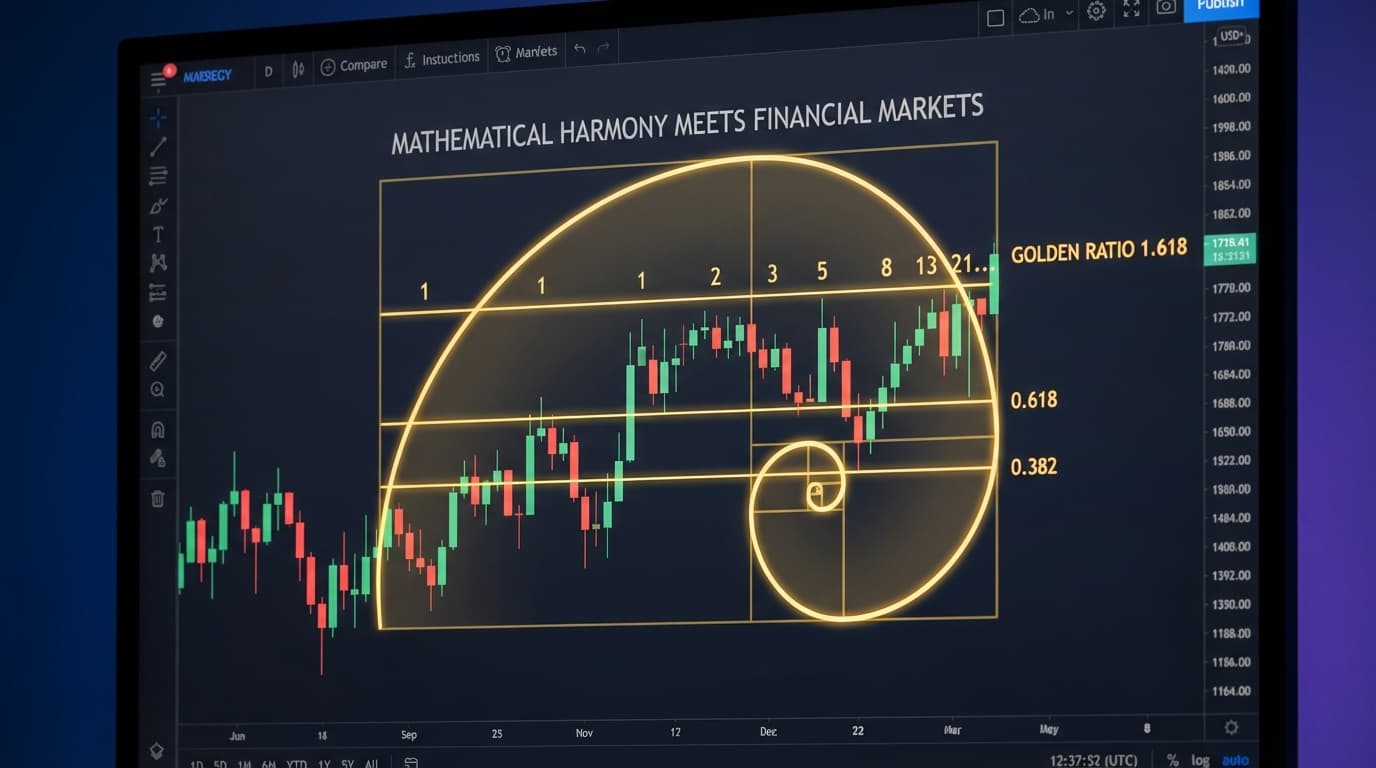
Fibonacci Trading: How to Use Retracement Levels That Actually Matter

Fibonacci Retracement: What It Actually Shows

Fibonacci retracement measures how much of a prior move price has given back. To draw it, you identify a swing low and swing high (for uptrends) and connect them. The tool automatically marks the key retracement levels as percentages of that move:

**Key retracement levels:** - 23.6% — shallow retracement, typical of strong trends - 38.2% — common in strong trends, often first support - 50% — not a Fibonacci ratio mathematically, but extremely widely watched - 61.8% — the "golden ratio" level, most cited in literature - 78.6% — deep retracement, near the origin of the move

The 61.8% level (the reciprocal of the golden ratio, ~0.618) has the most academic literature behind it. According to Bober and Szczecinska's 2014 analysis of Fibonacci levels in the forex market, the 61.8% retracement showed the highest probability of price reversal among all standard levels, with a 64% accuracy rate in trending market conditions.

Important: Fibonacci levels are not horizontal lines — they move with each new swing high and low you anchor them to. The same chart will show entirely different Fibonacci levels depending on which swing points you use. This subjectivity is the primary weakness of the tool.

  • 61.8% (golden ratio) has the strongest statistical support for reversals
  • 38.2% and 50% are the most commonly traded levels by volume
  • 23.6% rarely provides meaningful support — trend is too strong
  • 78.6% is a last-chance level before invalidation of the prior trend
  • Anchor points matter — anchoring to the same swings as other traders creates better self-fulfilling effect

Why Confluence Makes Fibonacci Work

A Fibonacci level alone is a weak signal. A Fibonacci level that coincides with other evidence is a meaningful setup.

The confluence principle: multiple independent reasons for price to react at the same level creates a cluster of orders — from traders using Fibonacci, traders using prior swing levels, traders using moving averages, and traders using trendlines. The density of orders at that level creates stronger actual support or resistance.

**High-probability Fibonacci confluence setups:**

**Fib + Prior structure**: The 61.8% retracement falls exactly at a prior swing high (now potential support) or swing low. Two independent reasons for orders to cluster there.

**Fib + Moving average**: The 38.2% retracement coincides with the 50-day EMA. Momentum traders and Fibonacci traders both have orders at that level.

**Fib + Trendline**: The 50% retracement sits on an ascending trendline. Price reaches two support mechanisms simultaneously.

**Fib + Candlestick reversal**: A hammer or bullish engulfing candle forms exactly at the 61.8% level. The candlestick confirms that buyers stepped in at that specific price.

According to Lo, Mamaysky, and Wang (2000) in their comprehensive analysis of technical pattern prediction, confluence of multiple independent technical signals generates significantly higher predictive accuracy than any single signal alone — the additive effect of non-correlated evidence compounds probability.

Fibonacci Extensions: Setting Targets

Fibonacci extensions project potential price targets beyond the prior swing high (for uptrends). While retracements measure pullback depth, extensions measure how far the next leg might travel.

**Key extension levels:** - 127.2% — conservative first target - 161.8% — the most widely targeted extension level - 200% — measured move target (next leg equals prior leg) - 261.8% — aggressive extension in strong trends

The 161.8% extension (the inverse golden ratio) is the most reliable extension target because it is the most widely watched. Institutional traders who used Fibonacci retracements for their entry frequently use the 161.8% extension as their profit target — creating actual selling pressure at that level.

Practical application: If you entered at the 61.8% retracement with a stop below the swing low, your first target is the prior swing high, and your second target is the 127.2% or 161.8% extension. This creates a natural risk/reward framework directly from the Fibonacci structure.

  • 161.8% extension is the most widely used profit target
  • 127.2% is a conservative first target to take partial profits
  • 200% is a measured-move target (second leg equals first leg)
  • Extensions are most reliable when the entry (retracement) was at a high-confluence level
  • Never use extensions as the only reason to hold — context matters

How to Journal Fibonacci Trades to Build Edge

The key variable to track with Fibonacci is confluence quality — how many independent reasons existed at that level before entry. Without tracking this, you cannot know whether your Fibonacci trades succeed because of the Fibonacci level or because of the other confluence factors.

For each Fibonacci trade, record:

**Entry level**: Which specific retracement level (38.2%, 50%, 61.8%, 78.6%)? **Confluence factors**: What other evidence coincided? List each (MA, trendline, prior structure, candlestick pattern) **Confluence count**: Total number of independent confluence factors (1-4+) **Trend quality**: Strong trend, moderate trend, or ranging market? **Extension target used**: Which extension was your profit target? **Outcome**: Did price react at the level? Did it reach the extension target?

After 50 trades, analyze by confluence count. You will almost certainly find that 0-1 confluence factor trades perform at or below breakeven, while 3+ confluence factor trades significantly outperform. The data will also reveal which specific confluence combinations work best for your instruments.

Tiltless tracks setup tags and outcome data — tag each Fibonacci trade with the retracement level and confluence count, and the pattern analysis will surface automatically.

Related Resources

FAQ

?Do Fibonacci levels really work?

Research is mixed on whether Fibonacci levels have intrinsic predictive value, but they demonstrably work as self-fulfilling levels when widely watched. Bhattacharya and Kumar (2006) found statistically significant reactions at Fibonacci levels in equity markets. More practically: when tens of millions of traders place orders at the same levels, those orders create real buying and selling pressure. The levels work because of their widespread use, regardless of whether there is deeper mathematical significance.

?Which Fibonacci level is most important?

The 61.8% level (golden ratio) has the strongest statistical support and is most cited in academic literature. In practice, the 50% level is the most widely traded because it is intuitive (half the move has retraced), creating strong order density. For most traders, the combination of 50% and 61.8% as a "zone" is more reliable than either level alone.

?How do I know which swing points to anchor Fibonacci to?

Use the most significant swing high and swing low on the timeframe you're trading. For daily chart Fibonacci, anchor to daily swing points visible on the daily chart. A common rule: only use swing points that were followed by a meaningful move (at least 5-8 days of directional price action). The more significant the swing, the more traders will anchor their Fibonacci to the same points, increasing the self-fulfilling effect.

?Can Fibonacci be used for crypto trading?

Yes — crypto markets respond to Fibonacci levels clearly, often more so than traditional markets because retail participation is higher and many crypto traders use the same technical analysis education materials. The 61.8% retracement is widely watched in Bitcoin and major altcoin markets. Apply standard Fibonacci on the daily and 4-hour charts for the most reliable signals.

Measure whether your Fibonacci trades actually have edge

Tiltless lets you tag each trade with setup type and confluence factors — so after 50 trades you know exactly which Fibonacci levels and confluence combinations generate your edge vs. which are noise.

Fibonacci Trading Strategy: Retracement Levels, Confluence, and How to Journal Them