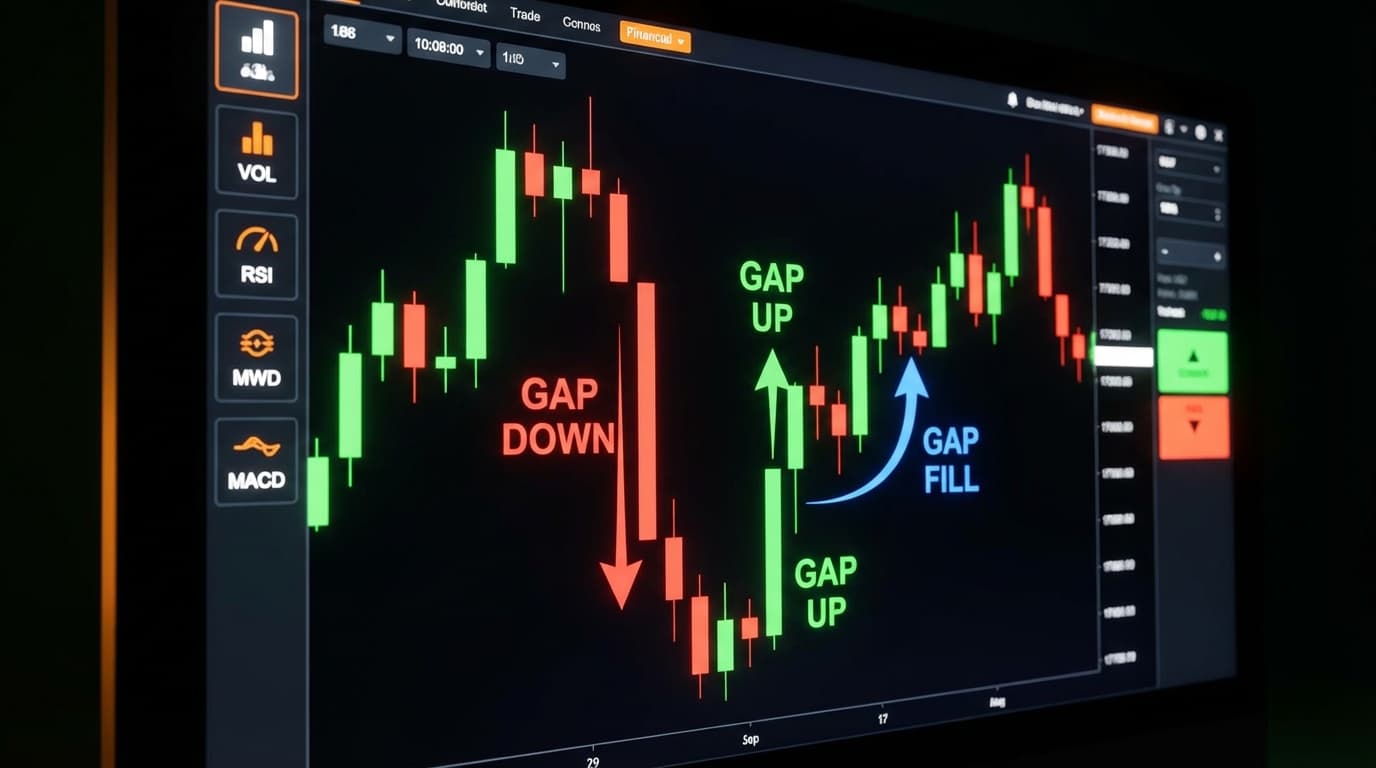
Not all gaps are created equal. The type of gap determines whether you trade with it (gap-and-go) or against it (gap-fill).
**1. Common Gap**
Occurs within a trading range, often on light volume. No significant news or catalyst. Price simply opened at a different level from its prior close due to order imbalances overnight.
Fill probability: ~91% within 5 trading days. These are the easiest gaps to fade back to the prior close because they have no fundamental justification.
**2. Breakaway Gap**
Occurs when price gaps out of a consolidation base or trading range — often on strong earnings, sector news, or macro catalysts — on significantly above-average volume. The gap represents the market repricing the asset to a new level.
Fill probability: ~40% within 5 days. Breakaway gaps often sustain because the catalyst justifies the new price level. This is the gap-and-go setup.
**3. Continuation Gap (Runaway Gap)**
Occurs in the middle of a strong trend, confirming the trend is accelerating. Price gaps in the direction of the trend on above-average volume without a major catalyst — just institutional momentum buying.
Fill probability: ~46% within 5 days. Similar to breakaway gaps, continuation gaps tend to hold because they reflect genuine institutional conviction.
**4. Exhaustion Gap**
Occurs near the end of a strong trend — price gaps to new extremes on high volume, but the move quickly stalls and reverses. Often identified in retrospect, but can be anticipated by: climactic volume, extreme extension from moving averages, and very high RSI/momentum readings.
Fill probability: ~72% within 5 days. Exhaustion gaps fill quickly because they represent the final panic buying or selling before institutional reversal.