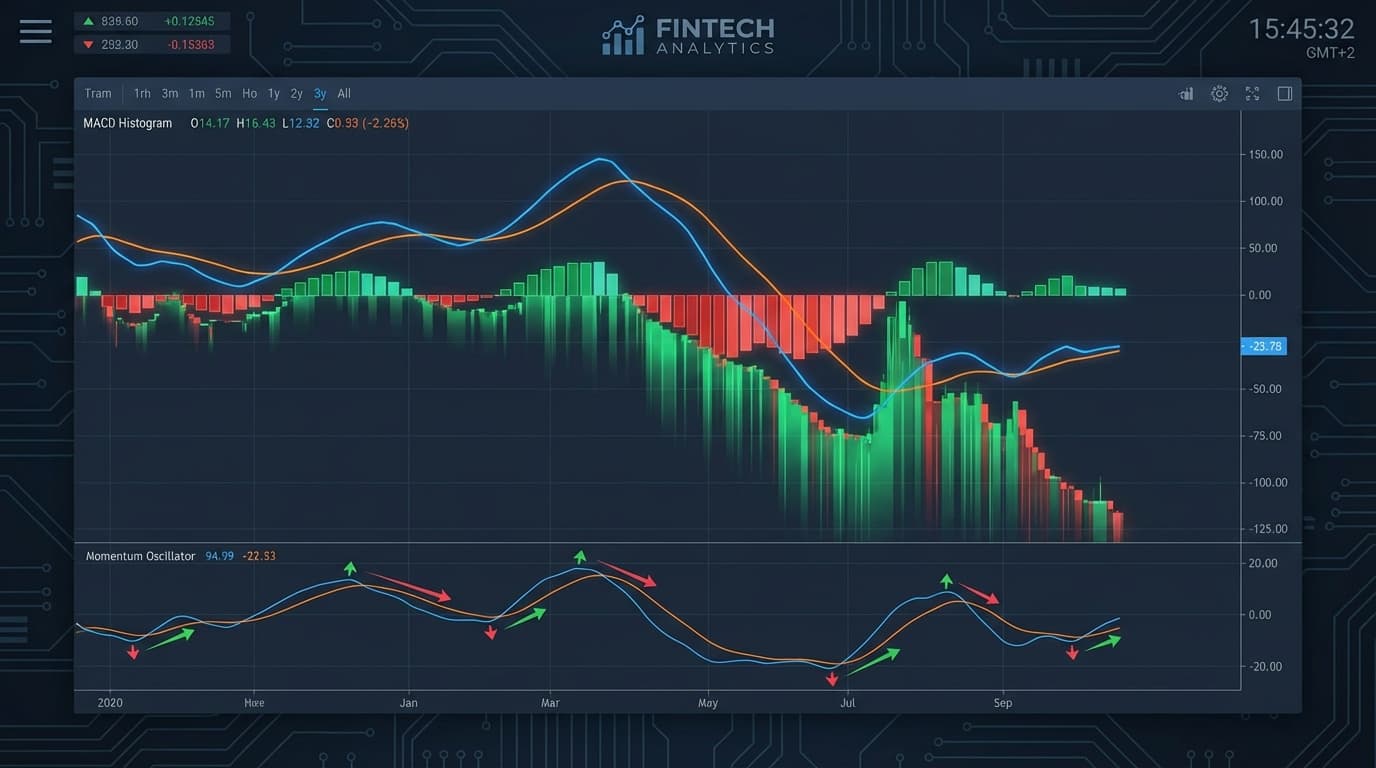
**Application 1: MACD Histogram Momentum (Most Actionable)**
Instead of waiting for a crossover, watch for histogram direction changes. When the histogram bars are declining in size (moving toward zero) while price is still rising, momentum is weakening — this often precedes a crossover by several days and gives an earlier signal.
Bullish histogram setup: histogram bars are increasing in size above zero (momentum accelerating to the upside). Bearish setup: histogram bars are increasing in size below zero (downside momentum building).
Entry on histogram direction change + price context is 2-3 days earlier than crossover entry with nearly equivalent accuracy.
**Application 2: MACD Divergence (Highest Reliability)**
Macd divergence applies the same logic as RSI divergence: when price makes a new high but MACD makes a lower high (bearish divergence), momentum has deteriorated even though price appears strong. Institutions are selling into strength while retail buyers are still purchasing.
According to Elder's Trading for a Living (1993), MACD divergence at price extremes — especially when accompanied by overbought/oversold conditions on the weekly chart — is one of the highest-reliability reversal signals in technical analysis. The key: divergence must form after a sustained trend (minimum 8-12 weeks), not during choppy price action.
Classic bearish MACD divergence:
1. Price makes high #1, MACD makes high #1 (aligned)
2. Price makes higher high #2
3. MACD makes LOWER high #2 (divergence)
4. Entry: short on a confirming bearish candle at resistance
**Application 3: MACD Zero Line as Trend Filter**
When MACD is above zero, the 12-period EMA is above the 26-period EMA — price is in a short-to-medium-term uptrend. When below zero, downtrend.
Using MACD zero line as a trend filter: only take long setups when MACD is above zero on the daily chart AND the weekly chart. Only take short setups when MACD is below zero on both. This eliminates counter-trend trades that look good locally but are fighting the larger momentum structure.
Elder's Triple Screen System formalizes this: use MACD on the weekly chart as the trend filter, then RSI or stochastics on the daily chart for entry timing.