Updated: 2026-03-07

RSI Trading Strategy: What Actually Works (Not the 70/30 Method)

J. Welles Wilder developed the Relative Strength Index in 1978 and published it in New Concepts in Technical Trading Systems. His original use case: identifying overbought and oversold conditions in commodity markets using 70/30 thresholds. What happened next is the problem — this single application became the default RSI strategy taught in every beginner resource, applied uncritically to every instrument and every market condition. According to Robert Colby's Encyclopedia of Technical Market Indicators (2003), RSI divergence signals have nearly 3x the predictive power of standard overbought/oversold signals in trending markets. In other words, the most commonly taught RSI strategy is one of its weakest applications. This guide covers the three RSI uses with genuine edge and how to distinguish them from the ones that just look reliable on backtests.

RSI Trading Strategy: What Actually Works (Not the 70/30 Method)

What RSI Actually Measures

RSI measures the relative strength of recent gains versus recent losses over a lookback period. The formula:

**RSI = 100 − [100 / (1 + RS)]** Where RS = Average gain over N periods / Average loss over N periods

Wilder's default was 14 periods. The output is a 0-100 oscillator: - Above 70: more gains than losses over the lookback period ("overbought") - Below 30: more losses than gains ("oversold") - 50: balanced — gains and losses equal over the period

The critical misunderstanding: RSI above 70 does not mean price must fall. In a strong uptrend, RSI can stay above 70 for weeks or months. Amazon in 2017 had RSI above 70 for over 40 consecutive weeks while price continued climbing. Shorting every RSI-above-70 reading in a trend is a reliable way to lose money.

RSI is a momentum oscillator, not a reversal indicator by default. It shows whether recent price action is dominated by gains or losses — it does not predict when that domination will end.

  • RSI 70+ in a strong trend = continuation signal, NOT reversal
  • RSI 30− in a strong downtrend = continuation signal, NOT bottom
  • RSI divergence = meaningful signal regardless of trend
  • RSI 50 crossover = trend direction indicator (above = bullish structure)
  • Period setting (9/14/21) changes sensitivity, not the underlying calculation

The Three RSI Applications With Real Predictive Power

**Application 1: RSI Divergence (Strongest Signal)**

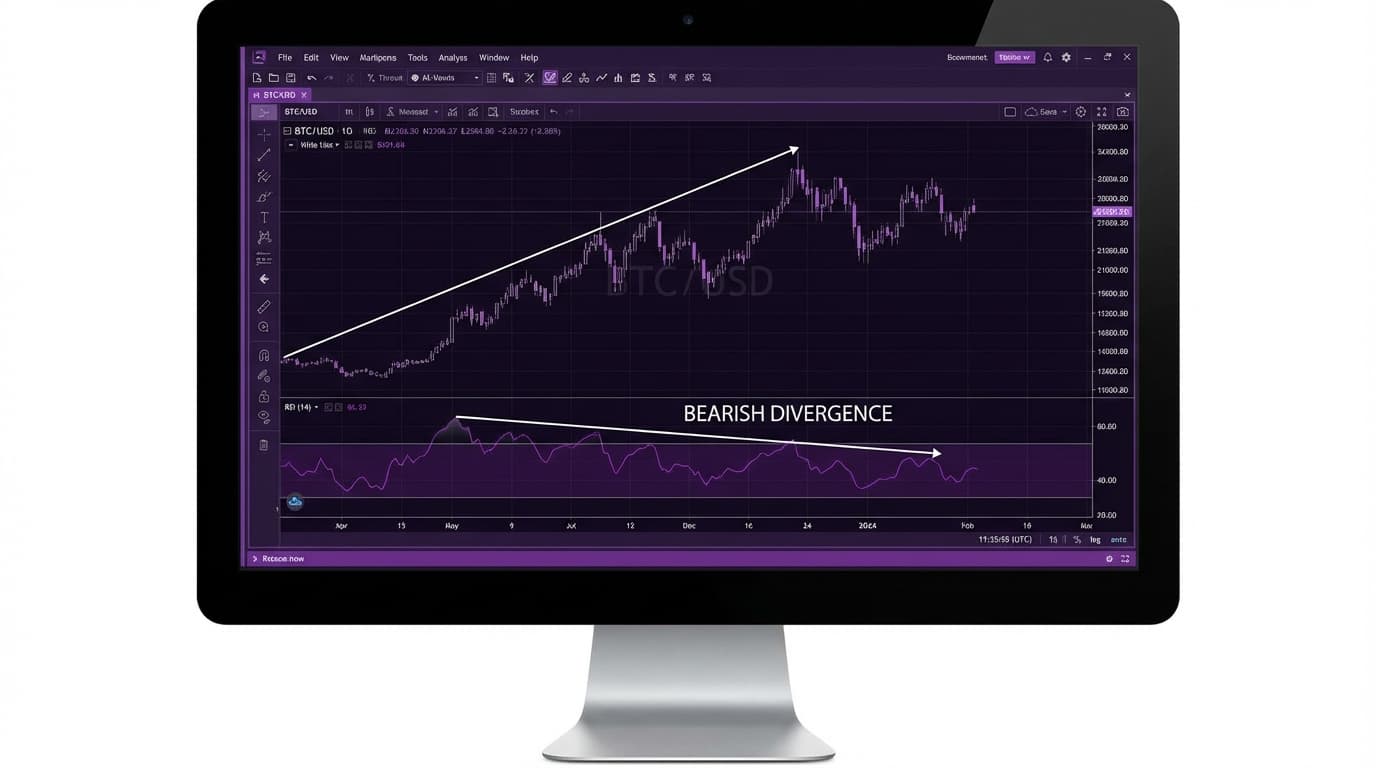
RSI divergence occurs when price and RSI disagree — price makes a new high but RSI makes a lower high (bearish divergence), or price makes a new low but RSI makes a higher low (bullish divergence).

Why it works: divergence reveals that the momentum behind a price move is weakening before price itself reverses. Institutions begin distributing into strength (bearish divergence) or accumulating into weakness (bullish divergence), and RSI captures this divergence in momentum before it appears in price.

Bearish divergence reliability is significantly higher when it occurs after a prolonged uptrend (50+ bars) and at a known resistance level. Bullish divergence is most reliable in a downtrend at known support. Per Colby (2003), RSI divergence generates roughly 67% accuracy in these conditions versus approximately 48% for standalone overbought/oversold signals.

**Application 2: RSI Trend / 50-Level Filter**

RSI staying above 50 indicates that recent price action is dominated by gains — a useful filter for confirming an uptrend. RSI staying below 50 confirms a downtrend.

Using RSI-50 as a trend filter: - Only take long setups when RSI is above 50 on the entry timeframe AND the higher timeframe - Only take short setups when RSI is below 50 on both - When RSI crosses 50 with momentum (fast move through), treat it as a trend change signal

This simple filter eliminates a large percentage of counter-trend entries that look good on the chart but fade quickly.

**Application 3: RSI Failure Swing**

This is Wilder's own preferred RSI application, largely forgotten in favor of the simpler overbought/oversold method.

A bullish failure swing: 1. RSI falls below 30 2. RSI bounces above 30 3. RSI pulls back but stays above 30 (higher low) 4. RSI breaks above the prior bounce high

The breakout of the RSI pattern — not the initial oversold reading — is the signal. This confirmation step dramatically reduces false positives compared to simply entering when RSI hits 30.

RSI Period Settings: 9, 14, or 21?

Wilder's original 14-period RSI remains the most widely used setting, which itself creates some signal value — because so many traders watch the same levels, price can react at those levels due to self-fulfilling expectations.

**RSI-9 (fast)** More responsive, generates more signals, more noise. Useful on intraday charts where you want faster feedback. Divergence signals occur more frequently but with lower reliability per signal.

**RSI-14 (standard)** The best balance for daily charts. Smooth enough to filter intraday noise, responsive enough to catch meaningful momentum shifts. Most stock market research uses this setting as the baseline.

**RSI-21 (slow)** Useful for weekly charts and for identifying major cyclical tops and bottoms. Slow enough to only signal significant momentum shifts. Fewer trades, higher per-signal accuracy for major turning points.

According to Murphy's Technical Analysis of the Financial Markets, the optimal RSI period depends entirely on the instrument and timeframe — there is no universal best setting. The only way to determine which works for your specific instruments is to test systematically with tracked trade data.

  • RSI-9: more signals, more noise — better for intraday scalping
  • RSI-14: best default for daily chart swing and position trading
  • RSI-21: higher accuracy per signal on weekly charts for major turns
  • Never change settings based on recent performance — test over 100+ trades
  • Consistency matters more than optimization — pick one setting and stick with it

How to Journal RSI Setups to Find Your Edge

The only way to know which RSI applications work on your specific instruments and timeframes is to track them systematically over at least 50 trades per setup type.

For each RSI-triggered trade, record:

**Signal type** — overbought/oversold, divergence (bullish/bearish), 50-level crossover, or failure swing **Trend context** — were you trading with or against the higher-timeframe trend? **RSI level at entry** — exact reading at trade trigger **Timeframe** — which chart generated the RSI signal? **Volume context** — was volume above or below average during the RSI signal formation? **Outcome** — trade result and whether the RSI prediction materialized

After 50 trades per signal type, calculate win rate and average R per signal type. Most traders discover that 1-2 specific RSI applications have positive expectancy in their instruments, while 2-3 others are below breakeven.

Tiltless auto-tags your trades by setup type and calculates win rate, expectancy, and behavioral patterns — so your RSI signal analysis is automatic rather than manual.

Related Resources

FAQ

?What is the best RSI setting for day trading?

For intraday trading on 5-15 minute charts, RSI-9 or RSI-14 are most common. RSI-9 is more responsive but generates more false signals. The best setting depends on your specific instrument — test both over at least 50 trades before deciding. Consistency with one setting matters more than finding the theoretically optimal one.

?Is RSI reliable for crypto trading?

RSI works on crypto but with important differences: crypto markets are 24/7 and significantly more volatile than stocks, which means RSI can reach extreme readings (RSI-20 in a crypto crash, RSI-85 in a bull run) and stay there far longer than on stocks. For crypto, RSI divergence on 4-hour and daily charts is more reliable than overbought/oversold signals on shorter timeframes.

?Should I use RSI alone or with other indicators?

RSI is most powerful as a confirmation tool, not a standalone entry trigger. Combining RSI divergence with a key support/resistance level significantly increases signal reliability. A bearish divergence forming exactly at a prior swing high is far more actionable than a bearish divergence at a random price level. Use RSI to confirm what price action is already suggesting.

?What does RSI 50 mean?

RSI at 50 means recent gains and losses over the lookback period are equal — the market is in balance. RSI crossing above 50 suggests the balance is shifting toward buyers (bullish momentum). RSI crossing below 50 suggests the balance is shifting toward sellers (bearish momentum). Many professional traders use RSI-50 as their primary trend filter — only taking longs when RSI is above 50 on both the entry and higher timeframe.

Find out which RSI setups actually work for you

Tiltless auto-tags your trades by signal type and calculates win rate per setup — so you discover whether your RSI divergence trades, trend trades, or overbought/oversold trades are generating your edge.

RSI Trading Strategy: Beyond Overbought/Oversold — What Actually Works